Loading...
Done
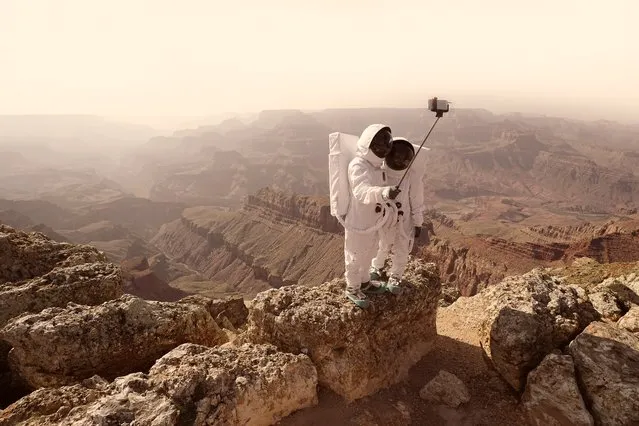
Professional conceptual category winner. Greetings from Mars, by Julien Mauve, France. Mauve says: “I have always wondered what it would be like to discover a totally different world ... and to photograph it for the first time as if I was Ansel Adams. So I came up with this project, which is about space exploration and discovery. But it’s also about our behavior in front of landscapes and how we create pictures that will share our personal story with the world”. (Photo by Julien Mauve)

Professional conceptual category winner. Greetings from Mars, by Julien Mauve, France. Mauve says: “I have always wondered what it would be like to discover a totally different world ... and to photograph it for the first time as if I was Ansel Adams. So I came up with this project, which is about space exploration and discovery. But it’s also about our behavior in front of landscapes and how we create pictures that will share our personal story with the world”. (Photo by Julien Mauve)
Details
23 Apr 2016 13:57:00
An Egyptian passenger sits on the locomotive of a train as it leaves Cairo train station in Egypt, Wednesday, October 14, 2015. (Photo by Amr Nabil/AP Photo)

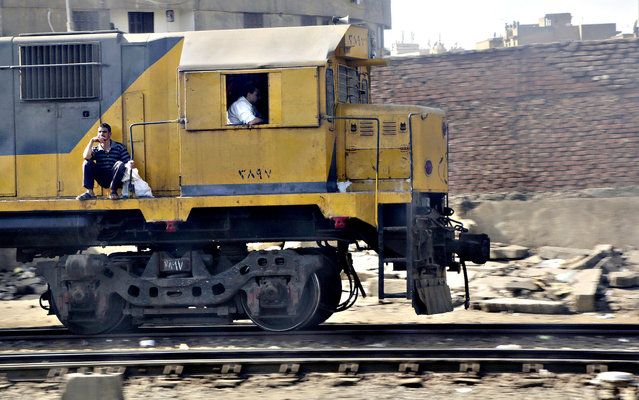
An Egyptian passenger sits on the locomotive of a train as it leaves Cairo train station in Egypt, Wednesday, October 14, 2015. (Photo by Amr Nabil/AP Photo)
Details
12 Nov 2015 08:02:00
U.S. Army helicopters providing support for U.S. ground troops  fly into a staging area fifty miles northeast of Saigon, Vietnam, August 28, 1966. Helicopter fuel is stored in the large rubber tanks, foreground. (Photo by Henri Huet/AP Photo)

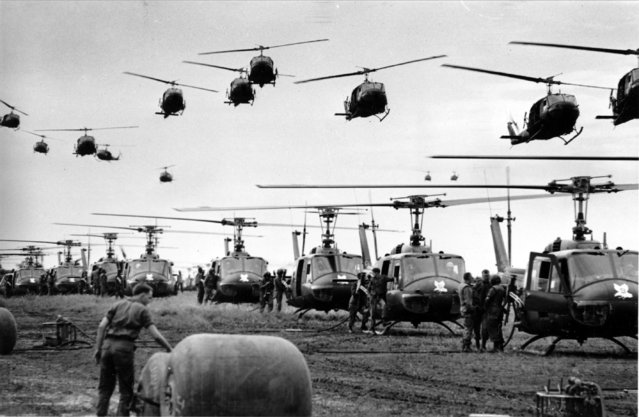
U.S. Army helicopters providing support for U.S. ground troops fly into a staging area fifty miles northeast of Saigon, Vietnam, August 28, 1966. Helicopter fuel is stored in the large rubber tanks, foreground. (Photo by Henri Huet/AP Photo)
Details
29 Aug 2015 11:05:00
Snorkelers interact with a Florida Manatee inside of the Three Sisters Springs in Crystal River, Florida January 15, 2015. On winter days, Florida manatees flock by the hundreds to the balmy waters of Three Sisters Springs, drawing crowds of snorkelers and kayakers to the U.S. sanctuary, where people may swim with the endangered species. (Photo by Scott Audette/Reuters)

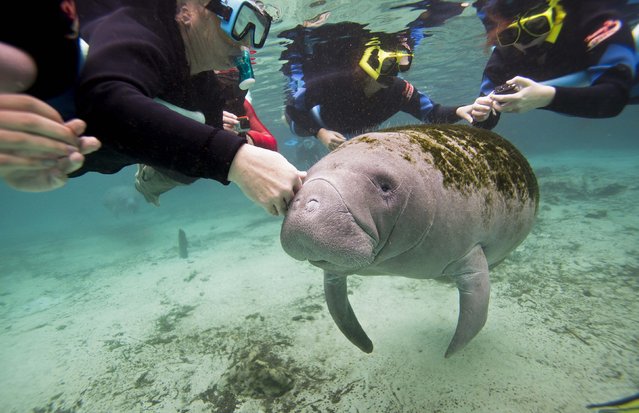
Snorkelers interact with a Florida Manatee inside of the Three Sisters Springs in Crystal River, Florida January 15, 2015. On winter days, Florida manatees flock by the hundreds to the balmy waters of Three Sisters Springs, drawing crowds of snorkelers and kayakers to the U.S. sanctuary, where people may swim with the endangered species. But as tolerant as the gentle, whiskered sea giants can be of the accidental kicks and splashes of delighted tourists, wild life regulators want to ban most canoes and paddle boards and create people-free zones to protect the wintering “sea cow”. Proposed limitations for this winter are awaiting approval by the U.S. Fish and Wildlife Service. (Photo by Scott Audette/Reuters)
Details
22 Jan 2015 13:34:00
Among the fish populations that could be harmed by the Xayaburi dam in Laos is the critically endangered Mekong giant catfish, considered by the Guinness Book of World Records to be the world’s largest freshwater fish. The fish, which grows to 650 pounds and about 10 feet long, is only found in the Mekong River. It is migratory, moving between downstream habitats in Cambodia upstream to northern Thailand and Laos each year to spawn. Some experts fear the Xayaburi dam could block the migration and drive the giant catfish to extinction

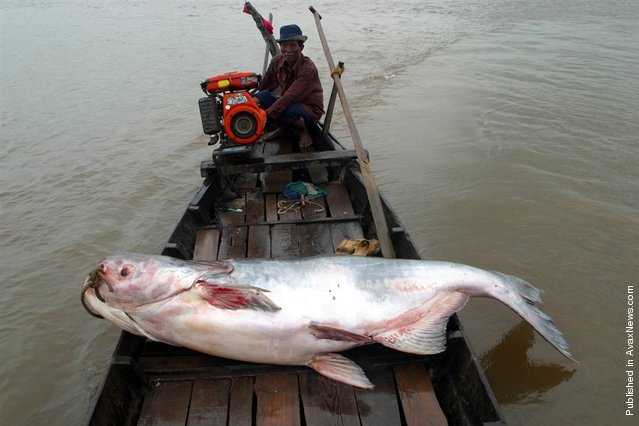
Among the fish populations that could be harmed by the Xayaburi dam in Laos is the critically endangered Mekong giant catfish, considered by the Guinness Book of World Records to be the world’s largest freshwater fish. The fish, which grows to 650 pounds and about 10 feet long, is only found in the Mekong River. It is migratory, moving between downstream habitats in Cambodia upstream to northern Thailand and Laos each year to spawn. Some experts fear the Xayaburi dam could block the migration and drive the giant catfish to extinction. (Photo by Courtesy of Zeb Hogan/University of Nevada, Reno)
Details
20 Apr 2012 13:10:00
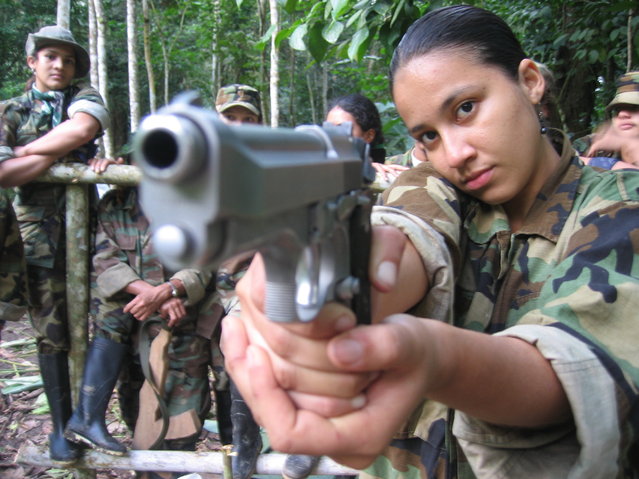
A member of the Revolutionary Armed Forces of Colombia (FARC) pose for a picture at a camp in the Colombian mountains on February 2005. (Photo by Frank Piasecki Poulsen)

A member of the Revolutionary Armed Forces of Colombia (FARC) pose for a picture at a camp in the Colombian mountains on February 2005. (Photo by Frank Piasecki Poulsen)
Details
29 Sep 2016 08:51:00
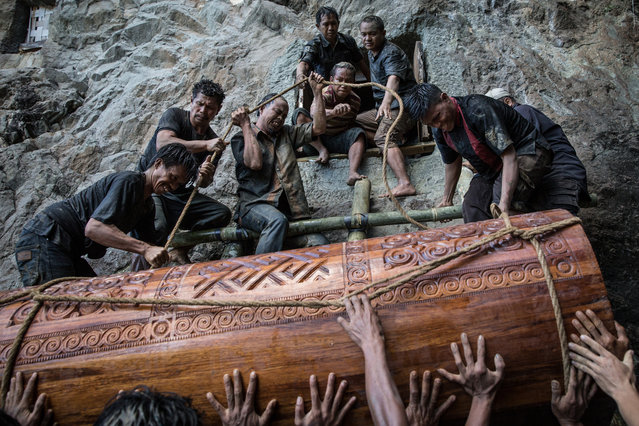
It is said that Torajans are people who “live to die”. For this Indonesian ethnic group, funerals are such extravagant events that they sometimes attract tourists. Families can postpone burials years (and the deceased are considered sick and hosted at home until the funeral) until the family can raise enough money and gather as many relatives as possible. And then it’s a jubilant multiday social event with a parade, dances and animal sacrifices. Agung Parameswara photographed these funerary practices when he traveled to South Sulawesi province, where the Torajans live. But often, their funeral isn’t the last time the dead are seen. In August, crypts are opened, coffins are slid back out and bodies delicately unsheathed. This tender ritual is known as Ma’Nene, which is customarily performed every few years. (Photo by Agung Parameswara/The Washington Post)

It is said that Torajans are people who “live to die”. For this Indonesian ethnic group, funerals are such extravagant events that they sometimes attract tourists. Families can postpone burials years (and the deceased are considered sick and hosted at home until the funeral) until the family can raise enough money and gather as many relatives as possible. And then it’s a jubilant multiday social event with a parade, dances and animal sacrifices. Agung Parameswara photographed these funerary practices when he traveled to South Sulawesi province, where the Torajans live. (Photo by Agung Parameswara/The Washington Post)
Details
06 Oct 2016 09:15:00
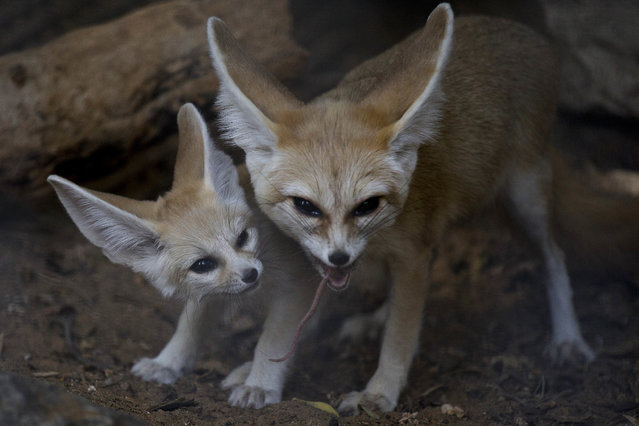
A 6-week old Fennec fox, the smallest species of foxes, and a native to the Sahara desert in Africa, looks as its mother eats in the Ramat Gan Safari Park near Tel Aviv, Israel, Sunday, November 6, 2016. Sagit Horowitz, the safari spokeswoman said four Fennec foxes were born about six weeks ago. (Photo by Ariel Schalit/AP Photo)

A 6-week old Fennec fox, the smallest species of foxes, and a native to the Sahara desert in Africa, looks as its mother eats in the Ramat Gan Safari Park near Tel Aviv, Israel, Sunday, November 6, 2016. Sagit Horowitz, the safari spokeswoman said four Fennec foxes were born about six weeks ago. (Photo by Ariel Schalit/AP Photo)
Details
13 Nov 2016 10:00:00