Loading...
Done


“Sepak takraw or kick volleyball, is a sport native to the Malay-Thai Peninsula. Sepak takraw differs from the similar sport of volleyball in its use of a rattan ball and only allowing players to use their feet, knee, chest and head to touch the ball. It is a popular sport in Indonesia, Malaysia, Thailand, Singapore, Myanmar, Vietnam, Cambodia, Laos, and Philippines”. – Wikipedia

Photo: Hyun Ju Kim of Korea kicks over the net against Yukie Sato of Japan during the round robin match between Korea and Japan during day one of the ISTAF Sepaktakraw World Cup at Titiwangsa Stadium on July 21, 2011 in Kuala Lumpur, Malaysia. (Photo by Ryan Pierse/Getty Images for UFA Sports)
Details
23 Jul 2011 11:45:00
A horror face carved out of a pumpkin by Ray Villafane and team in Bellaire, Michigan. (Photo by Ray Villafane/Barcroft Media)

These Halloween horrors were all carved out of humble pumpkins by Ray Villafane and his team of professional sculptors who meticulously carved the terrifying characters using spoons and scalpels. Each one takes on average two hours to complete – with the horrifying results netting Villafane, plus colleagues Andy Bergholtz and Chris Vierra, numerous TV appearances each Halloween. This year the team has gone global travelling to Germany, Switzerland and Hong Kong to create their masterpieces. Photo: A horror face carved out of a pumpkin by Ray Villafane and team in Bellaire, Michigan. (Photo by Ray Villafane/Barcroft Media)
Details
30 Oct 2013 10:32:00
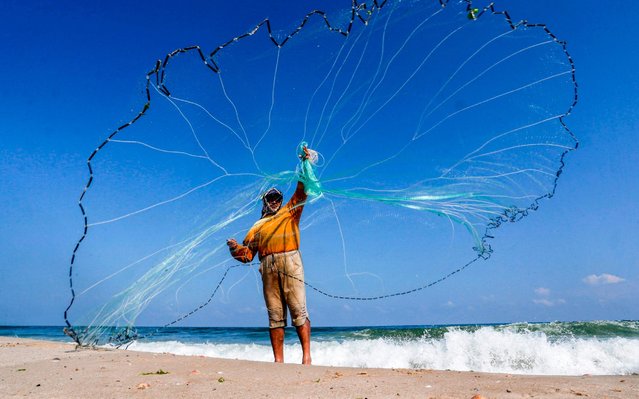
A Palestinian fisherman casts his net as he stands along the beach in Khan Yunis in the southern Gaza Strip on June 14, 2019. The Israeli government said late on June 12 that the fishing zone off the coast of Gaza had been closed, in retaliation for the launch of incendiary balloons from the Palestinian enclave. The move came after COGAT said on Tuesday it had reduced the extent of the fishing zone to six nautical miles offshore from 10 nautical miles, having downscaled it from 15 nautical miles a week ago. (Photo by Said Khatib/AFP Photo)

A Palestinian fisherman casts his net as he stands along the beach in Khan Yunis in the southern Gaza Strip on June 14, 2019. The Israeli government said late on June 12 that the fishing zone off the coast of Gaza had been closed, in retaliation for the launch of incendiary balloons from the Palestinian enclave. The move came after COGAT said on Tuesday it had reduced the extent of the fishing zone to six nautical miles offshore from 10 nautical miles, having downscaled it from 15 nautical miles a week ago. (Photo by Said Khatib/AFP Photo)
Details
12 Jul 2019 00:01:00
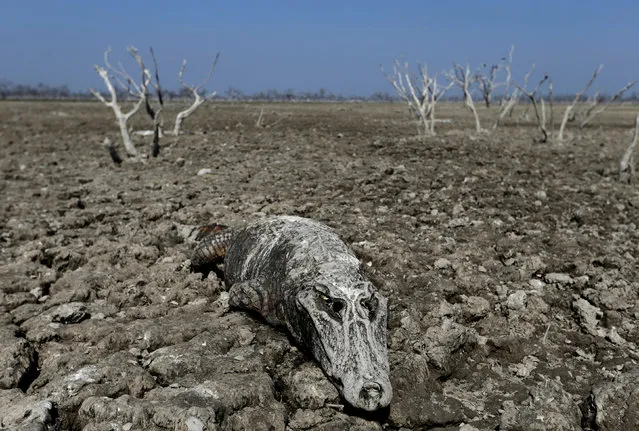
The carcass of a yacare caiman lies in the dried-up river bed of the Pilcomayo river in Boqueron, Paraguay, August 14, 2016. In Paraguay, alongside the Pilcomayo River, black vultures flew over a shrinking pond where a group of crocodilian reptiles known as yacare caimans sought refuge. Water from the river, which divides Paraguay and Argentina in the area of the Gran Chaco, was scarce. This is not an uncommon sight in the region of General Diaz, about 700 kilometres (435 miles) northwest of the country's capital Asuncion, where the Pilcomayo's waters form lakes and streams that give life to capybaras, birds and caimans. “The river's situation is critical. No water is forecast to enter the basin until December, as happens every year”, said Alcides Gonzalez, a resident of the area. (Photo by Jorge Adorno/Reuters)

The carcass of a yacare caiman lies in the dried-up river bed of the Pilcomayo river in Boqueron, Paraguay, August 14, 2016. In Paraguay, alongside the Pilcomayo River, black vultures flew over a shrinking pond where a group of crocodilian reptiles known as yacare caimans sought refuge. Water from the river, which divides Paraguay and Argentina in the area of the Gran Chaco, was scarce. This is not an uncommon sight in the region of General Diaz, about 700 kilometres (435 miles) northwest of the country's capital Asuncion, where the Pilcomayo's waters form lakes and streams that give life to capybaras, birds and caimans. (Photo by Jorge Adorno/Reuters)
Details
03 Nov 2016 12:40:00
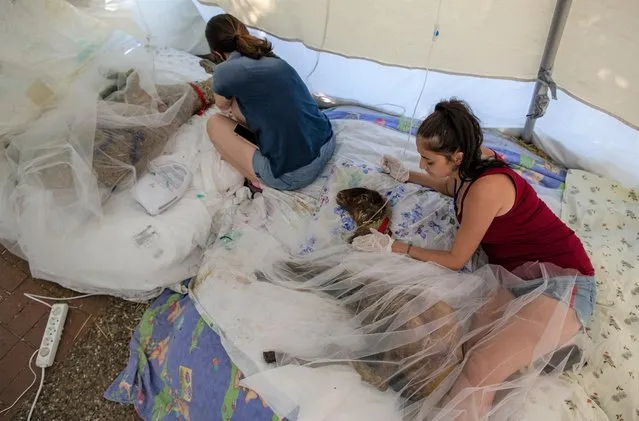
Volunteers care for burned sheeps in a field hospital established by HAYTAP (The Federation of the Animals Rights in Turkey) for animals after a wildfire at the Manavgat district of Antalya, Turkey, 09 August 2021. It is not known how many wild animals living in the forest died in the fires, but about 33,000 farm animals perished. About 30 veterinarians and hundreds of volunteers work around the clock at the field hospital. Sheep, covered in mosquito nets to protect their wounds from flies, lay there in the shade trying to recover, and various animals such as cats, dogs, owls, and cows have been treated or are still being treated there. (Photo by Erdem Sahin/EPA/EFE)

Volunteers care for burned sheeps in a field hospital established by HAYTAP (The Federation of the Animals Rights in Turkey) for animals after a wildfire at the Manavgat district of Antalya, Turkey, 09 August 2021. It is not known how many wild animals living in the forest died in the fires, but about 33,000 farm animals perished. About 30 veterinarians and hundreds of volunteers work around the clock at the field hospital. Sheep, covered in mosquito nets to protect their wounds from flies, lay there in the shade trying to recover, and various animals such as cats, dogs, owls, and cows have been treated or are still being treated there. (Photo by Erdem Sahin/EPA/EFE)
Details
27 Aug 2021 08:30:00
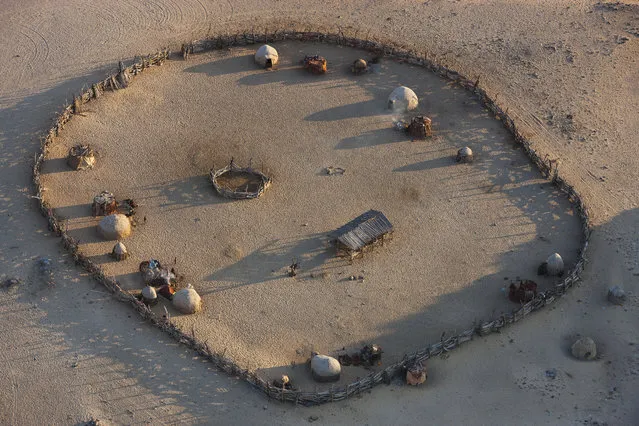
An aerial view of a livestock enclosure of the Himba people, in October, 2014, in the Namib Desert, Namibia. (Photo by Theo Allofs/Barcroft Media)

An aerial view of a livestock enclosure of the Himba people, in October, 2014, in the Namib Desert, Namibia. A photographer has captured a bird's eye view of the stunning Namib Desert from a paraglider. Theo Allofs travels the world taking stunning pictures of untouched landscapes from a unique perspective. Soaring 300 metres above ground, Theo shot the yellow sand dunes, dry red river beds and remote townships in Namibia. (Photo by Theo Allofs/Barcroft Media)
Details
24 Apr 2015 11:06:00
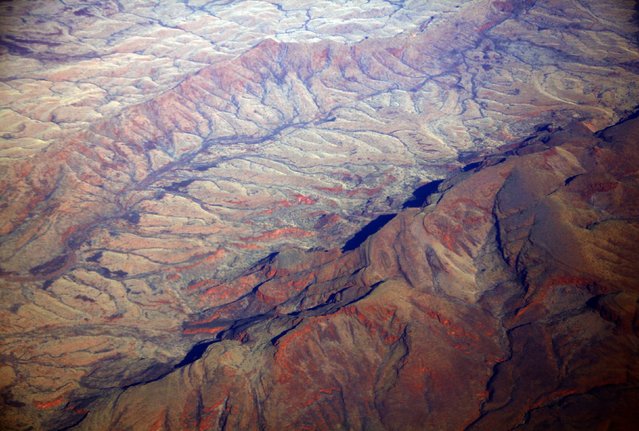
A general view of dried-up river beds and hills in the Pilbara region of Western Australia December 2, 2013. (Photo by David Gray/Reuters)

A general view of dried-up rivers in the Pilbara region of Western Australia December 2, 2013. Western Australia's Pilbara region, which is the size of Spain, has the world's largest known deposits of iron ore and supplies nearly 45 percent of global trade in the mineral. (Photo by David Gray/Reuters)
Details
17 Mar 2014 08:52:00
A dead green sea turtle is collected from the beach at the Khor Kalba Conservation Reserve, in the city of Kalba, on the east coast of the United Arab Emirates, Tuesday, February 1, 2022.  A staggering 75% of all dead green turtles and 57% of all loggerhead turtles in Sharjah had eaten marine debris, including plastic bags, bottle caps, rope and fishing nets, a new study published in the Marine Pollution Bulletin. The study seeks to document the damage and danger of the throwaway plastic that has surged in use around the world and in the UAE, along with other marine debris. (Photo by Kamran Jebreili/AP Photo)

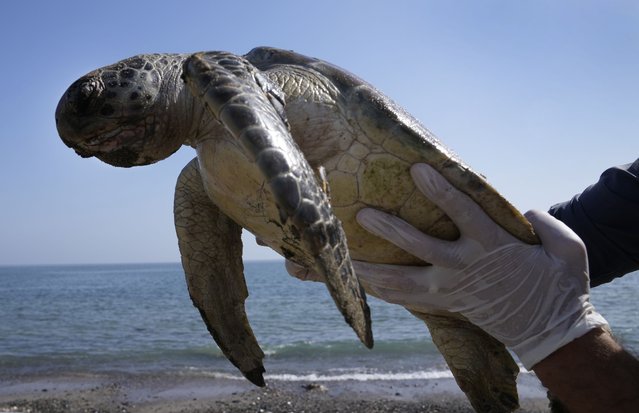
A dead green sea turtle is collected from the beach at the Khor Kalba Conservation Reserve, in the city of Kalba, on the east coast of the United Arab Emirates, Tuesday, February 1, 2022. A staggering 75% of all dead green turtles and 57% of all loggerhead turtles in Sharjah had eaten marine debris, including plastic bags, bottle caps, rope and fishing nets, a new study published in the Marine Pollution Bulletin. The study seeks to document the damage and danger of the throwaway plastic that has surged in use around the world and in the UAE, along with other marine debris. (Photo by Kamran Jebreili/AP Photo)
Details
26 Feb 2022 04:58:00