American rapper Belcalis Marlenis Almánzar, known professionally as Cardi B in the last decade of October 2022 says she's giving “you a*s, hair and heels”. (Photo by iamcardib/Instagram)
A conscript hugs a girl as he says goodbye to family members at a local railway station during departure for the garrisons, in Sevastopol, Crimea on November 9, 2022. (Photo by Alexey Pavlishak/Reuters)
A skater observes pancakes snow on the frozen Lake des Rousses in Les Rousses, central-eastern France, on January 1, 2025. This phenomenon forms when slushy ice in water clumps into round, pancake-like shapes due to waves or currents. (Photo by Fabrice Coffrini/AFP Photo)
Plebes form a human pyramid to place an upperclassman hat atop the 21-foot vegetable shortening-covered Herndon Monument, a tradition marking the end of their plebe year at the U.S. Naval Academy in Annapolis, Maryland, U.S., May 23, 2022. (Photo by Kevin Lamarque/Reuters)
Cambodia's Pov Sokha and Soeur Chanleakhena compete in the female pair sword form category of the vovinam event during the 31st Southeast Asian Games (SEA Games) in Hanoi on May 19, 2022. (Photo by Nhac Nguyen/AFP Photo)
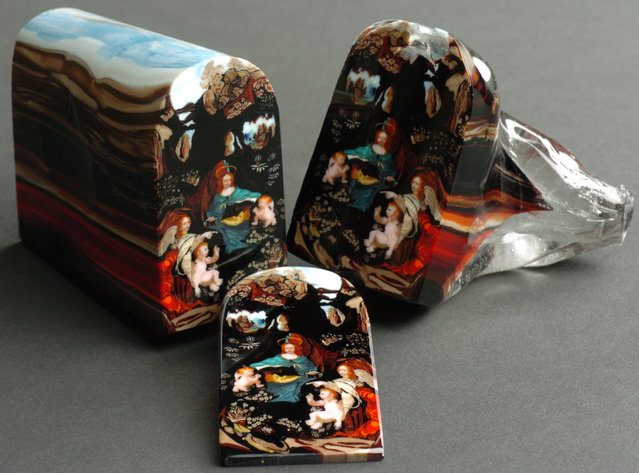
California-based glass artist Loren Stump specializes in a form of glasswork called murrine, where rods of glass are melted together and then sliced to reveal elaborate patterns and forms. While the murrina process appeared in the Mideast some 4,000 years ago, Stump has perfected his own technique over the past 35 years to the point where he can now layer entire portraits and paintings in glass before slicing them to see the final results. His most complex piece to date is a detailed interpretation of Leonardo da Vinci’s Virgin of the Rocks, which involved hundreds of glass components that were melted into a final piece.
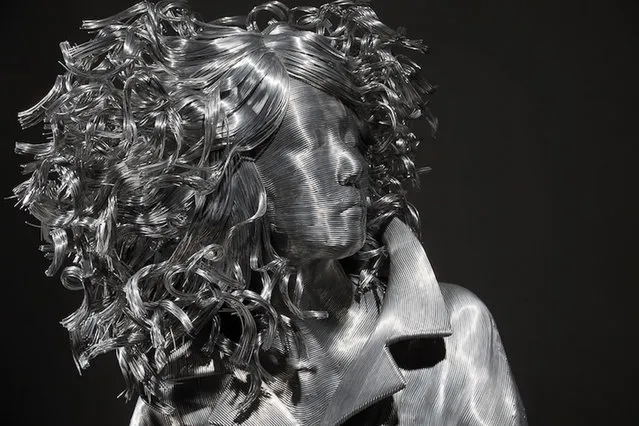
Korean artist Seung Mo Park continues to amaze with his astonishingly crafted figurative sculptures made with tightly wrapped layers of aluminum wire based on fiberglass forms. The works shown here are part of the Brooklyn-based artist’s Human series where he recreates the delicate wrinkles and folds of clothing as well as the sinuous musculature of the human body in metallic layers remeniscent of tree rings. He’s also sculpted bicycles, musical insturments and other forms as part of his Object series.
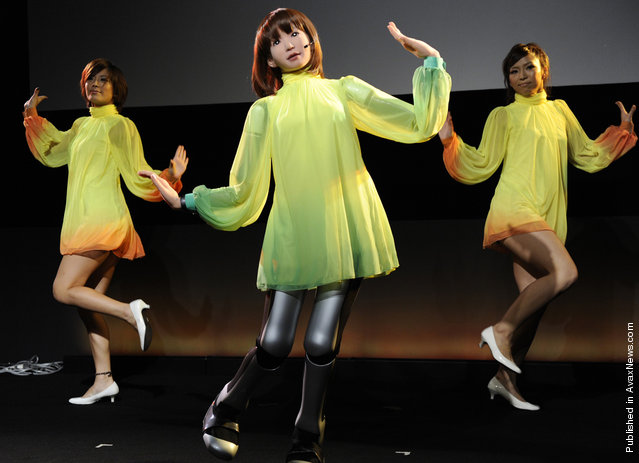
HRP-4C, a five-foot humanoid robot developed at Japan's National Institute of Advanced Industrial Science and Technology, sings and dances with performers at the Digital Contents Expo in Tokyo on October 17, 2010. The robot runs entertainment software called Choreonoid, a name formed from the words “choreograph” and “humanoid”. (Yoshikazu Tsuno/AFP)