Loading...
Done
These girls are scantily dressed as they head out for a night out in Portsmouth, Hampshire on September 21, 2016 in matching outfits. Thousands of Portsmouth University students enjoy freshers week. Teenagers enjoy their first taste of freedom in bars and clubs near Portsmouth Guildhall which on a midweek alcohol fuelled night of fun in the early hours of Wednesday morning much to the despair of local residents who get disturbed up to 4am when they eventually wander home. Girls dressed in “Dirty Disco” outfits with “Don't tell daddy” on their bums. (Photo by Paul Jacobs/PictureExclusive.com)

These girls are scantily dressed as they head out for a night out in Portsmouth, Hampshire on September 21, 2016 in matching outfits. Thousands of Portsmouth University students enjoy freshers week. Teenagers enjoy their first taste of freedom in bars and clubs near Portsmouth Guildhall which on a midweek alcohol fuelled night of fun in the early hours of Wednesday morning much to the despair of local residents who get disturbed up to 4am when they eventually wander home. Girls dressed in “Dirty Disco” outfits with “Don't tell daddy” on their bums. (Photo by Paul Jacobs/PictureExclusive.com)
Details
22 Sep 2016 10:11:00
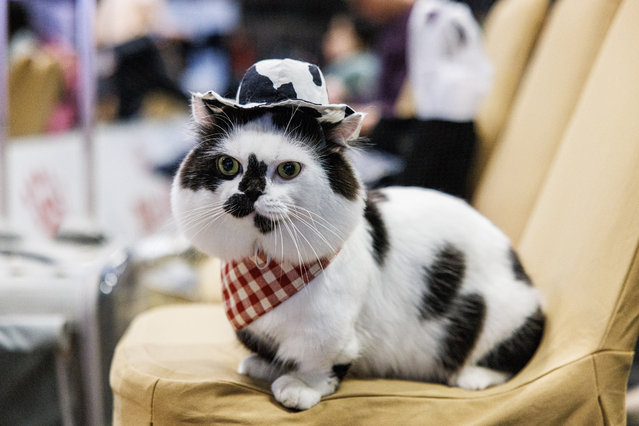
A participant in the “Cats Who Look Like Cows” competition wears a cowboy outfit back stage before judging on March 05, 2023 in Bangkok, Thailand. Thailand's Cat Fanciers' Club hosted a “Cats Who Look Like Cows” competition during a Cat Expo in Bangkok's Ladphro neighborhood. Over 100 cats were judged on how similarly their pattern resembled a cow, color, fur softness and personality. A relaxed, fluffy cat named Arpo took home first prize. (Photo by Lauren DeCicca/Getty Images)

A participant in the “Cats Who Look Like Cows” competition wears a cowboy outfit back stage before judging on March 05, 2023 in Bangkok, Thailand. Thailand's Cat Fanciers' Club hosted a “Cats Who Look Like Cows” competition during a Cat Expo in Bangkok's Ladphro neighborhood. Over 100 cats were judged on how similarly their pattern resembled a cow, color, fur softness and personality. A relaxed, fluffy cat named Arpo took home first prize. (Photo by Lauren DeCicca/Getty Images)
Details
18 Jul 2024 05:04:00
People take part in a water gun battle as part of the annual Songkran festival, also known as water festival, the traditional Thai New Year celebrations, at the tourist spot of Khao San Road in Bangkok, Thailand, 13 April 2023. Thailand celebrates its first water-splashing Songkran festival following a three-year pause due to the COVID-19 pandemic. Songkran is celebrated with splashing water and putting powder on each other's faces as a symbolic sign of cleansing and washing away the sins from the old year. (Photo by Rungroj Yongrit/EPA)

People take part in a water gun battle as part of the annual Songkran festival, also known as water festival, the traditional Thai New Year celebrations, at the tourist spot of Khao San Road in Bangkok, Thailand, 13 April 2023. Thailand celebrates its first water-splashing Songkran festival following a three-year pause due to the COVID-19 pandemic. Songkran is celebrated with splashing water and putting powder on each other's faces as a symbolic sign of cleansing and washing away the sins from the old year. (Photo by Rungroj Yongrit/EPA)
Details
29 Jul 2024 03:44:00
This Bahamian oceanic whitetip shark, known for the distinctive coloring on its white-tipped, rounded extremities, is part of a globally threatened species due to overfishing demands, primarily for its fins. (Photo by Brian Skerry)

Brian Skerry can be called many things – explorer, journalist, conservation advocate – but he is first and foremost a photographer. His journeys to capture amazing underwater photographs have taken him across the world’s oceans. Photo: This Bahamian oceanic whitetip shark, known for the distinctive coloring on its white-tipped, rounded extremities, is part of a globally threatened species due to overfishing demands, primarily for its fins. (Photo by Brian Skerry)
Details
08 Sep 2013 07:26:00
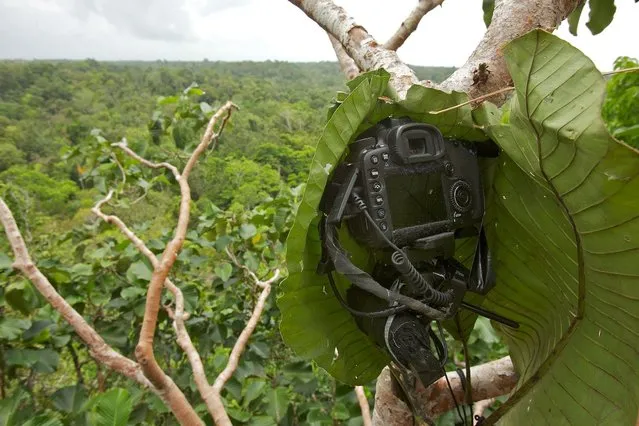
Tim Laman - Wildlife Photojournalist

Tim Laman is a field biologist and wildlife photojournalist. His pioneering research in the rain forest canopy in Borneo led to a PhD from Harvard and his first National Geographic article in 1997. Since then, he has pursued his passion for exploring wild places and documenting little-known and endangered wildlife by becoming a regular contributor to National Geographic. He has eighteen articles to his credit to date, all of which have had a conservation message. Some have focused on endangered species such as Orangutans or Hornbills, while others, such as a series of articles on Conservation International’s Biodiversity Hotspots, have highlighted regions under intense pressure.
Details
14 Sep 2013 10:13:00
This picture taken on December 17, 2013 shows people taking photos of a pole dancer (R) practising after it snowed in Tianjin during a promotional event by members of China's national pole dancing team and students of the sport. (Photo by AFP Photo)

This picture taken on December 17, 2013 shows people taking photos of a pole dancer (R) practising after it snowed in Tianjin during a promotional event by members of China's national pole dancing team and students of the sport. China set up its first national pole dancing team in Tianjin in 2012 in order to compete in the World Pole Dancing Championships. (Photo by AFP Photo)
Details
20 Dec 2013 09:03:00
Gavin Worth's Steel Wire Sculptures

“I was born in Zimbabwe, Africa in 1981 and grew up in Las Cruces, New Mexico. I graduated with a degree in Acting, and after college, worked as an actor and musician for the Santa Fe Shakespeare Festival, the San Francisco Shakespeare Festival, and the California Shakespeare Theater. I have had a lifelong passion for drawing, painting, and sculpture since I first saw Michelangelo's “Head of Leda” in a book in the library”.

Gavin Worth
Details
09 Mar 2013 10:54:00
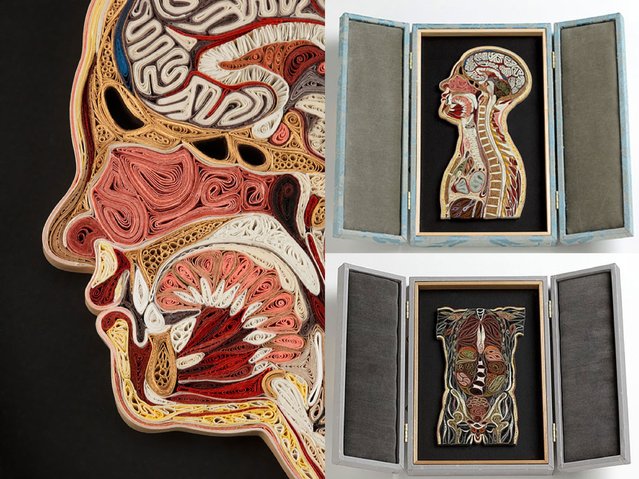
 Paper Anatomy By Lisa Nilsson

These pieces are made of Japanese mulberry paper and the gilded edges of old books. They are constructed by a technique of rolling and shaping narrow strips of paper called quilling or paper filigree. Quilling was first practiced by Renaissance nuns and monks who are said to have made artistic use of the gilded edges of worn out bibles, and later by 18th century ladies who made artistic use of lots of free time. I find quilling exquisitely satisfying for rendering the densely squished and lovely internal landscape of the human body in cross section.
Details
14 Apr 2013 11:07:00