Loading...
Done
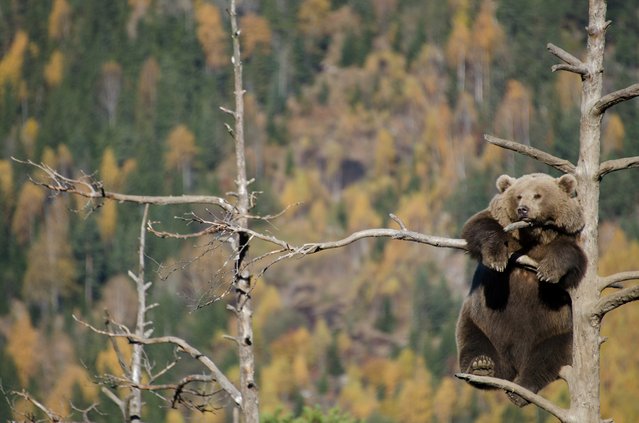
“Just hanging out”. As full autumn hits the valley of Hallingdal in Norway, this bear chills out in a tree which seems to barely cover its weight. Photo location: Flå, Hallingdal, Norway. (Photo and caption by Jorgen Tharaldsen/National Geographic Photo Contest)

“Just hanging out”. As full autumn hits the valley of Hallingdal in Norway, this bear chills out in a tree which seems to barely cover its weight. Photo location: Flå, Hallingdal, Norway. (Photo and caption by Jorgen Tharaldsen/National Geographic Photo Contest)
Details
30 Apr 2014 07:35:00
His goal with the project is to make the invisible visible. (Photo by Luis Hernan)

Luis Hernan was always curious about how wireless technologies like radio are transmitted through the air. So after finishing up his studies in architecture, computer science, and design, Hernan decided to research these invisible signals through a PhD at Newcastle University. Hernan set up a system that turned the wireless signals around him into colourful, ghostlike images using long-exposure photography, allowing people to see the strength of the signals around them. (Photo by Luis Hernan)
Details
13 Aug 2014 09:38:00
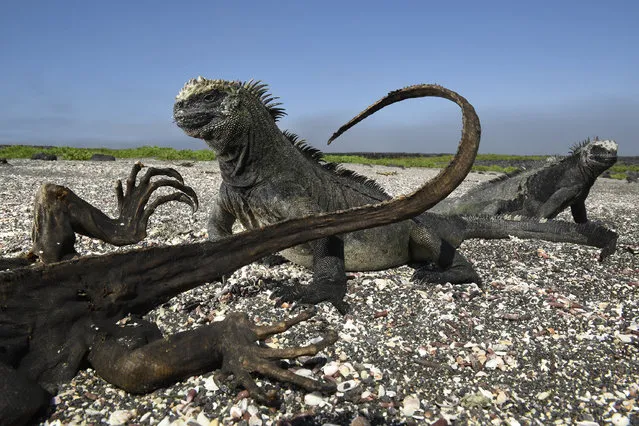
Galapagos – Rocking the Cradle: Four major ocean currents converge along the Galapagos archipelago, creating the conditions for an extraordinary diversity of animal life, April 25, 2016. The islands are home to at least 7,000 flora and fauna species, of which 97 percent of the reptiles, 80 percent of the land birds, 50 percent of the insects and 30 percent of the plants are endemic. The local ecosystem is highly sensitive to the changes in temperature, rainfall and ocean currents that characterize the climatic events known as El Niño and La Niña. These changes cause marked fluctuations in weather and food availability. Many scientists expect the frequency of El Niño and La Niña to increase as a result of climate change, making the Galapagos a possible early-warning location for its effects. (Photo by Thomas P. Peschak for National Geographic/World Press Photo)

Galapagos – Rocking the Cradle: Four major ocean currents converge along the Galapagos archipelago, creating the conditions for an extraordinary diversity of animal life, April 25, 2016. The islands are home to at least 7,000 flora and fauna species, of which 97 percent of the reptiles, 80 percent of the land birds, 50 percent of the insects and 30 percent of the plants are endemic. (Photo by Thomas P. Peschak for National Geographic/World Press Photo)
Details
16 Apr 2018 00:01:00
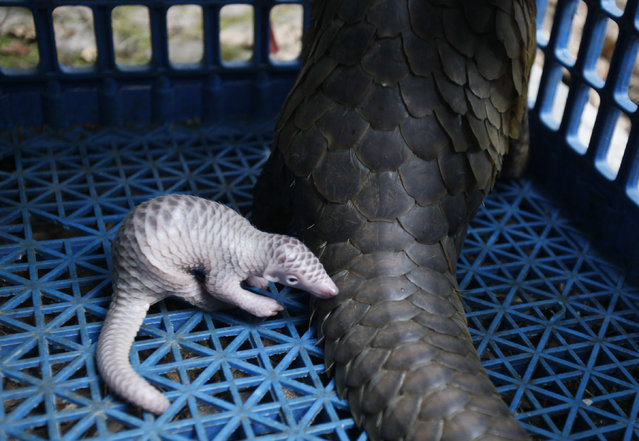
A baby pangolin sits with its mother inside a cage prior to their release into the wild in Sibolangit, North Sumatra, Indonesia, Monday, April 27, 2015. (Photo by Binsar Bakkara/AP Photo)

A baby pangolin sits with its mother inside a cage prior to their release into the wild in Sibolangit, North Sumatra, Indonesia, Monday, April 27, 2015. The anteaters are part of dozens of live pangolins and around five tons (11,000 lbs) of pangolin meat ready to be shipped abroad confiscated in a police a raid last week. (Photo by Binsar Bakkara/AP Photo)
Details
29 Apr 2015 06:16:00
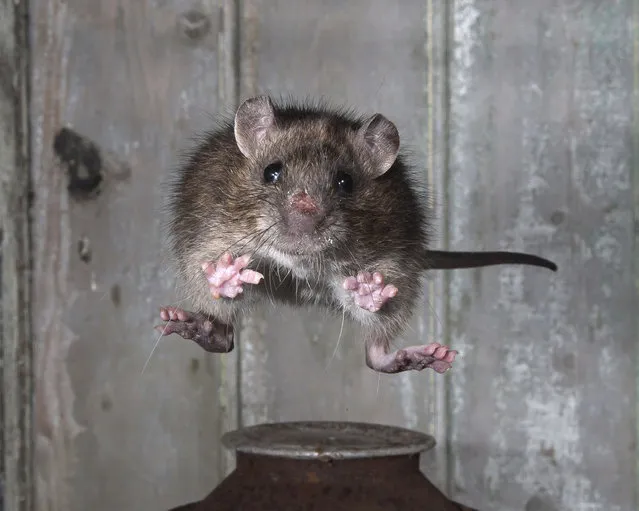
A) 1st place WINNER – Roy Rimmer. This rat was in an outdoor set I made, the set up is two meters long and a meter wide made of Perspex,it has a plywood front with holes cut in for my camera and flash guns, I placed two rusty paint cans in the set up and the rat would leap from one can too the other, I had to use flash to freeze the action.

A) 1st place WINNER – Roy Rimmer. “This rat was in an outdoor set I made, the set up is two meters long and a meter wide made of Perspex,it has a plywood front with holes cut in for my camera and flash guns, I placed two rusty paint cans in the set up and the rat would leap from one can too the other, I had to use flash to freeze the action”.
Details
08 Mar 2013 14:49:00
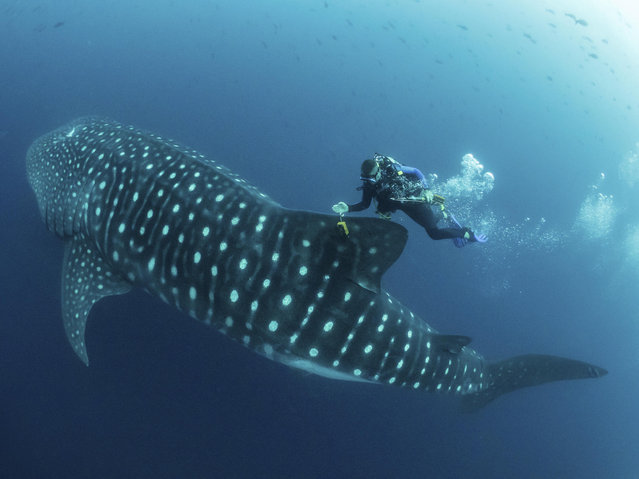
In this 2017 photo provided by Simon Pierce, Jonathan Green checks on a fin-mounted satellite tag on a whale shark in the Galapagos Islands area of Ecuador.  Despite typically being bigger than a double-decker bus, the elusive whale shark has only tiny, almost useless teeth. It's also one of the least understood animals in the ocean. (Photo by Simonjpierce.com via AP Photo)

In this 2017 photo provided by Simon Pierce, Jonathan Green checks on a fin-mounted satellite tag on a whale shark in the Galapagos Islands area of Ecuador. Despite typically being bigger than a double-decker bus, the elusive whale shark has only tiny, almost useless teeth. It's also one of the least understood animals in the ocean. (Photo by Simonjpierce.com via AP Photo)
Details
02 Mar 2018 00:03:00
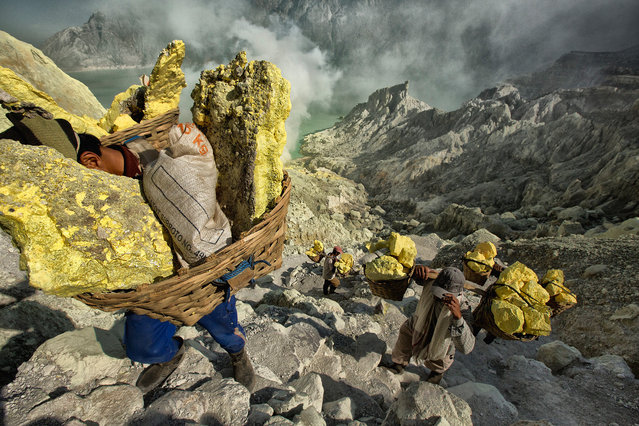
Sulphur miners haul sulphur up an arduous path out of Indonesia’s Ijen volcano. The average carry out of the volcano is 70 kilograms per load per miner.  The all-time record carry was 120 kilograms in one load.  Extraordinary numbers given most of the miners only weigh around 55 kilograms.  Ijen volcano, Indonesia, 2012. (Photo by Hugh Brown/South West News Service)

Sulphur miners haul sulphur up an arduous path out of Indonesia’s Ijen volcano. The average carry out of the volcano is 70 kilograms per load per miner. The all-time record carry was 120 kilograms in one load. Extraordinary numbers given most of the miners only weigh around 55 kilograms. Ijen volcano, Indonesia, 2012. (Photo by Hugh Brown/South West News Service)
Details
30 Jul 2018 00:05:00
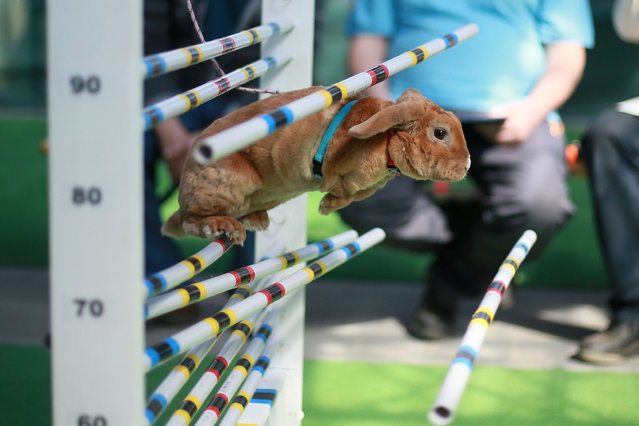
A rabbit fails to jump over an obstacle during a rabbit track and field competition on the sidelines of a hunting exhibition in Kromeriz, about 60 km east of Prague, on April 1, 2017. Circa 100 rabbits took part in the competition, including disciplines as long jump, high jump and running on a flat track. (Photo by  Radek Mica/AFP Photo)

A rabbit fails to jump over an obstacle during a rabbit track and field competition on the sidelines of a hunting exhibition in Kromeriz, about 60 km east of Prague, on April 1, 2017. Circa 100 rabbits took part in the competition, including disciplines as long jump, high jump and running on a flat track. (Photo by Radek Mica/AFP Photo)
Details
09 Apr 2017 09:49:00