Loading...
Done
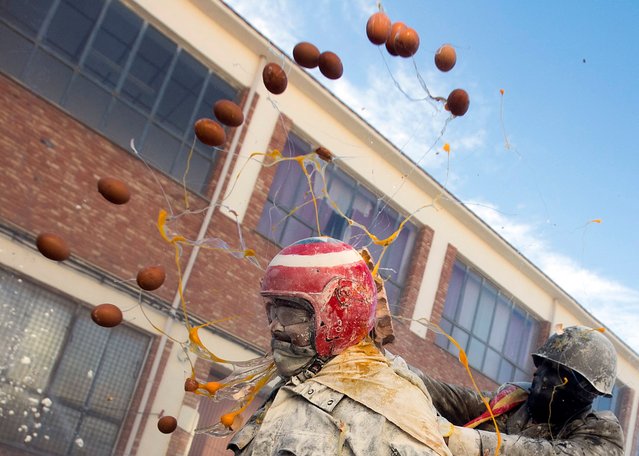
Revellers dressed in mock military garb take part in “Els Enfarinats” food-battle in the southeastern Spanish town of Ibi on December 28, 2022. (Photo by Jaime Reina/AFP Photo)

Revellers dressed in mock military garb take part in “Els Enfarinats” food-battle in the southeastern Spanish town of Ibi on December 28, 2022. (Photo by Jaime Reina/AFP Photo)
Details
30 Dec 2022 06:08:00
A woman counts her money as she sells flowers ahead of International Women's Day in central Kiev, Ukraine March 7, 2019. (Photo by Gleb Garanich/Reuters)

A woman counts her money as she sells flowers ahead of International Women's Day in central Kiev, Ukraine on March 7, 2019. (Photo by Gleb Garanich/Reuters)
Details
10 Mar 2019 00:05:00
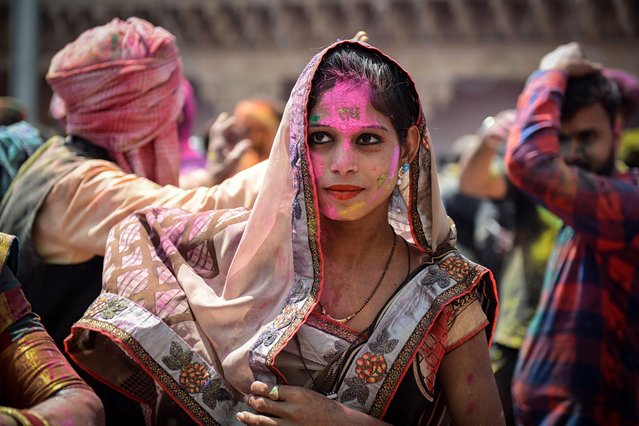
An Indian Hindu devotee celebrates Holi, the spring festival of colours, during a traditional gathering at a temple in Nandgaon village in Uttar Pradesh state on March 16, 2019. Holi, the popular Hindu spring festival of colours is observed in India at the end of the winter season on the last full moon of the lunar month. (Photo by Noemi Cassanelli/AFP Photo)

An Indian Hindu devotee celebrates Holi, the spring festival of colours, during a traditional gathering at a temple in Nandgaon village in Uttar Pradesh state on March 16, 2019. Holi, the popular Hindu spring festival of colours is observed in India at the end of the winter season on the last full moon of the lunar month. (Photo by Noemi Cassanelli/AFP Photo)
Details
28 Mar 2019 00:01:00
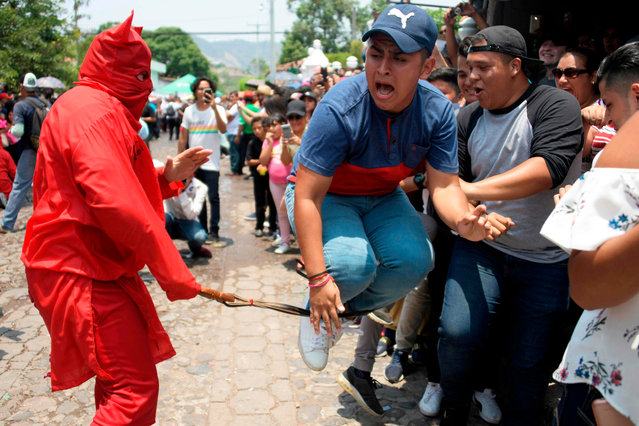
A Catholic faithful fancy dressed as a “talciguin” -character of the local folklore- takes part in the celebration of an ancient local tradition that marks the start of Holy Week, in Texistepeque, some 80 km west of San Salvador, on April 15, 2019. Talciguines are devils who “lash” Catholic faithfuls to cleanse their sins. (Photo by Marvin Recinos/AFP Photo)

A Catholic faithful fancy dressed as a “talciguin” -character of the local folklore- takes part in the celebration of an ancient local tradition that marks the start of Holy Week, in Texistepeque, some 80 km west of San Salvador, on April 15, 2019. Talciguines are devils who “lash” Catholic faithfuls to cleanse their sins. (Photo by Marvin Recinos/AFP Photo)
Details
18 Apr 2019 00:07:00
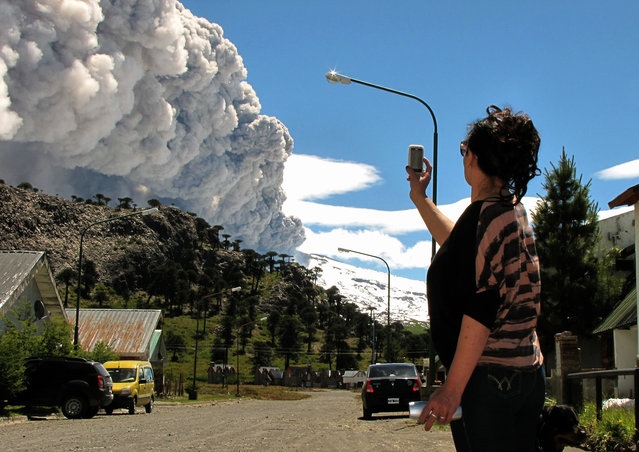
A woman takes a picture with her mobile phone from Caviahue, Neuquen province, Argentina, some 1500 km southwest of Buenos Aires, of the Copahue volcano spewing ashes on December 22, 2012. The authorities of Chile and Argentina issued yellow alerts due to the eruption of the Copahue volcano, placed in the border between both countries. (Photo by Antonio Huglich/AFP Photo)

A woman takes a picture with her mobile phone from Caviahue, Neuquen province, Argentina, some 1500 km southwest of Buenos Aires, of the Copahue volcano spewing ashes on December 22, 2012. The authorities of Chile and Argentina issued yellow alerts due to the eruption of the Copahue volcano, placed in the border between both countries. (Photo by Antonio Huglich/AFP Photo)
Details
23 Dec 2012 09:25:00
Anne Sudworth – Gowrim Idhree

“Anne Sudworth is a British artist internationally known for her paintings of magical trees and haunting moonlit landscapes”. – Wikipedia. Photo: Anne Sudworth – “Gowrim Idhree”.
Details
20 Jan 2013 10:01:00
Atomic Annie at work during the Upshot-Knothole test series, 1953. (Photo by Los Alamos National Laboratory/US Army)

“A fter the former Soviet Union conducted its first nuclear test in August 1949, the US reevaluated its postwar defense policies. With the US monopoly on atomic weapons broken, military and political leaders chose to diversify the American stockpile by developing thermonuclear and tactical nuclear weapons. One of the more interesting concepts to come out of this period was atomic artillery, which was successfully tested at the Nevada Proving Grounds (now the Nevada Test Site) in May 1953”. – Alan Carr. Photo: Atomic Annie at work during the Upshot-Knothole test series, 1953. (Photo by Los Alamos National Laboratory/US Army)
Details
11 Mar 2013 11:43:00
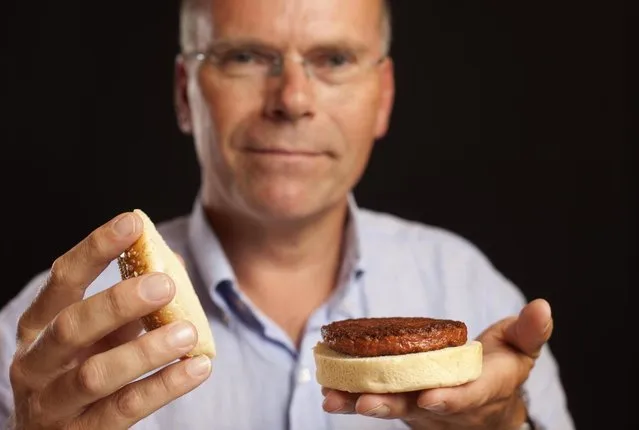
In this handout image provided by Ogilvy, a burger made from cultured beef, which has been developed by Professor Mark Post of Maastricht University in the Netherlands (pictured) is shown to the media during a press conference on August 5, 2013 in London, England. Cultured Beef could help solve the coming food crisis and combat climate change with commercial production of Cultured Beef beginning within ten to twenty years. (Photo by David Parry via Getty Images)

In this handout image provided by Ogilvy, a burger made from cultured beef, which has been developed by Professor Mark Post of Maastricht University in the Netherlands (pictured) is shown to the media during a press conference on August 5, 2013 in London, England. The in-vitro burger, cultured from cattle stem cells, the first example of what its creator says could provide an answer to global food shortages and help combat climate change, was fried in a pan and tasted by two volunteers. The burger is the result of years of research by Dutch scientist Mark Post, a vascular biologist at the University of Maastricht, who is working to show how meat grown in petri dishes might one day be a true alternative to meat from livestock.The meat in the burger has been made by knitting together around 20,000 strands of protein that has been cultured from cattle stem cells in Post's lab. (Photo by David Parry)
Details
06 Aug 2013 08:48:00