Loading...
Done
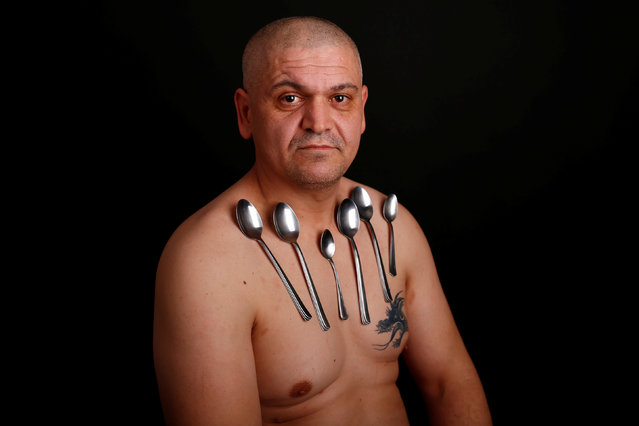
Nermin Halilagic, 38, poses with kitchen utensils in Bihac, Bosnia and Herzegovina, January 23, 2017. (Photo by Dado Ruvic/Reuters)

Nermin Halilagic, 38, poses with kitchen utensils in Bihac, Bosnia and Herzegovina, January 23, 2017. Halilagic discovered earlier this year that he had the unusual ability to attach items to his body using what he says is a special energy radiated from his body. (Photo by Dado Ruvic/Reuters)
Details
26 Jan 2017 12:52:00
Dancers perform as human sculptures during an exhibition in Hong Kong, China, 26 March 2019. (Photo by Jerome Favre/EPA/EFE)

Dancers perform as human sculptures during an exhibition in Hong Kong, China, 26 March 2019. The exhibition entitled “Multisensory Exhibition Urban Playgrounds” shows how Austrian artist Willi Dorner uses urban spaces to interpret the relationship between bodies and objects. (Photo by Jerome Favre/EPA/EFE)
Details
30 Mar 2019 00:01:00
Norwegian Trolls By Ivar Rodningen Part 1

Ivar Rodningem is a professional illustrator, whose imaginative mind transports us into a parallel world where trolls roam the lands.

Please Subscribe To: Our Youtube Channel
Details
19 Dec 2016 23:59:00
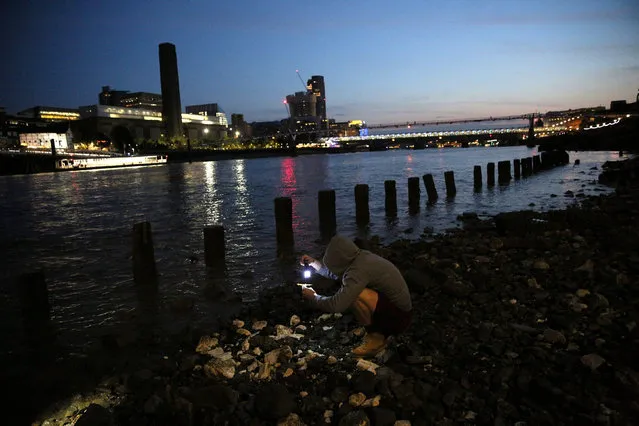
A mudlark uses a torch to look for items on the bank of the River Thames in London, Britain June 06, 2016. Mudlarking is believed to trace its origins to the 18th and 19th century, when scavengers searched the Thames' shores for items to sell. These days, history and archaeology fans are the ones hoping to find old relics such as coins, ceramics, artifacts or everyday items from across centuries. They wait for the low tide and then scour specific areas of exposed shores. "If you're in a field you could be out all day long, with the river you're restricted to about two or three hours," mudlark Nick Stevens said. While many just use the naked eye for their searches, others rely on metal detectors for which a permit from the Port of London Authority is needed. Digging also requires consent. (Photo by Neil Hall/Reuters)

A mudlark uses a torch to look for items on the bank of the River Thames in London, Britain June 06, 2016. Mudlarking is believed to trace its origins to the 18th and 19th century, when scavengers searched the Thames' shores for items to sell. These days, history and archaeology fans are the ones hoping to find old relics such as coins, ceramics, artifacts or everyday items from across centuries. their finds with the Portable Antiquities Scheme. Any item over 300 years old must be recorded. (Photo by Neil Hall/Reuters)
Details
27 Aug 2016 10:43:00
Kate Beckinsale attends the GQ Men of the Year Awards at Tate Modern on September 5, 2018 in London, England. (Photo by Karwai Tang/WireImage)

English actress Kate Beckinsale attends the GQ Men of the Year Awards at Tate Modern on September 5, 2018 in London, England. (Photo by Karwai Tang/WireImage)
Details
11 Sep 2018 05:27:00
Maura Higgins attends the Pretty Little Thing X Molly-Mae party at Rosso on September 01, 2019 in Manchester, England. (Photo by Splash News and Pictures)

UK Love Island's Maura Higgins attends the Pretty Little Thing X Molly-Mae party at Rosso on September 01, 2019 in Manchester, England. (Photo by Splash News and Pictures)
Details
08 Sep 2019 00:05:00
A Hawaiian photographer braved freezing temperatures for this cold SNAP – of what appears to be a firebird bursting from an aurora. (Photo by CJ Kale/Caters News)

“A Hawaiian photographer braved freezing temperatures for this cold SNAP – of what appears to be a firebird bursting from an aurora. Keen snapper CJ Kale, more used to sun, sea and sand while at work than snow, captured the incredible moment while on a trip to Alaska. It was his first time seeing the spectacular sight and lucked out – capturing some of the rarest colors of aurora on his first night”. – Caters News
Details
12 Aug 2014 12:15:00
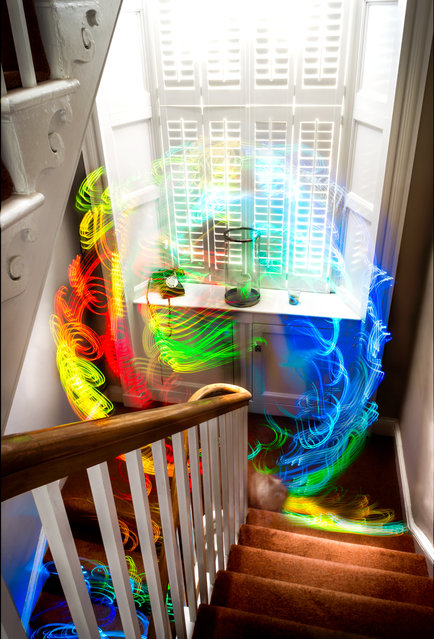
His goal with the project is to make the invisible visible. (Photo by Luis Hernan)

Luis Hernan was always curious about how wireless technologies like radio are transmitted through the air. So after finishing up his studies in architecture, computer science, and design, Hernan decided to research these invisible signals through a PhD at Newcastle University. Hernan set up a system that turned the wireless signals around him into colourful, ghostlike images using long-exposure photography, allowing people to see the strength of the signals around them. (Photo by Luis Hernan)
Details
13 Aug 2014 09:38:00