Loading...
Done
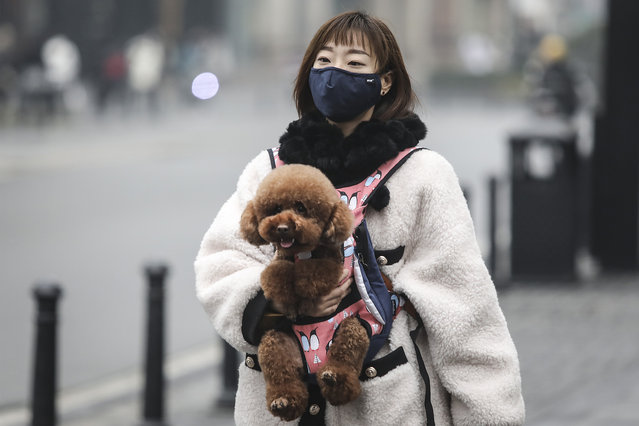
A woman wears a mask while carrying a dog in the street on January 22, 2020 in Wuhan, Hubei province, China. A new infectious coronavirus known as “2019-nCoV” was discovered in Wuhan as the number of cases rose to over 400 in mainland China. Health officials stepped up efforts to contain the spread of the pneumonia-like disease which medicals experts confirmed can be passed from human to human. The death toll has reached 17 people as the Wuhan government issued regulations today that residents must wear masks in public places. Cases have been reported in other countries including the United States, Thailand, Japan, Taiwan, and South Korea. (Photo by Getty Images/China Stringer Network)

A woman wears a mask while carrying a dog in the street on January 22, 2020 in Wuhan, Hubei province, China. A new infectious coronavirus known as “2019-nCoV” was discovered in Wuhan as the number of cases rose to over 400 in mainland China. Health officials stepped up efforts to contain the spread of the pneumonia-like disease which medicals experts confirmed can be passed from human to human. The death toll has reached 17 people as the Wuhan government issued regulations today that residents must wear masks in public places. Cases have been reported in other countries including the United States, Thailand, Japan, Taiwan, and South Korea. (Photo by Getty Images/China Stringer Network)
Details
31 Dec 2020 00:01:00
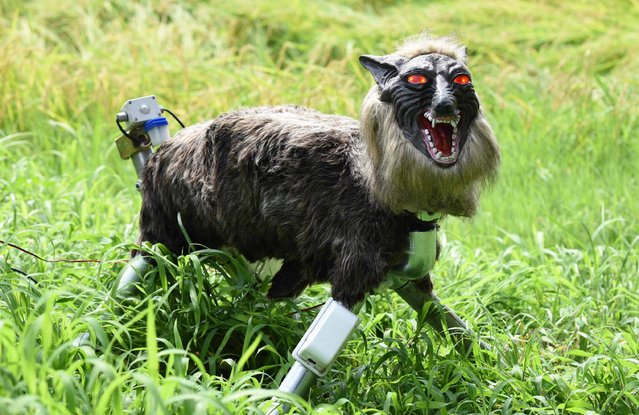
A wolf-like robot “Super Monster Wolf” stands beside a rice field to drive away wild animals that cause damages to crops in Kisarazu, Chiba prefecture, on August 25, 2017. The agricultural coopetative association JA Kisarazu-shi introduced the 65cm-long and 50cm-high robot recently on a trial basis which can detect wild animals such as boars and deers with an infrared ray sensor when they approach and intimidates them, flashing the red LED eyes and blaring 48 types of sounds including a wolf growl and human voice. (Photo by Toru Yamanaka/AFP Photo)

A wolf-like robot “Super Monster Wolf” stands beside a rice field to drive away wild animals that cause damages to crops in Kisarazu, Chiba prefecture, on August 25, 2017. The agricultural coopetative association JA Kisarazu-shi introduced the 65cm-long and 50cm-high robot recently on a trial basis which can detect wild animals such as boars and deers with an infrared ray sensor when they approach and intimidates them, flashing the red LED eyes and blaring 48 types of sounds including a wolf growl and human voice. (Photo by Toru Yamanaka/AFP Photo)
Details
27 Aug 2017 07:17:00
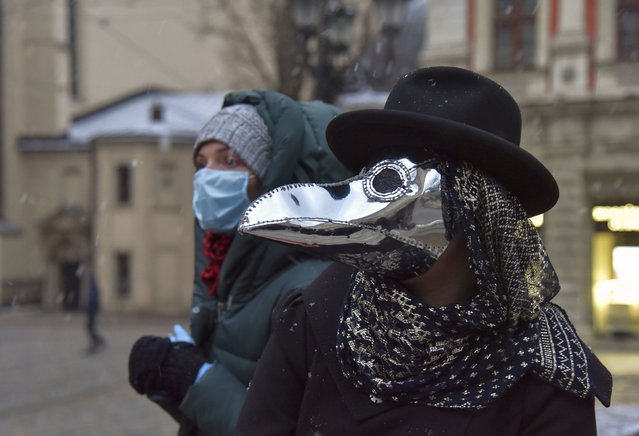
A woman wearing a protective mask is seen behind a girl dressed in a Plague Doctor Mask in Western-Ukrainian city of Lviv, Ukraine, 22 March 2020. Ukrainian Designer Anastasia Markovska sewed protective masks looking like Plague Doctor Masks, the traditional costume of Venice Carnival, for herself and her friends due to the ongoing pandemic of the COVID-19 disease caused by the SARS-CoV-2 coronavirus. In Ukraine had been 47 laboratory-confirmed cases of COVID-19, including three deaths and one recovery as Ukraine's Health Ministry announced. (Photo by Pavlo Palamarchuk/EPA/EFE)

A woman wearing a protective mask is seen behind a girl dressed in a Plague Doctor Mask in Western-Ukrainian city of Lviv, Ukraine, 22 March 2020. Ukrainian Designer Anastasia Markovska sewed protective masks looking like Plague Doctor Masks, the traditional costume of Venice Carnival, for herself and her friends due to the ongoing pandemic of the COVID-19 disease caused by the SARS-CoV-2 coronavirus. In Ukraine had been 47 laboratory-confirmed cases of COVID-19, including three deaths and one recovery as Ukraine's Health Ministry announced. (Photo by Pavlo Palamarchuk/EPA/EFE)
Details
02 May 2020 00:05:00
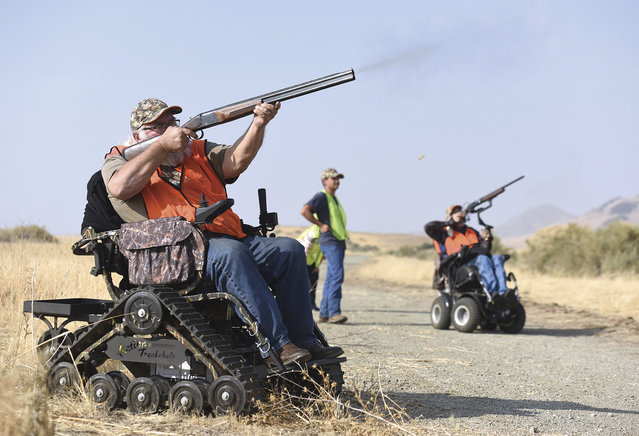
In this November 16, 2018, file photo, Duane Townsend, left, shoots a pheasant at Special Friday Pheasant Hunts, sponsored by Southern Tulare County Sportsman's Association, at Lake Success Recreation Area in Porterville, Calif. A Utah man who has been in a wheelchair for more than three decades has created a pheasant hunt for people like him who need help getting into the outdoors. The Daily Herald in Provo reports that Clint Robinson broke his neck after being thrown off a horse at a rodeo 32 years ago. The event called “Wheelchairs in the Wild” pairs people that have physical disabilities with hunters who help them with whatever they need. Many go in off-road vehicles. (Photo by Chieko Hara/The Porterville Recorder via AP Photo/File)

In this November 16, 2018, file photo, Duane Townsend, left, shoots a pheasant at Special Friday Pheasant Hunts, sponsored by Southern Tulare County Sportsman's Association, at Lake Success Recreation Area in Porterville, Calif. A Utah man who has been in a wheelchair for more than three decades has created a pheasant hunt for people like him who need help getting into the outdoors. The Daily Herald in Provo reports that Clint Robinson broke his neck after being thrown off a horse at a rodeo 32 years ago. The event called “Wheelchairs in the Wild” pairs people that have physical disabilities with hunters who help them with whatever they need. Many go in off-road vehicles. (Photo by Chieko Hara/The Porterville Recorder via AP Photo/File)
Details
19 Oct 2019 00:01:00
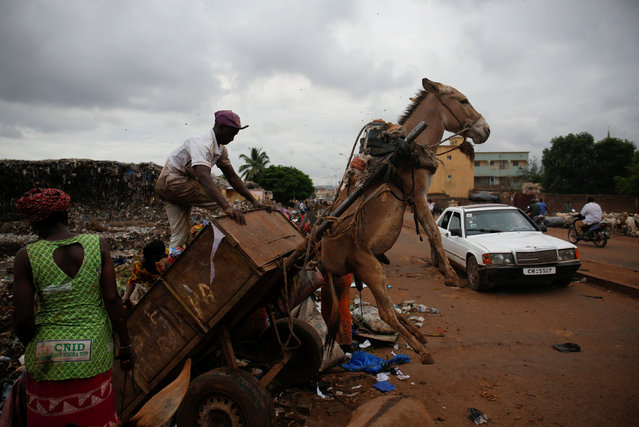
A waste picker unloads garbage at a waste transfer station in Bamako, Mali, August 19, 2018. In the Malian capital of Bamako, donkey carts driven by young men like 19-year-old Arouna Diabate play a vital role battling the fast-growing city's waste problem. Every morning before dawn, Diabate hitches his donkey to a cart and sets off on his rounds, going door-to-door to collect household garbage which he delivers to a local waste transfer station for a monthly salary of around $35. “I won't be picking up trash with a donkey cart for the rest of my life, but for now people appreciate us because we help clean up the homes of Bamako”, Diabate said. (Photo by Luc Gnago/Reuters)

A waste picker unloads garbage at a waste transfer station in Bamako, Mali, August 19, 2018. In the Malian capital of Bamako, donkey carts driven by young men like 19-year-old Arouna Diabate play a vital role battling the fast-growing city's waste problem. Every morning before dawn, Diabate hitches his donkey to a cart and sets off on his rounds, going door-to-door to collect household garbage which he delivers to a local waste transfer station for a monthly salary of around $35. “I won't be picking up trash with a donkey cart for the rest of my life, but for now people appreciate us because we help clean up the homes of Bamako”, Diabate said. (Photo by Luc Gnago/Reuters)
Details
18 Sep 2018 00:01:00
Second Place Winner: “Thunderstorm at False Kiva”. I hiked out to these ruins at night hoping to photograph them with the Milky Way, but instead a thunderstorm rolled through, creating this dramatic image. – Max Seigal. (Photo and caption by Max Seigal/National Geographic Traveler Photo Contest)

Second Place Winner: “Thunderstorm at False Kiva”. I hiked out to these ruins at night hoping to photograph them with the Milky Way, but instead a thunderstorm rolled through, creating this dramatic image. – Max Seigal. National Geographic Traveler Director of Photography Dan Westergren, one of this year's judges, shares his thoughts on the second place winner: “This photo combines two different scenes into one: the small kiva in a cliff dwelling and the grand vista of Canyonlands National Park across the valley. I really like the two different color palettes – warm inside and purple outside. This two-for-one scene was caused by the lightning storm outside the dwelling, which lit up the landscape like it was a huge electronic flash. Looking at this picture I can imagine what a wonderful sight it must have been for the ancient people who lived here. It doesn't seem too amazing now in our modern world, but might have been mind-blowing for the prehistoric residents”. Location: Utah. (Photo and caption by Max Seigal/National Geographic Traveler Photo Contest)
Details
02 Aug 2013 06:16:00
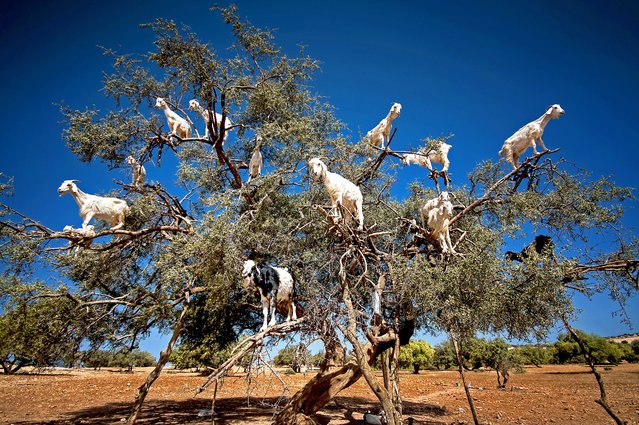
These goats threw caution to the wind and scaled this Argan tree right to the very top, even balancing on the most unsturdy of branches. It looks like a bit of a baa-lancing act, but the goats hooves are perfectly adapted to climbing the trees, where they graze on the Argan fruit. Amateur photographer Burak Senbak, 51, took these photos whilst travelling through Morocco in July 2016. Burak is originally from Turkey and works as a mechanical engineer, but has pursued his passion for photography for 10 years. Intrigued by the sight of goats in a tree, Burak couldnt resist the opportunity to take some photos, and said the goats proved a perfect subject. (Photo by Burak Senbak/Caters News)

These goats threw caution to the wind and scaled this Argan tree right to the very top, even balancing on the most unsturdy of branches. It looks like a bit of a baa-lancing act, but the goats hooves are perfectly adapted to climbing the trees, where they graze on the Argan fruit. Amateur photographer Burak Senbak, 51, took these photos whilst travelling through Morocco in July 2016. Burak is originally from Turkey and works as a mechanical engineer, but has pursued his passion for photography for 10 years. Intrigued by the sight of goats in a tree, Burak couldnt resist the opportunity to take some photos, and said the goats proved a perfect subject. (Photo by Burak Senbak/Caters News)
Details
27 Aug 2017 07:00:00
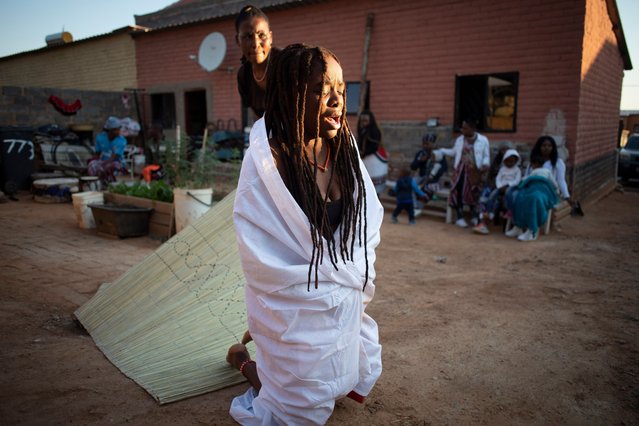
“Sangoma” initiate Dipuo Banda (C) is led out of her teachers shack while she remains in a trance like state prior to dancing during her 3 day initiation ceremony with her teacher, family, friends and students in the Alexandra Township in Johannesburg, South Africa, 14 May 2021. Sangomas, the Zulu term for Medicine Women or traditional healers, fulfill different social and political roles in the community, including divination, physical healing, emotional and spiritual illnesses, directing birth or death rituals and finding lost cattle. (Photo by Kim Ludbrook/EPA/EFE)

“Sangoma” initiate Dipuo Banda (C) is led out of her teachers shack while she remains in a trance like state prior to dancing during her 3 day initiation ceremony with her teacher, family, friends and students in the Alexandra Township in Johannesburg, South Africa, 14 May 2021. Sangomas, the Zulu term for Medicine Women or traditional healers, fulfill different social and political roles in the community, including divination, physical healing, emotional and spiritual illnesses, directing birth or death rituals and finding lost cattle. (Photo by Kim Ludbrook/EPA/EFE)
Details
28 May 2021 08:13:00