Loading...
Done
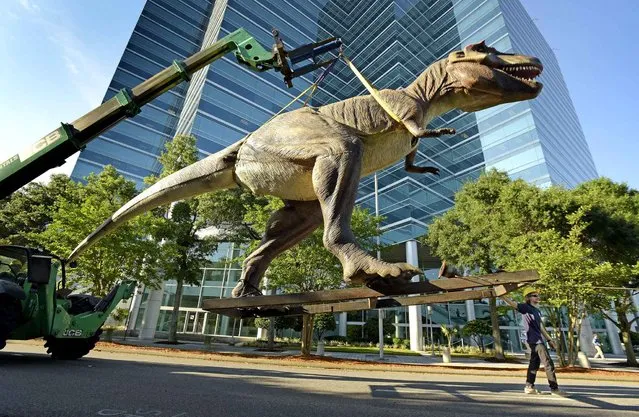
Crews move a 39 foot long, 16 foot tall, 2400 lbs. replica of a Tyrannosaurus Rex from behind the Museum Of Science And History in Jacksonville, Fla., to its new location in front of the entrance of the museum Wednesday morning, May 20, 2015, to kickoff the upcoming Dinosaurs Unearthed exhibit. (Photo by Bob Self/The Florida Times-Union via AP Photo)

Crews move a 39 foot long, 16 foot tall, 2400 lbs. replica of a Tyrannosaurus Rex from behind the Museum Of Science And History in Jacksonville, Fla., to its new location in front of the entrance of the museum Wednesday morning, May 20, 2015, to kickoff the upcoming Dinosaurs Unearthed exhibit. The exhibiti, which opens this week, includes animatronic dinosaurs as well as prehistoric fossils and runs through September 7. (Photo by Bob Self/The Florida Times-Union via AP Photo)
Details
23 May 2015 11:22:00
Two men push a classic Messerschmidt KR200 “Kabinenroller” at the 7th Cairo Classic Meet in Cairo, Egypt, 23 March 2019. The exhibition for classic cars is held at the Smart Village in Cairo. The exhibition is held to exchange experiences in how to preserve the old cars, and also for promoting tourism. (Photo by Mohamed Hossam/EPA/EFE)

Two men push a classic Messerschmidt KR200 “Kabinenroller” at the 7th Cairo Classic Meet in Cairo, Egypt, 23 March 2019. The exhibition for classic cars is held at the Smart Village in Cairo. The exhibition is held to exchange experiences in how to preserve the old cars, and also for promoting tourism. (Photo by Mohamed Hossam/EPA/EFE)
Details
15 Apr 2019 00:03:00
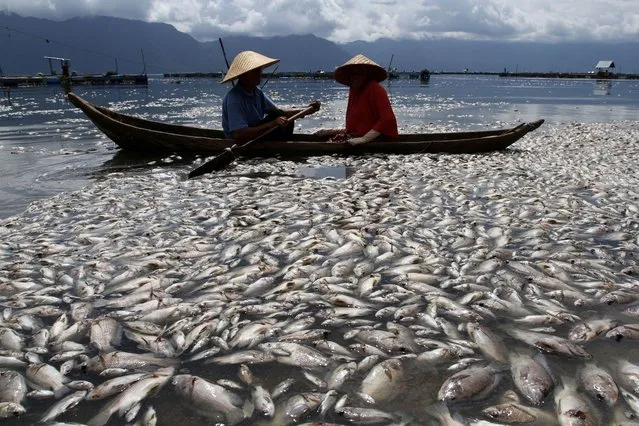
Fishermen are seen near thousands of fish found dead at Lake Maninjau due to lack of oxygen levels at the bottom of the lake and bad weather that hit the area in Agam, West Sumatra Province, Indonesia on April 29, 2021. (Photo by Muhammad Arif Pribadi/Antara Foto via Reuters)

Fishermen are seen near thousands of fish found dead at Lake Maninjau due to lack of oxygen levels at the bottom of the lake and bad weather that hit the area in Agam, West Sumatra Province, Indonesia on April 29, 2021. (Photo by Muhammad Arif Pribadi/Antara Foto via Reuters)
Details
27 May 2021 08:54:00
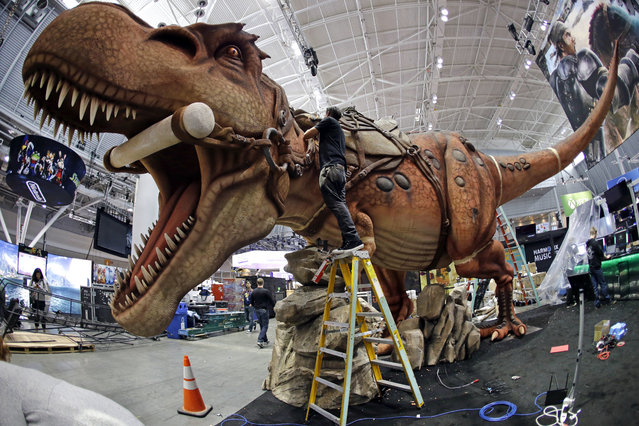
Joshua Patino stands on a ladder to put finishing touches on a giant dinosaur exhibit at PAX East in the Boston Convention and Expo Center, Thursday, April 21, 2016, in Boston. PAX East, an annual celebration of gaming culture, is expected to draw tens of thousands of visitors Friday through Sunday. It's a place where serious gamers can preview unreleased video games and devices, compete in tournaments, hear live music and meet others for whom gaming is a way of life. (Photo by Elise Amendola/AP Photo)

Joshua Patino stands on a ladder to put finishing touches on a giant dinosaur exhibit at PAX East in the Boston Convention and Expo Center, Thursday, April 21, 2016, in Boston. PAX East, an annual celebration of gaming culture, is expected to draw tens of thousands of visitors Friday through Sunday. It's a place where serious gamers can preview unreleased video games and devices, compete in tournaments, hear live music and meet others for whom gaming is a way of life. (Photo by Elise Amendola/AP Photo)
Details
23 Apr 2016 14:02:00
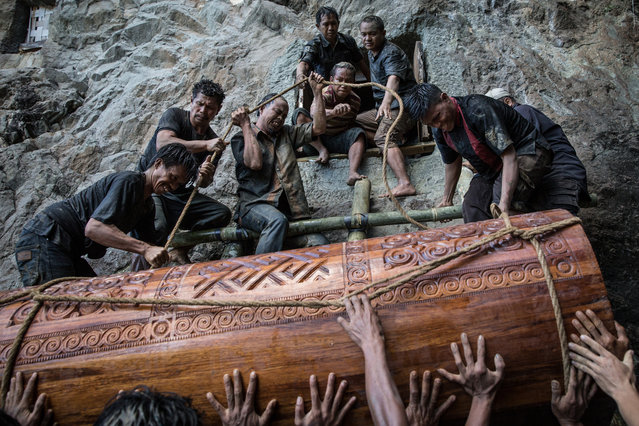
It is said that Torajans are people who “live to die”. For this Indonesian ethnic group, funerals are such extravagant events that they sometimes attract tourists. Families can postpone burials years (and the deceased are considered sick and hosted at home until the funeral) until the family can raise enough money and gather as many relatives as possible. And then it’s a jubilant multiday social event with a parade, dances and animal sacrifices. Agung Parameswara photographed these funerary practices when he traveled to South Sulawesi province, where the Torajans live. But often, their funeral isn’t the last time the dead are seen. In August, crypts are opened, coffins are slid back out and bodies delicately unsheathed. This tender ritual is known as Ma’Nene, which is customarily performed every few years. (Photo by Agung Parameswara/The Washington Post)

It is said that Torajans are people who “live to die”. For this Indonesian ethnic group, funerals are such extravagant events that they sometimes attract tourists. Families can postpone burials years (and the deceased are considered sick and hosted at home until the funeral) until the family can raise enough money and gather as many relatives as possible. And then it’s a jubilant multiday social event with a parade, dances and animal sacrifices. Agung Parameswara photographed these funerary practices when he traveled to South Sulawesi province, where the Torajans live. (Photo by Agung Parameswara/The Washington Post)
Details
06 Oct 2016 09:15:00
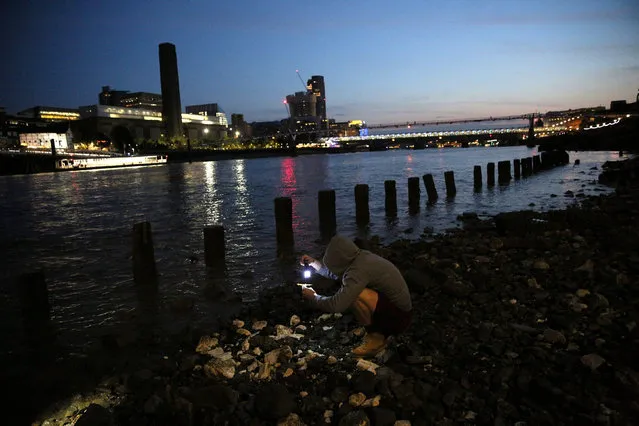
A mudlark uses a torch to look for items on the bank of the River Thames in London, Britain June 06, 2016. Mudlarking is believed to trace its origins to the 18th and 19th century, when scavengers searched the Thames' shores for items to sell. These days, history and archaeology fans are the ones hoping to find old relics such as coins, ceramics, artifacts or everyday items from across centuries. They wait for the low tide and then scour specific areas of exposed shores. "If you're in a field you could be out all day long, with the river you're restricted to about two or three hours," mudlark Nick Stevens said. While many just use the naked eye for their searches, others rely on metal detectors for which a permit from the Port of London Authority is needed. Digging also requires consent. (Photo by Neil Hall/Reuters)

A mudlark uses a torch to look for items on the bank of the River Thames in London, Britain June 06, 2016. Mudlarking is believed to trace its origins to the 18th and 19th century, when scavengers searched the Thames' shores for items to sell. These days, history and archaeology fans are the ones hoping to find old relics such as coins, ceramics, artifacts or everyday items from across centuries. their finds with the Portable Antiquities Scheme. Any item over 300 years old must be recorded. (Photo by Neil Hall/Reuters)
Details
27 Aug 2016 10:43:00
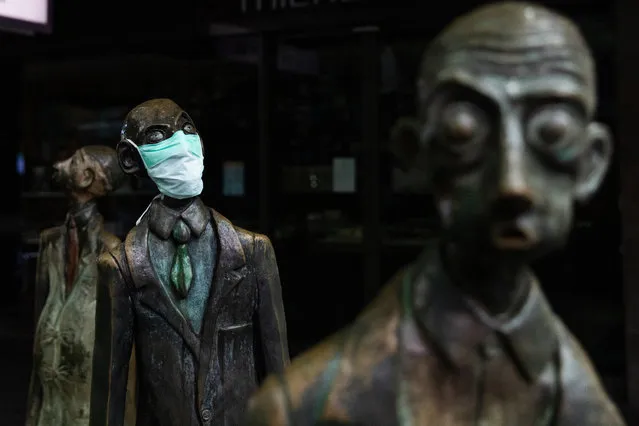
A face mask is placed on one of the 'Three business men who brought lunch' statues on Swanston street on March 29, 2020 in Melbourne, Australia. All international arrivals into Australia from midnight on Saturday will be placed into mandatory quarantine in hotels for 14 days as the Federal Government increases restrictions to stop the spread of COVID-19. All libraries, museums, galleries, beauty salons, tattoo parlours, shopping centre food courts, auctions, open houses, amusement parks, arcades, indoor and outdoor play centres, swimming pools are closed and indoor exercise activities are now banned. This is in addition to the closure of bars, pubs and nightclubs which came into effect on Monday. Restaurants and cafes are restricted to providing takeaway only. Weddings will now be restricted to five people including the couple while funerals are limited to 10 mourners. All Australians are now expected to stay at home except for essential outings such as work, grocery shopping and medical appointments. Exercising outdoors alone is still permitted. Australia now has more than 3,600 confirmed cases of COVID-19 while the death toll now stands at 16. (Photo by Asanka Ratnayake/Getty Images)

A face mask is placed on one of the 'Three business men who brought lunch' statues on Swanston street on March 29, 2020 in Melbourne, Australia. All international arrivals into Australia from midnight on Saturday will be placed into mandatory quarantine in hotels for 14 days as the Federal Government increases restrictions to stop the spread of COVID-19. (Photo by Asanka Ratnayake/Getty Images)
Details
31 Mar 2020 00:07:00
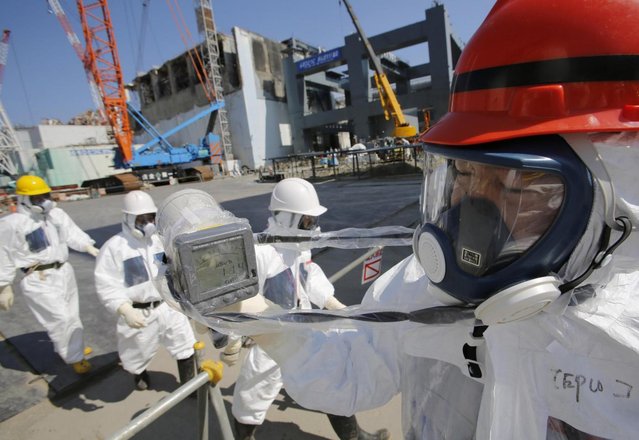
A radiation monitor indicates 114.00 microsieverts per hour near the building housing the plant's No. 4 reactor, center, and an under construction foundation, right, which will store the reactor's melted fuel rods at Tokyo Electric Power Co.'s tsunami-crippled Fukushima Dai-ichi nuclear power plant in Okuma, Fukushima prefecture, Wednesday, March 6, 2013, ahead of the second anniversary of the March 11, 2011 tsunami and earthquake. (Photo by Issei Kato/AP Photo/Pool)

A radiation monitor indicates 114.00 microsieverts per hour near the building housing the plant's No. 4 reactor, center, and an under construction foundation, right, which will store the reactor's melted fuel rods at Tokyo Electric Power Co.'s tsunami-crippled Fukushima Dai-ichi nuclear power plant in Okuma, Fukushima prefecture, Wednesday, March 6, 2013, ahead of the second anniversary of the March 11, 2011 tsunami and earthquake. Some 110,000 people living around the nuclear plant were evacuated after the massive March 11, 2011, earthquake and tsunami knocked out the plant's power and cooling systems, causing meltdowns in three reactors and spewing radiation into the surrounding air, soil and water. (Photo by Issei Kato/AP Photo/Pool)
Details
06 Mar 2013 13:19:00