Loading...
Done
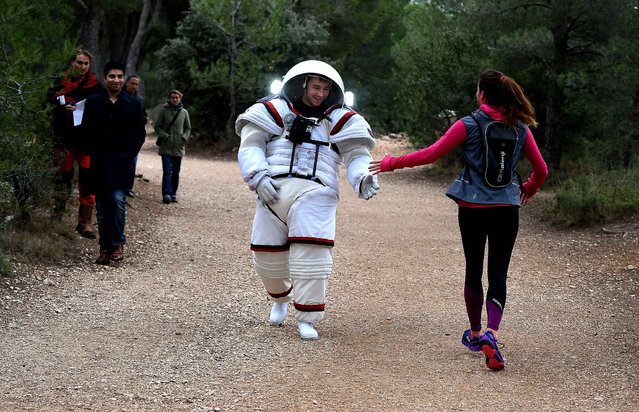
Aeronautics and Space engineer at France's Compagnie Maritime d'Expertises, or Comex, Arnaud Prost (C) meets with a jogger as he tests on the ground the “Gandolfi 2” underwater training suit for spacewalk, on January 20, 2016 in the calanques region (rocky inlets) of Marseille. The underwater training suit “Gandolfi 2”, developed with the European Space Agency (ESA), is designed for training astronauts underwater to simulate space gravity for the astronaut's extravehicular activities (EVAs). (Photo by Boris Horvat/AFP Photo)

Aeronautics and Space engineer at France's Compagnie Maritime d'Expertises, or Comex, Arnaud Prost (C) meets with a jogger as he tests on the ground the “Gandolfi 2” underwater training suit for spacewalk, on January 20, 2016 in the calanques region (rocky inlets) of Marseille. The underwater training suit “Gandolfi 2”, developed with the European Space Agency (ESA), is designed for training astronauts underwater to simulate space gravity for the astronaut's extravehicular activities (EVAs). (Photo by Boris Horvat/AFP Photo)
Details
23 Jan 2016 13:41:00
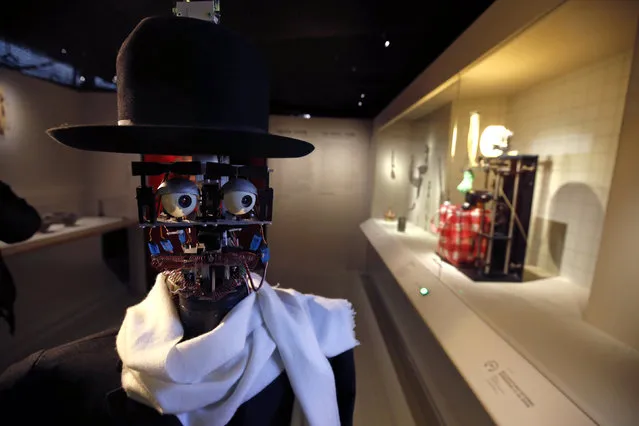
The Berenson robot strolls among visitors during the exhibition “Persona : Oddly Human” at the Quai Branly museum in Paris, France, February 23, 2016. The Berenson robot, developed in France in 2011, is the brainchild of anthropologist Denis Vidal and robotics engineer Philippe Gaussier. Its programming allows it to record reactions of museum visitors to certain pieces of art and then use the data to develop its own unique taste, which allows “Berenson” to judge whether or not it likes a certain work of art within an exhibition. (Photo by Philippe Wojazer/Reuters)

The Berenson robot strolls among visitors during the exhibition “Persona : Oddly Human” at the Quai Branly museum in Paris, France, February 23, 2016. The Berenson robot, developed in France in 2011, is the brainchild of anthropologist Denis Vidal and robotics engineer Philippe Gaussier. Its programming allows it to record reactions of museum visitors to certain pieces of art and then use the data to develop its own unique taste, which allows “Berenson” to judge whether or not it likes a certain work of art within an exhibition. (Photo by Philippe Wojazer/Reuters)
Details
25 Feb 2016 12:26:00
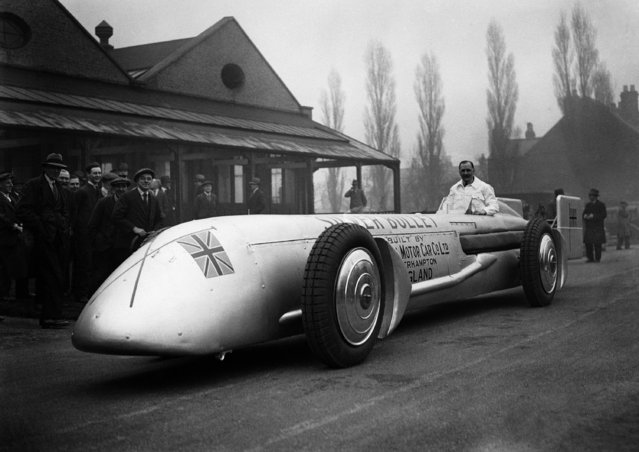
Kaye Don seated in the cockpit of his new racing car the “Silver Bullet” at Wolverhampton, England on February 21, 1930, in which he will attempt to beat world land speed record at Daytona. It has two 12-cylinder V shaped engines and each develops 2,000-h.p. The theoretical speed of the car is 275 m.p.h. but the designer estimated that will be able to reach 250 m.p.h. allowing for wind pressures. (Photo by AP Photo/Staff/Puttnam)

Kaye Don seated in the cockpit of his new racing car the “Silver Bullet” at Wolverhampton, England on February 21, 1930, in which he will attempt to beat world land speed record at Daytona. It has two 12-cylinder V shaped engines and each develops 2,000-h.p. The theoretical speed of the car is 275 m.p.h. but the designer estimated that will be able to reach 250 m.p.h. allowing for wind pressures. (Photo by AP Photo/Staff/Puttnam)
Details
03 Mar 2018 00:03:00
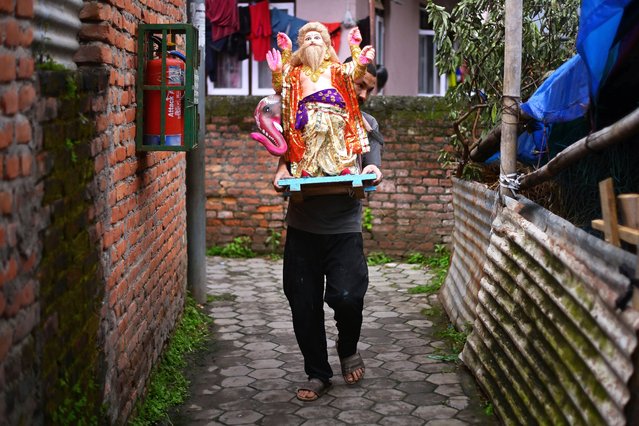
An artist carries a clay statue of Lord Vishwakarma to the market for sale before the Vishwakarma Puja festival in Nepal, Kathmandu on September 16, 2025. The festival, celebrated on September 17 this year, honors Lord Vishwakarma, regarded as the divine engineer and craftsman, and involves prayers for creativity, prosperity, and protection of tools and workplaces. (Photo by Safal Prakash Shrestha/ZUMA Press Wire/Rex Features/Shutterstock)

An artist carries a clay statue of Lord Vishwakarma to the market for sale before the Vishwakarma Puja festival in Nepal, Kathmandu on September 16, 2025. The festival, celebrated on September 17 this year, honors Lord Vishwakarma, regarded as the divine engineer and craftsman, and involves prayers for creativity, prosperity, and protection of tools and workplaces. (Photo by Safal Prakash Shrestha/ZUMA Press Wire/Rex Features/Shutterstock)
Details
29 Oct 2025 03:44:00


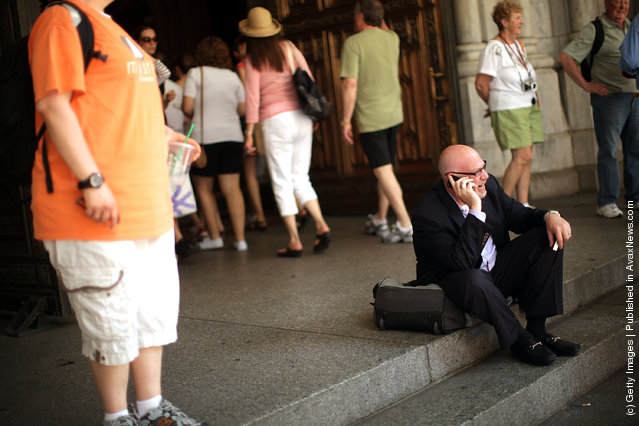
A man speaks on his mobile phone on May 31, 2011 in New York City. In a new report by 31 scientists meeting at the World Health Organization's International Agency for Research on Cancer (WHO/IARC) it was found that using a mobile phone may increase your risk for certain kinds of brain cancers. While further scientific work will be conducted, the group of scientists from 14 countries classified cell phones in the carcinogenic category 2B, which is similar to the pesticide DDT and gasoline engine exhaust. (Photo by Spencer Platt/Getty Images)
Details
01 Jun 2011 06:40:00
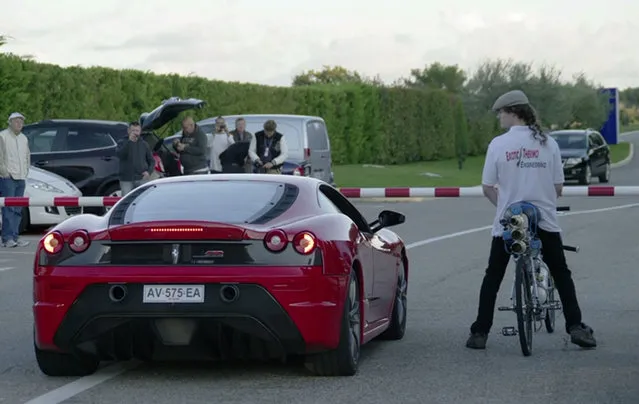
Bike New World Speed Record

Oh, those daredevils! They’re always willing to pull off another incredible stunt to gain fame and glory. Sometimes it’s something incredibly stupid, but sometimes it is simply incredible. The stunt that you can see on this video is of the latter kind. Who would have thought of attaching a jet engine to a bicycle? And who would have dared riding one? Circuit Paul Ricard, that’s who. On November 7 2014 he reached a whooping speed of 333 hm/h (207 mph) on his bicycle. Now that is a tale to tell your grandchildren… if you ever live long enough to see them with a lifestyle such as this.
Details
17 Nov 2014 12:02:00
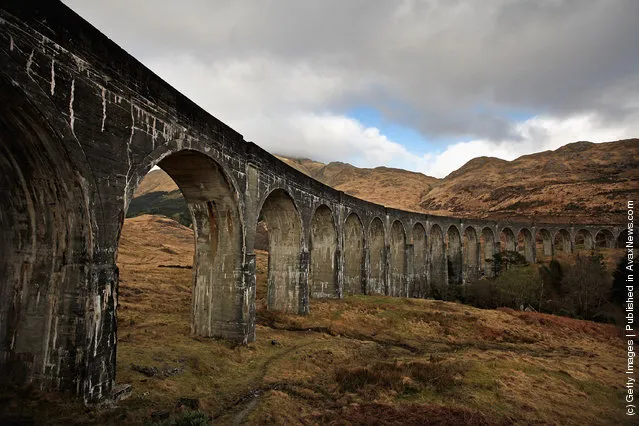
A view of the Glenfinnan Viaduct

“Glenfinnan Viaduct is a railway viaduct on the West Highland Line in Glenfinnan, Lochaber, Highland, Scotland. It was built between 1897 and 1901. Located at the top of Loch Shiel in the West Highlands of Scotland, the viaduct overlooks the Glenfinnan Monument and the waters of Loch Shiel”. – Wikipedia

Photo: A view of the Glenfinnan Viaduct on March 30, 2012 in Glenfinnan, Scotland. Built by Sir Robert McAlpine, the single track viaduct that is made up of 21 arches is considered to have been one of the largest engineering projects of its time. Today, it is still used by ScotRail and was recently used for scenes in three of the Harry Potter films. (Photo by Jeff J. Mitchell/Getty Images)
Details
31 Mar 2012 09:21:00
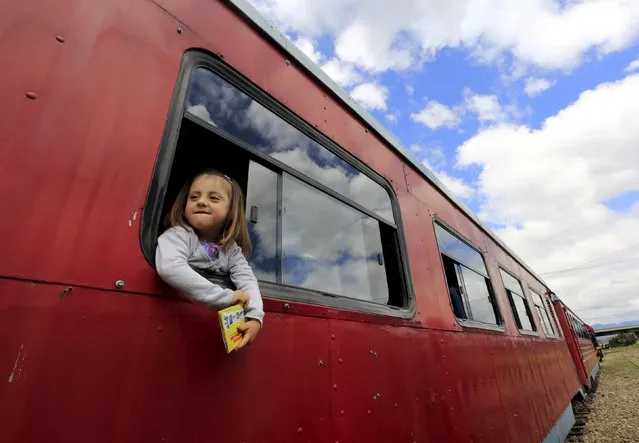
A girl looks out from the window of a “La Sabana” tourist train in La Caro March 1, 2015. (Photo by Jose Miguel Gomez/Reuters)

A girl looks out from the window of a “La Sabana” tourist train in La Caro March 1, 2015. The “La Sabana” tourist train that runs through the capital was founded by Eduardo Rodriguez, a railway engineer. Rodriguez has worked on Colombia's railway system his whole life and now, with an air of nostalgia, transports thousands of tourists in renovated steam locomotives that he fixes in Bogota's Central Station which dates back to 1913. (Photo by Jose Miguel Gomez/Reuters)
Details
23 Apr 2015 11:30:00