Loading...
Done
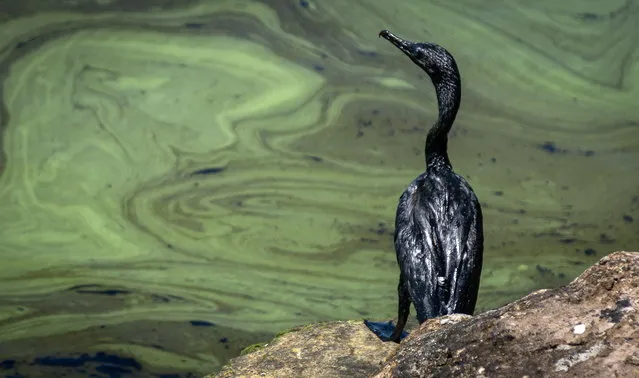
View of an oil-stained bird on the shore of a contaminated lake in Maracaibo, Venezuela on June 22, 2023. The Azul Ambientalistas foundation denounced on 22 June the “state of emergency” in which the Maracaibo Lake, the largest in Venezuela, finds itself, due to oil spills that, it assured, are affecting the lake economy and the health of the people. (Photo by Henry Chirinos/EPA)

View of an oil-stained bird on the shore of a contaminated lake in Maracaibo, Venezuela on June 22, 2023. The Azul Ambientalistas foundation denounced on 22 June the “state of emergency” in which the Maracaibo Lake, the largest in Venezuela, finds itself, due to oil spills that, it assured, are affecting the lake economy and the health of the people. (Photo by Henry Chirinos/EPA)
Details
24 Dec 2023 23:00:00
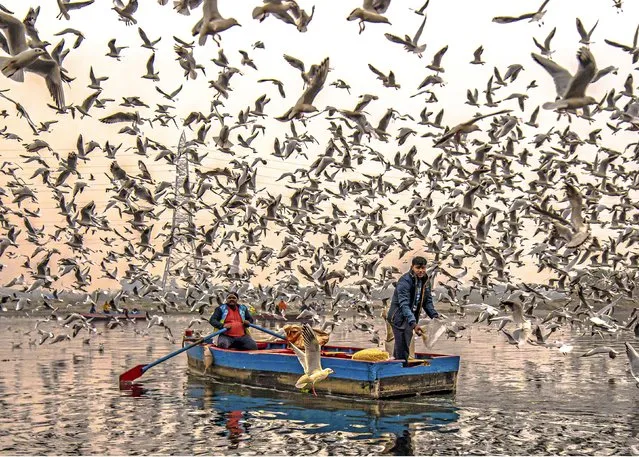
Flocks of seagulls swarm small fishing boats in the first decade of January 2024 like a scene from Alfred Hitchcock’s The Birds. Colonies of Heuglin’s gulls can be seen almost every morning on the Yamuna River in Delhi, India. (Photo by Raghav Rai Ralhan/Solent News)

Flocks of seagulls swarm small fishing boats in the first decade of January 2024 like a scene from Alfred Hitchcock’s The Birds. Colonies of Heuglin’s gulls can be seen almost every morning on the Yamuna River in Delhi, India. (Photo by Raghav Rai Ralhan/Solent News)
Details
20 Jan 2024 09:18:00
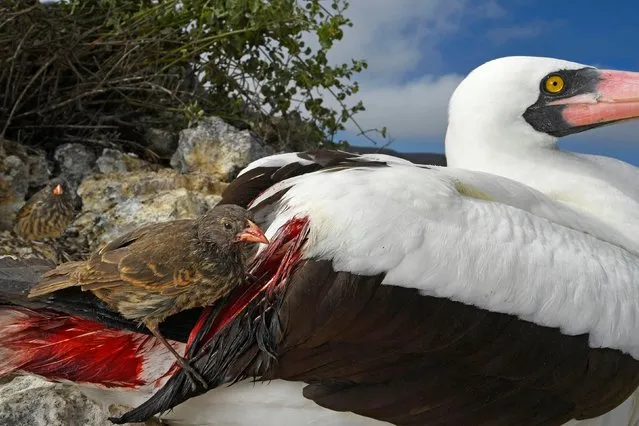
Bloodthirsty by Thomas P Peschak, Germany/South Africa — winner, Behaviour: birds. When rations run short on Wolf Island, in the remote northern Galápagos, the sharp-beaked ground finches become vampires. Their sitting targets are Nazca boobies and other large birds. The finches rely on a scant diet of seeds and insects, which regularly dries up, so they drink blood to survive. ‘I’ve seen more than half a dozen finches drinking from a single Nazca booby,’ says Tom. Rather than leave their nests the boobies tolerate the vampires, and the blood loss doesn’t seem to cause permanent harm. (Photo by Thomas P Peschak/2018 Wildlife Photographer of the Year)

Bloodthirsty by Thomas P. Peschak, Germany/South Africa — winner, Behaviour: birds. When rations run short on Wolf Island, in the remote northern Galápagos, the sharp-beaked ground finches become vampires. Their sitting targets are Nazca boobies and other large birds. The finches rely on a scant diet of seeds and insects, which regularly dries up, so they drink blood to survive. ‘I’ve seen more than half a dozen finches drinking from a single Nazca booby,’ says Tom. Rather than leave their nests the boobies tolerate the vampires, and the blood loss doesn’t seem to cause permanent harm. (Photo by Thomas P. Peschak/2018 Wildlife Photographer of the Year)
Details
19 Oct 2018 00:05:00
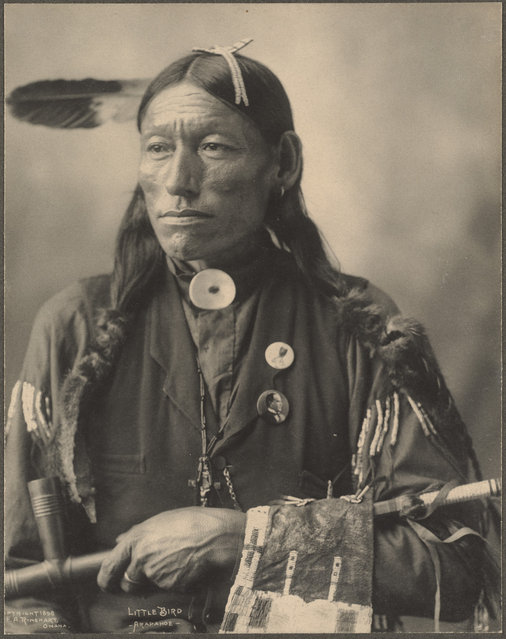
Little Bird, Arapahoe, 1899. (Photo by Frank A. Rinehart)

Frank A. Rinehart, a commercial photographer in Omaha, Nebraska, was commissioned to photograph the 1898 Indian Congress, part of the Trans-Mississippi International Exposition. More than five hundred Native Americans from thirty-five tribes attended the conference, providing the gifted photographer and artist an opportunity to create a stunning visual document of Native American life and culture at the dawn of the 20th century. Photo: Little Bird, Arapahoe, 1899. (Photo by Frank A. Rinehart)
Details
25 Apr 2013 11:30:00
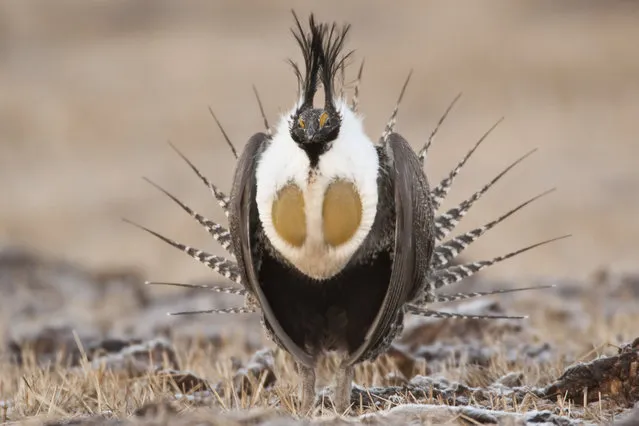
Greater Sage-Grouse

The Greater Sage-Grouse is certainly a formidable-looking bird. Being the largest grouse in North America and having tail feathers, which look like giant spikes, make for a ferocious sight. These birds are well known for their complicated courtship rituals, in which the males perform a special “strutting display” to attract the females. Another distinct feature of the Greater Sage-Grouse is two large yellow throat sacs (gular sacs), which are inflated by the males during the courtship display. Unlike pelicans, whose gular sacs are used to store fish while hunting, the throat sacks of the Greater Sage-Grouse are merely for display.
Details
21 Nov 2014 12:25:00
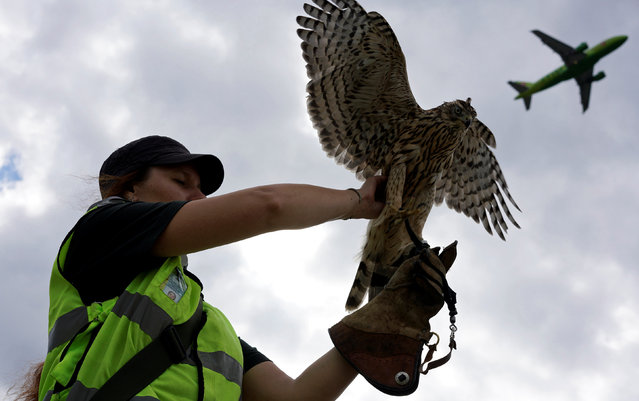
Employee of ornithological flight support service Nika Ryzhova-Alenicheva holds her hawk, which is used to control fauna to avoid bird strikes during takeoffs and landings, at Domodedovo airport outside Moscow, Russia September 2, 2016. (Photo by Maxim Zmeyev/Reuters)

Employee of ornithological flight support service Nika Ryzhova-Alenicheva holds her hawk, which is used to control fauna to avoid bird strikes during takeoffs and landings, at Domodedovo airport outside Moscow, Russia September 2, 2016. (Photo by Maxim Zmeyev/Reuters)
Details
06 Sep 2016 10:41:00
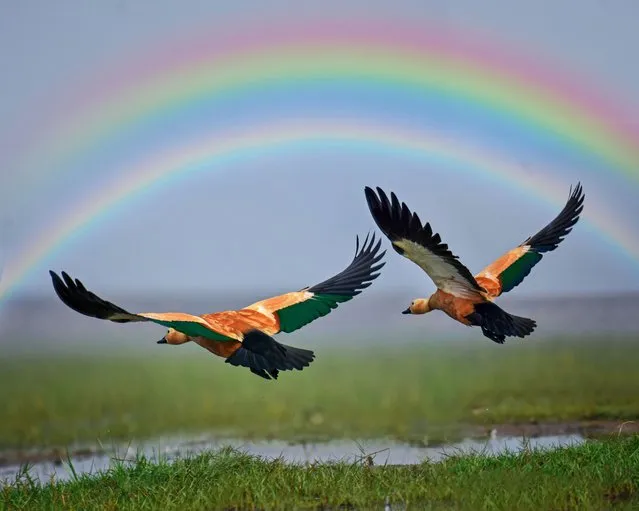
Two ruddy shelducks fly under a double rainbow in Odisha, India in July 2022. These birds are ruddy shelduck, known locally as the Brahminy duck. They have a wingspan of between 43 and 53 inches and stand at a maximum of 28 inches tall. (Photo by Suman Das/Media Drum Images)

Two ruddy shelducks fly under a double rainbow in Odisha, India in July 2022. These birds are ruddy shelduck, known locally as the Brahminy duck. They have a wingspan of between 43 and 53 inches and stand at a maximum of 28 inches tall. (Photo by Suman Das/Media Drum Images)
Details
18 Nov 2022 05:06:00
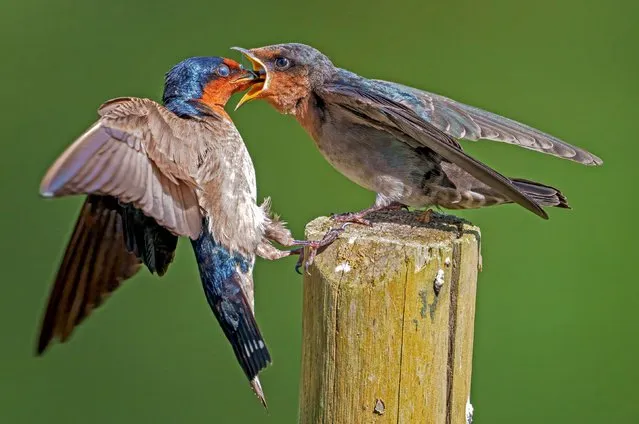
A bird swoops in to deliver its food to its chick, ramming it deep into its mouth while in flight. The photos of the swallows were captured by Kelvin Leong in Hampstead Wetlands Park, Singapore in July 2023. (Photo by Kelvin Leong/Solent News & Photo Agency)

A bird swoops in to deliver its food to its chick, ramming it deep into its mouth while in flight. The photos of the swallows were captured by Kelvin Leong in Hampstead Wetlands Park, Singapore in July 2023. (Photo by Kelvin Leong/Solent News & Photo Agency)
Details
20 Aug 2023 03:27:00