Loading...
Done
A crowd of people gathered at the seaside of Udaipur, Digha, India before a cloud burst of rain on May 21, 2022. India Meteorological Department (IMD) has predicted that the Monsoon rain will likely arrive a week early this year due to twin cyclones, Asani and Karim. (Photo by Avishek Das/SOPA Images/LightRocket via Getty Images)

A crowd of people gathered at the seaside of Udaipur, Digha, India before a cloud burst of rain on May 21, 2022. India Meteorological Department (IMD) has predicted that the Monsoon rain will likely arrive a week early this year due to twin cyclones, Asani and Karim. (Photo by Avishek Das/SOPA Images/LightRocket via Getty Images)
Details
23 Aug 2022 04:43:00
In the early morning of September 22, 2021, in the Baiyun Mountain Forest Park, Wuzhou City, Guangxi, the surrounding mountains are unobstructed, clouds and mists are lingering, and the gorgeous colorful glow is reflected by the sunrise. (Photo by Sipa Asia/Rex Features/Shutterstock)

In the early morning of September 22, 2021, in the Baiyun Mountain Forest Park, Wuzhou City, Guangxi, the surrounding mountains are unobstructed, clouds and mists are lingering, and the gorgeous colorful glow is reflected by the sunrise. (Photo by Sipa Asia/Rex Features/Shutterstock)
Details
29 Oct 2021 08:48:00
A boy kicks a football in Dudley Page Reserve as storm clouds gather over the city skyline on September 30, 2021 in Sydney, Australia. The Bureau of Meteorology has issued severe storm warnings for the city. (Photo by Mark Evans/Getty Images)

A boy kicks a football in Dudley Page Reserve as storm clouds gather over the city skyline on September 30, 2021 in Sydney, Australia. The Bureau of Meteorology has issued severe storm warnings for the city. (Photo by Mark Evans/Getty Images)
Details
02 Nov 2021 08:20:00
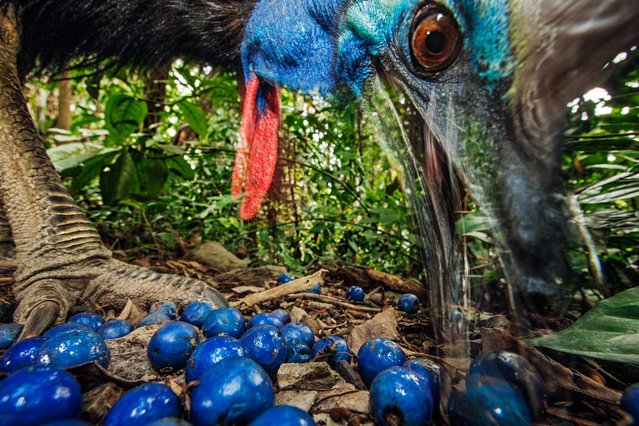
“Cassowaries are large, flightless birds related to emus and (more distantly) to ostriches, rheas, and kiwis”, writes Olivia Judson in the September issue of National Geographic magazine. (Photo by Christian Ziegler/National Geographic)

“Cassowaries are large, flightless birds related to emus and (more distantly) to ostriches, rheas, and kiwis”, writes Olivia Judson in the September issue of National Geographic magazine. How large? People-size: Adult males stand well over five foot five and top 110 pounds. Females are even taller, and can weigh more than 160 pounds. Dangerous when roused, they’re shy and peaceable when left alone. But even birds this big and tough are prey to habitat loss. The dense New Guinea and Australia rain forests where they live have dwindled. Today cassowaries might number 1,500 to 2,000. And because they help shape those same forests – by moving seeds from one place to another – “if they vanish”, Judson writes, “the structure of the forest would gradually change” too. (Photo by Christian Ziegler/National Geographic)
Details
06 Jan 2014 12:21:00
Cambodian Trees By Clement Briend

Back in September, French photographer Clement Briend projected giant gargoyle heads on to trees at Parc de Saint-Cloud near Paris. The installation was part of European Heritage Days 2012.
Details
16 Jan 2013 13:13:00
An incredible view of Thunderstorms light up the insides of clouds near a beautiful sky line. This is truly heavenly weather as pictures taken from an airplane cockpit reveal what pilots see from above. It looks like at cruising altitude the weather really hots up, with the flight deck revealing some amazing scenes. Thunderstorms light up the insides of clouds, lightening streaks across the sky like cracks in a windscreen, the northern lights sweep uninterrupted across the sky and the galaxy stretches on forever. The pictures were captured by senior first officer Christiaan van Heijst, a 33-year-old from the Netherlands, and his friend Daan Krans. (Photo by Christiaan van Heijst/Daan Krans/Caters News Agency)

An incredible view of Thunderstorms light up the insides of clouds near a beautiful sky line. This is truly heavenly weather as pictures taken from an airplane cockpit reveal what pilots see from above. It looks like at cruising altitude the weather really hots up, with the flight deck revealing some amazing scenes. Thunderstorms light up the insides of clouds, lightening streaks across the sky like cracks in a windscreen, the northern lights sweep uninterrupted across the sky and the galaxy stretches on forever. The pictures were captured by senior first officer Christiaan van Heijst, a 33-year-old from the Netherlands, and his friend Daan Krans. (Photo by Christiaan van Heijst/Daan Krans/Caters News Agency)
Details
22 Sep 2016 09:45:00
Baby Francois' Langur

“Francois' langur is one of several species of leaf monkeys. Over 50% of its diet is made up of young leaves. It will also consume fruits (17.2%), seeds, flowers, stems, roots, bark and occasionally minerals and insects off of rock surfaces and cliffs. This langur consumes its favorite food, young leaves, at the highest rate during the dry season, April through September, also known as the young leaf-lean period”. – Wikipedia

Photo: An endangered baby Francois' Langur monkey called Laa Laa settles in following her July 6 birth at London Zoo, Regent's Park on August 5, 2004 in London. The bright ginger youngster was born to glossy black parents Max and Shaneka and has the typical orange baby coat which is in stark contrast against the black of her parent's and older brother Grub's fur. (Photo by Steve Finn/Getty Images)

Details
22 Sep 2011 11:28:00
Merit: A Night at Deadvlei. The night before returning to Windhoek, we spent several hours at Deadveli. The moon was bright enough to illuminate the sand dunes in the distance, but the skies were still dark enough to clearly see the milky way and magellanic clouds. Deadveli means “dead marsh. (Photo and caption by Beth McCarley/National Geographic Traveler Photo Contest)

Merit: A Night at Deadvlei. The night before returning to Windhoek, we spent several hours at Deadveli. The moon was bright enough to illuminate the sand dunes in the distance, but the skies were still dark enough to clearly see the milky way and magellanic clouds. Deadveli means “dead marsh. The camelthorn trees are believed to be about 900 years old, but have not decomposed because the environment is so dry. (Photo and caption by Beth McCarley/National Geographic Traveler Photo Contest)
Details
04 Aug 2015 11:50:00