Loading...
Done
People dodge waves in Sansha Township of Xiapu, southeast China's Fujian Province, July 10, 2015. China is on highest alert as super typhoon Chan-Hom approaches the eastern coast at high speeds. The National Meteorological Center issued a red alert on Friday morning for Chan-Hom, whose center was spotted 550 km southeast off the coast of Zhejiang Province at 5 a.m. (Photo by Jiang Kehong/Xinhua)

People dodge waves in Sansha Township of Xiapu, southeast China's Fujian Province, July 10, 2015. China is on highest alert as super typhoon Chan-Hom approaches the eastern coast at high speeds. The National Meteorological Center issued a red alert on Friday morning for Chan-Hom, whose center was spotted 550 km southeast off the coast of Zhejiang Province at 5 a.m. (Photo by Jiang Kehong/Xinhua)
Details
11 Jul 2015 14:01:00


A devotee of the Chinese shrine of Samkong, pierces his cheeks with toy guns during a procession of Vegetarian Festival on October 11, 2010 in Phuket, Thailand. Ritual Vegetarianism in Phuket Island traces it roots back to the early 1800's. The festival begins on the first evening of the ninth lunar month and lasts for nine days. Participants in the festival perform acts of body piercing as a means of shifting evil spirits from individuals onto themselves and bring the community good luck. (Photo by Athit Perawongmetha/Getty Images)
Details
09 Jul 2011 11:55:00
An old locomotive train that was used for transporting coal is preserved as a monument at Ny-Alesund, in Svalbard, Norway, October 11, 2015. (Photo by Anna Filipova/Reuters)

An old locomotive train that was used for transporting coal is preserved as a monument at Ny-Alesund, in Svalbard, Norway, October 11, 2015. A Norwegian chain of islands just 1,200 km (750 miles) from the North Pole is trying to promote new technologies, tourism and scientific research in a shift from high-polluting coal mining that has been a backbone of the remote economy for decades. (Photo by Anna Filipova/Reuters)
Details
29 Jan 2016 13:19:00
Blooms

At first glance, these incredible images look like still-life portraits of flowers. But far from being drawn in the traditional way, they are created by photographing fast-moving droplets of paint as they fall through the air. Artist Jack Long, 53, spends months painstakingly planning and testing each work before capturing them with a high-speed camera.
Details
13 Jul 2012 11:17:00


The Intel logo is projected on the face of Intel Executive Vice President Dadi Perlmutter as he speaks during a news conference about the 3-D Tri-Gate transistors called “Ivy Bridge” on May 4, 2011 in San Francisco, California. Intel announced a technical breakthrough in the microprocessors with the world's first Tri-Gate transistors, that will increase speed and consume less energy. (Photo by Justin Sullivan/Getty Images)
Details
05 May 2011 07:25:00


PALEMBANG, SUMATRA, INDONESIA - NOVEMBER 14: Fitriyani Fitriyani (L) of Indonesia and Janice Ng (R) of Singapore compete in the Sport Climbing Womens Speed Track Finals on day four of the 2011 Southeast Asian Games at Jakabaring Sports Complex on November 14, 2011 in Palembang, Sumatra, Indonesia. (Photo by Matt King/Getty Images)
Details
21 Nov 2011 12:51:00
The world's first 3D printed car – the Stratti – was built in just 45 hours at the International Manufacturing Technology Show which took place between September 8 – 13, 2014. The Strati, which is Italian for layers, has a chassis body made of one solid piece and has a top speed of 40mph. (Photo by Barcroft Media/ABACAPress)

The world's first 3D printed car – the Stratti – was built in just 45 hours at the International Manufacturing Technology Show which took place between September 8 – 13, 2014. The Strati, which is Italian for layers, has a chassis body made of one solid piece and has a top speed of 40mph. The tyres, seats, wheels, battery, wiring, suspension, electric motor and window shield of the revolutionary vehicle were made using conventional methods. (Photo by Barcroft Media/ABACAPress)
Details
24 Oct 2014 12:44:00
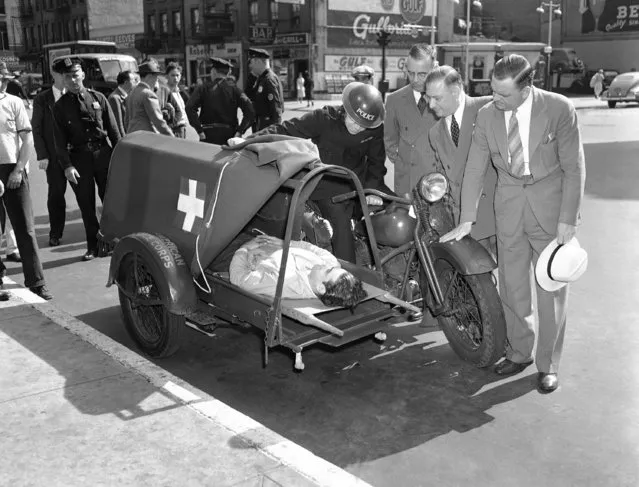
Developed for the British American Ambulance Corps, this new motorcycle ambulance is capable of speeding wounded soldiers 90 miles an hour from the front lines to field hospitals. Its springs are synchronized with the patient?s heartbeat to avoid increasing fever when traveling over various Terrain. Viewing it in New York  August 27, 1941, are left to right: constable Herbert Scott of England, driver; William E. Detlor, whose firm developed the vehicle; M. W. Stand, inspector-general of Civilian Defense, and Maj. Edward Riekert, also. (Photo by AP Photo)

Developed for the British American Ambulance Corps, this new motorcycle ambulance is capable of speeding wounded soldiers 90 miles an hour from the front lines to field hospitals. Its springs are synchronized with the patient's heartbeat to avoid increasing fever when traveling over various Terrain. Viewing it in New York August 27, 1941, are left to right: constable Herbert Scott of England, driver; William E. Detlor, whose firm developed the vehicle; M. W. Stand, inspector-general of Civilian Defense, and Maj. Edward Riekert, also. (Photo by AP Photo)
Details
28 Aug 2015 11:51:00