Loading...
Done
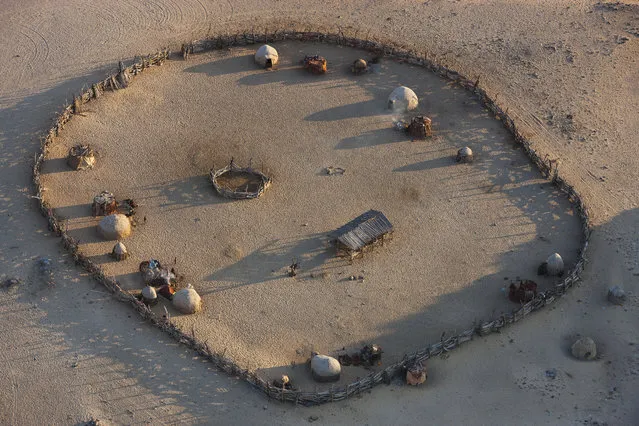
An aerial view of a livestock enclosure of the Himba people, in October, 2014, in the Namib Desert, Namibia. (Photo by Theo Allofs/Barcroft Media)

An aerial view of a livestock enclosure of the Himba people, in October, 2014, in the Namib Desert, Namibia. A photographer has captured a bird's eye view of the stunning Namib Desert from a paraglider. Theo Allofs travels the world taking stunning pictures of untouched landscapes from a unique perspective. Soaring 300 metres above ground, Theo shot the yellow sand dunes, dry red river beds and remote townships in Namibia. (Photo by Theo Allofs/Barcroft Media)
Details
24 Apr 2015 11:06:00

Tracy Sarita celebrates the sunrise during the Burning Man 2015 “Carnival of Mirrors” arts and music festival in the Black Rock Desert of Nevada, September 3, 2015. (Photo by Jim Urquhart/Reuters)

Tracy Sarita celebrates the sunrise during the Burning Man 2015 “Carnival of Mirrors” arts and music festival in the Black Rock Desert of Nevada, September 3, 2015. Approximately 70,000 people from all over the world are gathering at the sold-out festival to spend a week in the remote desert to experience art, music and the unique community that develops. (Photo by Jim Urquhart/Reuters)
Details
05 Sep 2015 12:13:00
From Britain to China to Mali, new maps showing travel times to the nearest urban centre reveal huge differences between countries. Using Open Street Map and Google, a University of Oxford team have created a visual breakdown that suggests major inequalities when it comes to commuting. Here: China. The dataset used for China was unique as it relied solely on Open Street Map, due to restrictions on accessing Google data. The population is densely concentrated in the east and accessibility is increased, whereas rural provinces in the west remain remote. (Photo by Daniel Weiss/Jennifer Rozier/Malaria Atlas Project/University of Oxford )

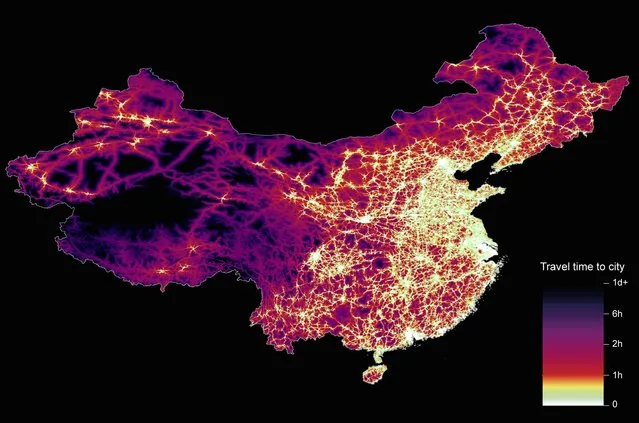
From Britain to China to Mali, new maps showing travel times to the nearest urban centre reveal huge differences between countries. Using Open Street Map and Google, a University of Oxford team have created a visual breakdown that suggests major inequalities when it comes to commuting. Here: China. The dataset used for China was unique as it relied solely on Open Street Map, due to restrictions on accessing Google data. The population is densely concentrated in the east and accessibility is increased, whereas rural provinces in the west remain remote. (Photo by Daniel Weiss/Jennifer Rozier/Malaria Atlas Project/University of Oxford)
Details
12 Jan 2018 06:43:00
In this March 13, 2015 photo,  Yohan, 4, from left, Cristian, 7, and Angelo, 6, playfully toss coca leaves into the air, singing: “I have a lot of money, look at all the money I have”, in La Mar, province of Ayacucho, Peru. Hauling cocaine out of the remote valley is about the only way to earn decent cash in this region where a farmhand earns less than $10 a day. Beyond extinguishing young lives, the practice has packed Peru's highland prisons with cocaine backpackers while their bosses evade incarceration. (Photo by Rodrigo Abd/AP Photo)

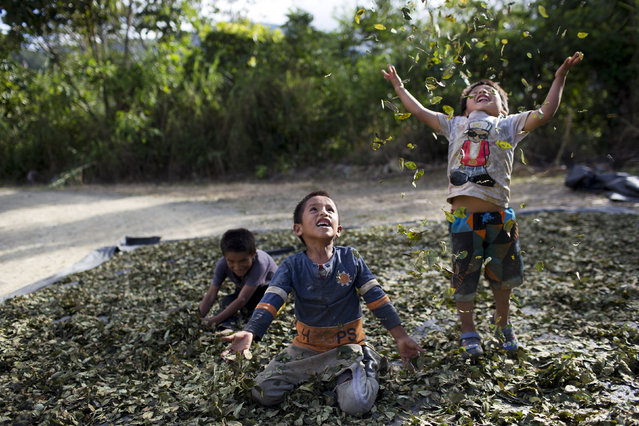
In this March 13, 2015 photo, Yohan, 4, from left, Cristian, 7, and Angelo, 6, playfully toss coca leaves into the air, singing: “I have a lot of money, look at all the money I have”, in La Mar, province of Ayacucho, Peru. Hauling cocaine out of the remote valley is about the only way to earn decent cash in this region where a farmhand earns less than $10 a day. Beyond extinguishing young lives, the practice has packed Peru's highland prisons with cocaine backpackers while their bosses evade incarceration. (Photo by Rodrigo Abd/AP Photo)
Details
12 May 2015 12:40:00
Looking for love by Tony Wu, USA. Highly commended, Animal Portraits. “Accentuating his mature appearance with pastel colours, protruding lips and an outstanding pink forehead, this Asian sheepshead wrasse sets out to impress females and see off rivals, which he will head-butt and bite, near Japan’s remote Sado Island. Individuals start out as females, and when they reach a certain age and size – up to a metre (more than 3 feet) long – can transform into males. Long-lived and slow-growing, the species is intrinsically vulnerable to overfishing”. (Photo by Tony Wu/2018 Wildlife Photographer of the Year)

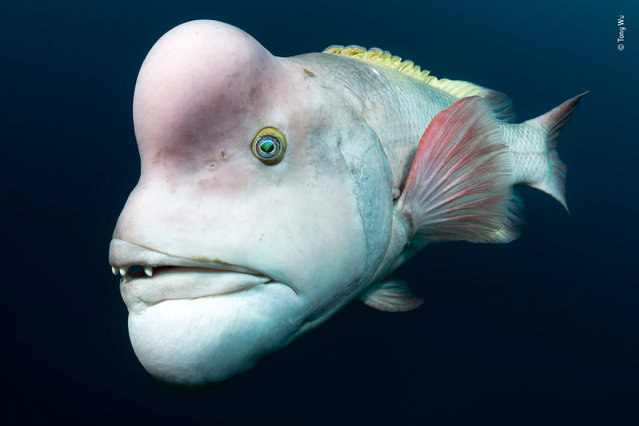
Looking for love by Tony Wu, USA. Highly commended, Animal Portraits. “Accentuating his mature appearance with pastel colours, protruding lips and an outstanding pink forehead, this Asian sheepshead wrasse sets out to impress females and see off rivals, which he will head-butt and bite, near Japan’s remote Sado Island. Individuals start out as females, and when they reach a certain age and size – up to a metre (more than 3 feet) long – can transform into males. Long-lived and slow-growing, the species is intrinsically vulnerable to overfishing”. (Photo by Tony Wu/2018 Wildlife Photographer of the Year)
Details
03 Sep 2018 08:17:00
Bloodthirsty by Thomas P Peschak, Germany/South Africa — winner, Behaviour: birds. When rations run short on Wolf Island, in the remote northern Galápagos, the sharp-beaked ground finches become vampires. Their sitting targets are Nazca boobies and other large birds. The finches rely on a scant diet of seeds and insects, which regularly dries up, so they drink blood to survive. ‘I’ve seen more than half a dozen finches drinking from a single Nazca booby,’ says Tom. Rather than leave their nests the boobies tolerate the vampires, and the blood loss doesn’t seem to cause permanent harm. (Photo by Thomas P Peschak/2018 Wildlife Photographer of the Year)

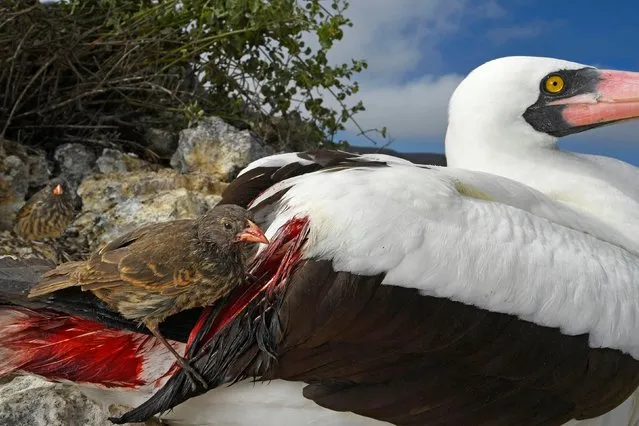
Bloodthirsty by Thomas P. Peschak, Germany/South Africa — winner, Behaviour: birds. When rations run short on Wolf Island, in the remote northern Galápagos, the sharp-beaked ground finches become vampires. Their sitting targets are Nazca boobies and other large birds. The finches rely on a scant diet of seeds and insects, which regularly dries up, so they drink blood to survive. ‘I’ve seen more than half a dozen finches drinking from a single Nazca booby,’ says Tom. Rather than leave their nests the boobies tolerate the vampires, and the blood loss doesn’t seem to cause permanent harm. (Photo by Thomas P. Peschak/2018 Wildlife Photographer of the Year)
Details
19 Oct 2018 00:05:00
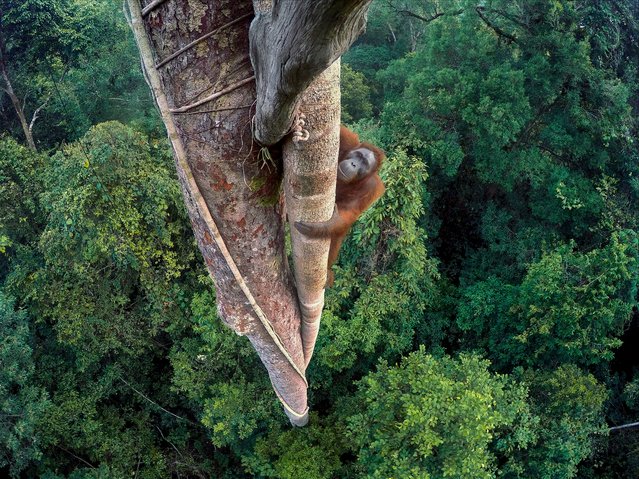
“Entwined Lives”. Tim Laman, US Winner, Wildlife photographer of the year. A young male orangutan makes the 30-metre climb up the thickest root of the strangler fig high above the canopy in Gunung Palung national park, one of the few protected orangutan strongholds in Indonesian Borneo. Laman had to do three days of climbing to position several GoPro cameras that he could trigger remotely. This shot was the one he had long visualised, looking down on the orangutan within its forest home. (Photo by Tim Laman/2016 Wildlife Photographer of the Year)

“Entwined Lives”. Tim Laman, US Winner, Wildlife photographer of the year. A young male orangutan makes the 30-metre climb up the thickest root of the strangler fig high above the canopy in Gunung Palung national park, one of the few protected orangutan strongholds in Indonesian Borneo. Laman had to do three days of climbing to position several GoPro cameras that he could trigger remotely. This shot was the one he had long visualised, looking down on the orangutan within its forest home. (Photo by Tim Laman/2016 Wildlife Photographer of the Year)
Details
19 Oct 2016 12:08:00
A performer wearing a lion mask performs the Ise Daikagura lion dance at the remote village of Yamanawa on February 08, 2021 in Ryuo, Japan. Ise Daikagura is a group of traditional Lion Dance performers who pray in front of farmers houses and businesses for good grain harvests and disease-free lives. Performers play sacred music using drums and flutes with two lion mask dancers. A lion mask is considered a symbol of God, who enters the house and performs in front of the Shinto God, a statue placed inside the house, mostly in the kitchen. These prayers are called “Kamodo Barai”. After the prayers, they are gifted with money, rice, sake and Japanese sweets from the householders. A group can travel for more than one hundred days to thousands of households and businesses throughout rural-villages in western Japan, and pray to those who are unable to visit the country’s most sacred shrine, the Grand Ise Shrine in Mie Prefecture. The group started its performance in the Edo era between 1603 to 1868 according to Japanese history. The Japanese government designated it as an important folk cultural national property in 1981. (Photo by Buddhika Weerasinghe/Getty Images)

A performer wearing a lion mask performs the Ise Daikagura lion dance at the remote village of Yamanawa on February 08, 2021 in Ryuo, Japan. Ise Daikagura is a group of traditional Lion Dance performers who pray in front of farmers houses and businesses for good grain harvests and disease-free lives. (Photo by Buddhika Weerasinghe/Getty Images)
Details
18 Feb 2021 09:27:00