Loading...
Done
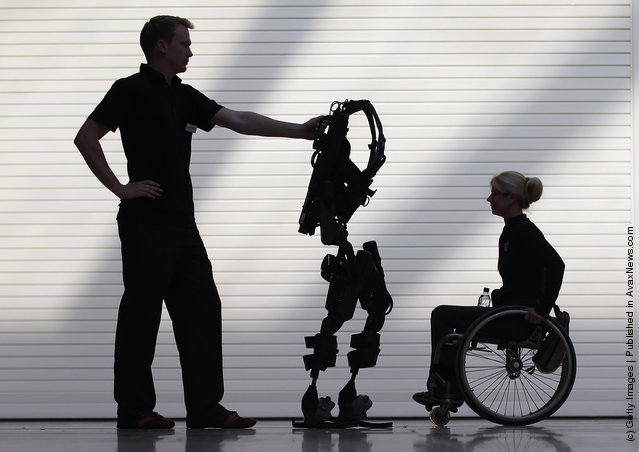
Bionic Exoskeleton

Engineer Thomas Dwyer stands with the new Bionic Exoskeleton next to Amanda Boxtel during its launch at the Excel centre on October 21, 2011 in London, England. The bionic device developed by Ekso Bionics is a wearable, battery-powered, robotic exoskeleton, designed to aid wheelchair users and those who have suffered from spinal chord injuries to stand and walk. (Photo by Dan Kitwood/Getty Images)
Details
22 Oct 2011 10:41:00


A genetically engineered featherless rooster struts around the campus of the Hebrew University of Jerusalem's Department of Agriculture May 22, 2002 in Rehovot, Israeli. After two years of research, departmental scientists announced the naked chicken, as it has been dubbed, as a low calorie bird because the lack of feathers means the chicken has less fat. It also matures earlier than its feathered counterparts. (Photo by Moshe Milner/GPO/Getty Images)
Details
29 Mar 2011 14:15:00
Russian cosmonaut Alexander Skvortsov, Expedition 40 flight engineer, attired in a Russian Orlan spacesuit, participates in a session of extravehicular activity (EVA) in support of science and maintenance on the International Space Station on August 18, 2014. During the five-hour, 11-minute spacewalk, Skvortsov and cosmonaut Oleg Artemyev (out of frame) deployed a small science satellite, retrieved and installed experiment packages and inspected components on the exterior of the orbital laboratory. (Photo by NASA)

Russian cosmonaut Alexander Skvortsov, Expedition 40 flight engineer, attired in a Russian Orlan spacesuit, participates in a session of extravehicular activity (EVA) in support of science and maintenance on the International Space Station on August 18, 2014. During the five-hour, 11-minute spacewalk, Skvortsov and cosmonaut Oleg Artemyev (out of frame) deployed a small science satellite, retrieved and installed experiment packages and inspected components on the exterior of the orbital laboratory. (Photo by NASA)
Details
13 Apr 2022 06:53:00
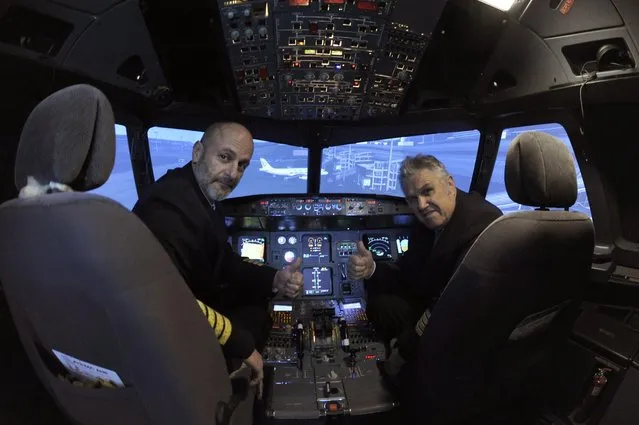
Igor Perne (L), 53, an electronic engineer and a member of the International Virtual Aviation Organisation (IVAO), and fellow virtual pilot Franc Lavric gesture for the camera before taking off on a virtual flight in a flight simulator in Nova Vas, Slovenia November 13, 2014. In 2011, Perne, a lifelong flying enthusiast, bought parts of a written-off Cyprus Airways airliner and then spent two and a half years turning the entire nose of the scrapped aircraft into an elaborate flight simulator. (Photo by Srdjan Zivulovic/Reuters)

Igor Perne (L), 53, an electronic engineer and a member of the International Virtual Aviation Organisation (IVAO), and fellow virtual pilot Franc Lavric gesture for the camera before taking off on a virtual flight in a flight simulator in Nova Vas, Slovenia November 13, 2014. In 2011, Perne, a lifelong flying enthusiast, bought parts of a written-off Cyprus Airways airliner and then spent two and a half years turning the entire nose of the scrapped aircraft into an elaborate flight simulator. (Photo by Srdjan Zivulovic/Reuters)
Details
16 Nov 2014 12:07:00
Zhang Jinduo's wife tries on a self-made racing car on the outskirts of Shenyang, Liaoning province May 10, 2008. Zhang, the 53-year-old local farmer made the racing car with the help of his son who is a car mechanic. The car is equipped with a rear-mounted motorcycle engine and can achieve 60-80 km per hour, according to local media. (Photo by Reuters/Stringer)

Zhang Jinduo's wife tries on a self-made racing car on the outskirts of Shenyang, Liaoning province May 10, 2008. Zhang, the 53-year-old local farmer made the racing car with the help of his son who is a car mechanic. The car is equipped with a rear-mounted motorcycle engine and can achieve 60-80 km per hour, according to local media. (Photo by Reuters/Stringer)
Details
17 Sep 2013 08:46:00
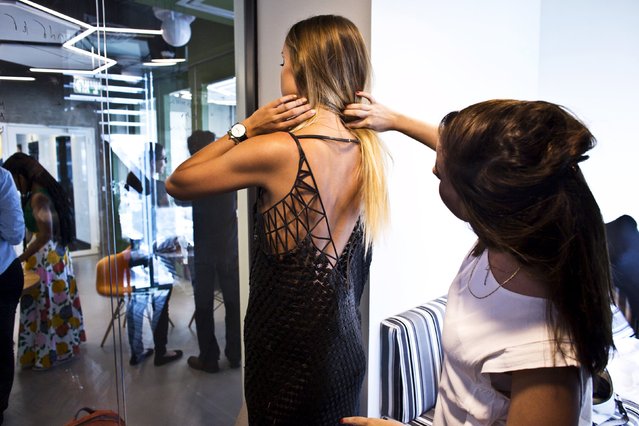
Israeli fashion design student from the Shenkar College of Engineering and Design Danit Peleg (R) assists a fashion blogger to wear an outfit from her graduate collection during a conference on 3-D printing in Tel Aviv, Israel September 3, 2015. (Photo by Nir Elias/Reuters)

Israeli fashion design student from the Shenkar College of Engineering and Design Danit Peleg (R) assists a fashion blogger to wear an outfit from her graduate collection during a conference on 3-D printing in Tel Aviv, Israel September 3, 2015. Peleg, 27, says she spent over 2000 hours to create her graduate collection which is made solely from home 3-D printers. International fashion bloggers, taking part in a project supported by “Stand With Us Israel fellowship”, a non-profit organisation, attended the conference and tried on Peleg's clothing before listening to her talk about her collection. (Photo by Nir Elias/Reuters)
Details
05 Sep 2015 12:08:00
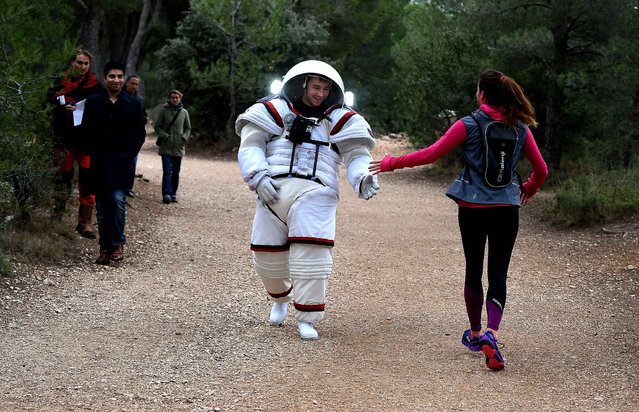
Aeronautics and Space engineer at France's Compagnie Maritime d'Expertises, or Comex, Arnaud Prost (C) meets with a jogger as he tests on the ground the “Gandolfi 2” underwater training suit for spacewalk, on January 20, 2016 in the calanques region (rocky inlets) of Marseille. The underwater training suit “Gandolfi 2”, developed with the European Space Agency (ESA), is designed for training astronauts underwater to simulate space gravity for the astronaut's extravehicular activities (EVAs). (Photo by Boris Horvat/AFP Photo)

Aeronautics and Space engineer at France's Compagnie Maritime d'Expertises, or Comex, Arnaud Prost (C) meets with a jogger as he tests on the ground the “Gandolfi 2” underwater training suit for spacewalk, on January 20, 2016 in the calanques region (rocky inlets) of Marseille. The underwater training suit “Gandolfi 2”, developed with the European Space Agency (ESA), is designed for training astronauts underwater to simulate space gravity for the astronaut's extravehicular activities (EVAs). (Photo by Boris Horvat/AFP Photo)
Details
23 Jan 2016 13:41:00
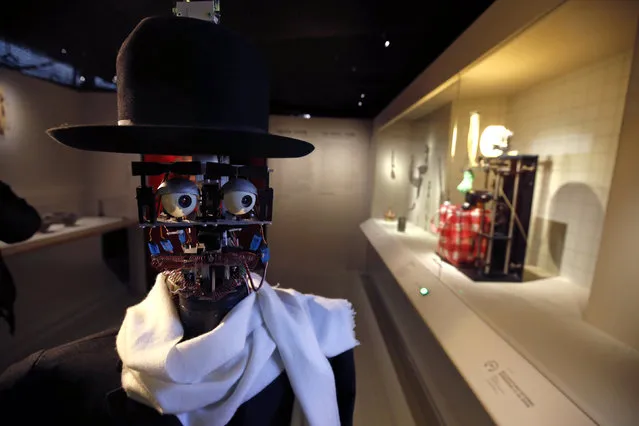
The Berenson robot strolls among visitors during the exhibition “Persona : Oddly Human” at the Quai Branly museum in Paris, France, February 23, 2016. The Berenson robot, developed in France in 2011, is the brainchild of anthropologist Denis Vidal and robotics engineer Philippe Gaussier. Its programming allows it to record reactions of museum visitors to certain pieces of art and then use the data to develop its own unique taste, which allows “Berenson” to judge whether or not it likes a certain work of art within an exhibition. (Photo by Philippe Wojazer/Reuters)

The Berenson robot strolls among visitors during the exhibition “Persona : Oddly Human” at the Quai Branly museum in Paris, France, February 23, 2016. The Berenson robot, developed in France in 2011, is the brainchild of anthropologist Denis Vidal and robotics engineer Philippe Gaussier. Its programming allows it to record reactions of museum visitors to certain pieces of art and then use the data to develop its own unique taste, which allows “Berenson” to judge whether or not it likes a certain work of art within an exhibition. (Photo by Philippe Wojazer/Reuters)
Details
25 Feb 2016 12:26:00