Loading...
Done
Artist Mr Brainwash stands with his paintings 'The Queen' (R) and 'Kate Moss' at the Opera Gallery

“Mr. Brainwash (“MBW”) is a pseudonym for Thierry Guetta. According to the Banksy directed film Exit Through the Gift Shop, Guetta is a French citizen who now lives in Los Angeles, having been a proprietor of a clothing store and videographer who evolved into a street artist and gallery artist, influenced by the street artists he documented through video over the years. According to the film, Guetta was first introduced to street art by his cousin, the French street artist, Invader”. – Wikipedia

Photo: Artist Mr. Brainwash stands with his paintings “The Queen” (R) and “Kate Moss” at the Opera Gallery on October 3, 2011 in London, England. Works by pop artist and film maker Thierry Guetta, known as Mr. Brainwash, are on display at the gallery from October 6th to 31st, 2011. (Photo by Peter Macdiarmid/Getty Images)
Details
04 Oct 2011 10:57:00
The maid-themed cafe in Hangzhou, China on September 29, 2016. (Photo by AsiaWire)

The maid-themed cafe in Hangzhou, China on September 29, 2016. A cafe has been bringing in droves of new customers after hiring young women to dress up in Frech maid costumes while serving diners. Curious coffee- and coffee-lovers are coming from all corners of Hangzhou, capital of East China's Zhejiang Province, to get a taste of the “maid cafe” experience. The business is said to have been opened by a man surnamed Yu and his friends, all whom are natives or graduates of the city. The all-female staff who donned the black and white French maid outfits are also students currenting living or studying in Hangzhou, allowing them to marry their passion for serving with the part-time job. (Photo by AsiaWire)
Details
30 Sep 2016 09:14:00
A clown plays the violin during the XXI Convention of Clowns, at the Jimenez Rueda Theatre, in Mexico City, Mexico, October 19, 2016. (Photo by Carlos Jasso/Reuters)

A clown plays the violin during the XXI Convention of Clowns, at the Jimenez Rueda Theatre, in Mexico City, Mexico, October 19, 2016. In the wake of the creepy clown sightings in several states of North and South Americas and Europe that caused widespread panic, professional clowns from across Latin America came together at an annual convention in Mexico to give a serious message: “We are clowns, not killers!”. Around 200 clowns took part in the 21st International Clown Convention, dressed in bright coloured clothes and makeup, and chanted the word as they clicked group pictures to counter the “creepy clown” craze. (Photo by Carlos Jasso/Reuters)
Details
20 Oct 2016 10:58:00
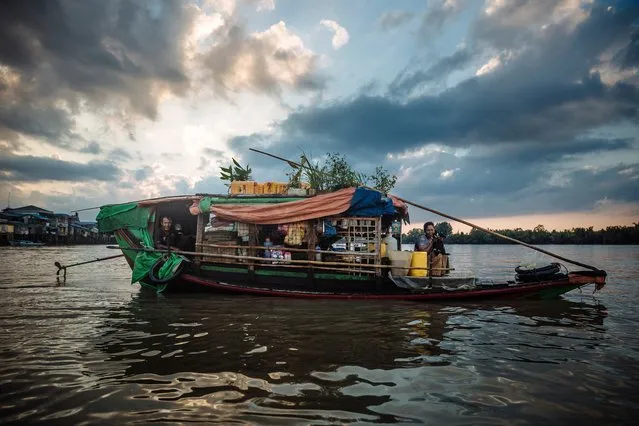
Tin and Naing win live on a small boat which they sail throughout the Delta region in Myanmar. The former gardeners once had a home on land but it was destroyed when a powerful cyclone ravaged the area in 2008. Since then, the couple have not been able to afford to rebuild their home, so they live on the boat from which they sell fish paste to make a living. (Photo by Muse Mohammed/IOM)

The ferocity of crises worldwide is forcing a record number of people to flee their homes, seeking some form of safety within their own country or across international borders. There are 65.3 million displaced people worldwide, including 21.3 million refugees. Most have lost their homes to armed conflict or natural disasters but other factors, such as extreme poverty and climate change, also drive displacement. The International Organisation for Migration commissioned photojournalist Muse Mohammed to document the plight of the displaced. (Photo by Muse Mohammed/IOM)
Details
02 Jan 2017 12:04:00
An African migrant stranded in Costa Rica bathes at a makeshift camp at the border between Costa Rica and Nicaragua, in Penas Blancas, Costa Rica, July 14, 2016. (Photo by Juan Carlos Ulate/Reuters)

An African migrant stranded in Costa Rica bathes at a makeshift camp at the border between Costa Rica and Nicaragua, in Penas Blancas, Costa Rica, July 14, 2016. Thousands of African migrants are currently stranded in Costa Rica after they were denied entry into neighbouring Nicaragua, which they have been using as a crossing point in order to reach the United States. According to the Costa Rican Red Cross, most of these people from Africa, Asia and Haiti. It has been reported that many of them paid smugglers to reach Central America. However, when they arrived at the border gates, they were denied entry and were left with nowhere to go. (Photo by Juan Carlos Ulate/Reuters)
Details
16 Jul 2016 08:17:00
People help a dancer as he falls on stilts in honor of Saint Mary Magdalene in a street for the traditional “Danza de Los Zancos” (Los Zancos Dance), in the small town of Anguiano, northern Spain, Saturday, July 23, 2016. (Photo by Alvaro Barrientos/AP Photo)

People help a dancer as he falls on stilts in honor of Saint Mary Magdalene in a street for the traditional “Danza de Los Zancos” (Los Zancos Dance), in the small town of Anguiano, northern Spain, Saturday, July 23, 2016. As an ancient tradition for more than 4th centuries, eight young people from the town balance on stilts down the old street, turning to the sound of folk music played on a pipe and drum. (Photo by Alvaro Barrientos/AP Photo)
Details
25 Jul 2016 11:36:00
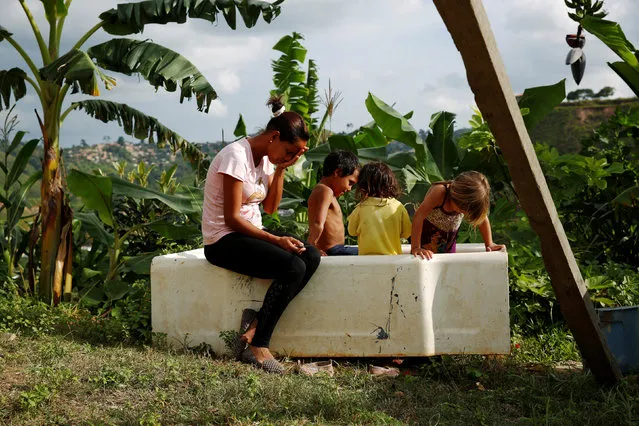
Lisibeht Martinez (L), 30, who was sterilized one year ago, sits next to her children while they play in a bathtub in the backyard of their house in Los Teques, Venezuela July 19, 2016. (Photo by Carlos Garcia Rawlins/Reuters)

Venezuela's food shortages, inflation and crumbling medical sector have become such a source of anguish that a growing number of young women are reluctantly opting for sterilizations rather than face the hardship of pregnancy and child-rearing. Traditional contraceptives like condoms or birth control pills have virtually vanished from store shelves, pushing women towards the hard-to-reverse surgery. While no recent national statistics on sterilizations are available, doctors and health workers say demand for the procedure is growing. (Photo by Carlos Garcia Rawlins/Reuters)
Details
04 Aug 2016 12:22:00
Rooftops of solar powered houses are pictured in Ota, 80 km northwest of Tokyo in this October 28, 2008 file photo. One by one, Japan is turning off the lights at the giant oil-fired power plants that propelled it to the ranks of the world's top industrialised nations. With nuclear power in the doldrums after the Fukushima disaster, it's solar energy that is becoming the alternative. (Photo by Yuriko Nakao/Reuters)

Rooftops of solar powered houses are pictured in Ota, 80 km northwest of Tokyo in this October 28, 2008 file photo. One by one, Japan is turning off the lights at the giant oil-fired power plants that propelled it to the ranks of the world's top industrialised nations. With nuclear power in the doldrums after the Fukushima disaster, it's solar energy that is becoming the alternative. Solar power is set to become profitable in Japan as early as this quarter, according to the Japan Renewable Energy Foundation (JREF), freeing it from the need for government subsidies and making it the last of the G7 economies where the technology has become economically viable. (Photo by Yuriko Nakao/Reuters)
Details
24 Nov 2015 08:04:00