Loading...
Done


Workers demonstrate outside the factory of Hua Yang Printing Holdings Co Ltd on October 30, 2007 in Shenzhen of Guangdong Province, China. Over 1,000 workers of the company have blocked the 107 State Highway where the firm is located, to protest against their employer, who owed half a month's salary to the workers. (Photo by China Photos/Getty Images)
Details
17 Jun 2011 11:43:00
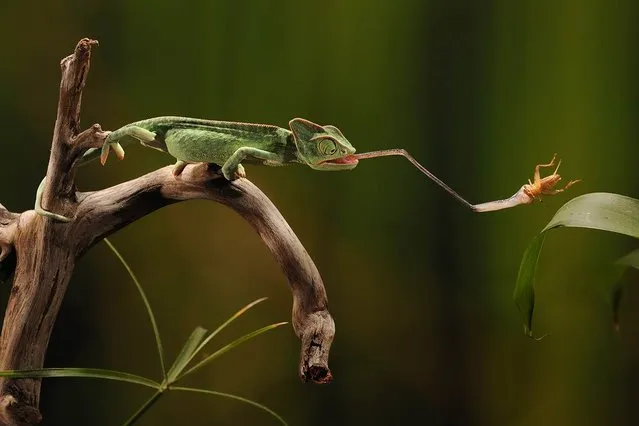
A veiled chameleon extends its tongue to catch a cricket

“Scott Linstead is an internationally published, freelance wildlife photographer/writer. His clients include Natural History Magazine, Hewlett Packard, Ranger Rick Magazine and a number of wildlife publications in North America and Europe. Scott's column on the techniques of bird photography appears in every issue of Outdoor Photography Canada”.

Photo: A veiled chameleon extends its tongue to catch a cricket. Canadian wildlife photographer Scott Linstead, formerly an aerospace engineer and high school teacher, uses a device called Phototrap “to not only photograph the elusive, but also the unimaginably quick”. (Photo by Scott Linstead)
Details
22 May 2012 11:32:00
Yang Shiguang, 77, performs stunts at a park in Xi'an, Shaanxi province, September 3, 2013. Yang has been a member of a stunt performance club since 2007, after retiring from a research institution. (Photo by Reuters/China Daily)

Yang Shiguang, 77, performs stunts at a park in Xi'an, Shaanxi province, September 3, 2013. Yang has been a member of a stunt performance club since 2007, after retiring from a research institution. (Photo by Reuters/China Daily)
Details
07 Sep 2013 11:51:00
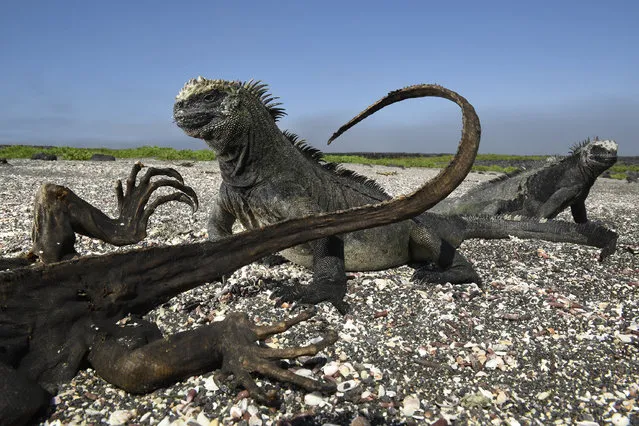
Galapagos – Rocking the Cradle: Four major ocean currents converge along the Galapagos archipelago, creating the conditions for an extraordinary diversity of animal life, April 25, 2016. The islands are home to at least 7,000 flora and fauna species, of which 97 percent of the reptiles, 80 percent of the land birds, 50 percent of the insects and 30 percent of the plants are endemic. The local ecosystem is highly sensitive to the changes in temperature, rainfall and ocean currents that characterize the climatic events known as El Niño and La Niña. These changes cause marked fluctuations in weather and food availability. Many scientists expect the frequency of El Niño and La Niña to increase as a result of climate change, making the Galapagos a possible early-warning location for its effects. (Photo by Thomas P. Peschak for National Geographic/World Press Photo)

Galapagos – Rocking the Cradle: Four major ocean currents converge along the Galapagos archipelago, creating the conditions for an extraordinary diversity of animal life, April 25, 2016. The islands are home to at least 7,000 flora and fauna species, of which 97 percent of the reptiles, 80 percent of the land birds, 50 percent of the insects and 30 percent of the plants are endemic. (Photo by Thomas P. Peschak for National Geographic/World Press Photo)
Details
16 Apr 2018 00:01:00
Protesters shield themselves as police beat them with sticks during a violent demonstration near the India Gate against a gang rape and brutal beating of a 23-year-old student on a bus last week, in New Delhi, India, December 23, 2012. The attack last Sunday has sparked days of protests across the country. (Photo by Kevin Frayer/Associated Press)

Protesters shield themselves as police beat them with sticks during a violent demonstration near the India Gate against a gang rape and brutal beating of a 23-year-old student on a bus last week, in New Delhi, India, December 23, 2012. The attack last Sunday has sparked days of protests across the country. (Photo by Kevin Frayer/Associated Press)
Details
28 Dec 2012 10:05:00
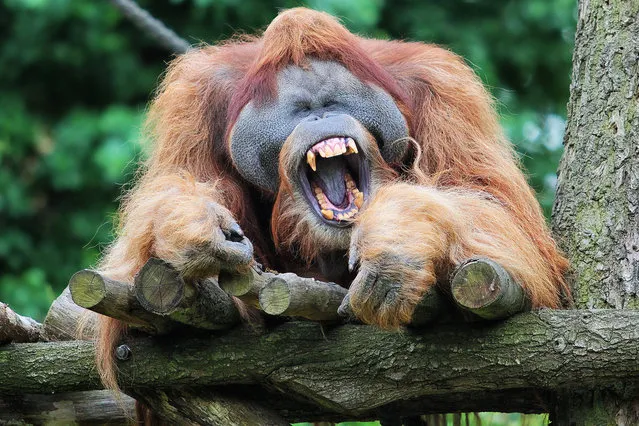
This huge male orangutan is having a right old laugh as he squints his eyes and shows his huge teeth.  The orangutan, called Bimbo, was relaxing on a platform around 5m high in his enclosure when he broke out into a laugh. But his happy smile soon disappeared when another orangutan came over to see what was going on.  Bimbo – the only male in the group of five apes at Leipzig Zoo, in Germany - appears to be laughing in much the same way as a human would. (Photo by Martina Radtke/Solent News)

This huge male orangutan is having a right old laugh as he squints his eyes and shows his huge teeth. The orangutan, called Bimbo, was relaxing on a platform around 5m high in his enclosure when he broke out into a laugh. But his happy smile soon disappeared when another orangutan came over to see what was going on. Bimbo – the only male in the group of five apes at Leipzig Zoo, in Germany - appears to be laughing in much the same way as a human would. (Photo by Martina Radtke/Solent News)
Details
29 Aug 2015 11:10:00
A girl dances in front of the digital art installation “Light in Dark” created by teamLab, a collaborative of Japanese digital artists, during a special exhibition of “Shake! Art Exhibition! and Learn and Play! teamLab Future Park” at National Museum of Emerging Science and Innovation (or Miraikan) in Tokyo, Japan, 19 January 2015. The exhibition is held through 01 March 2015. (Photo by Kimimasa Mayama/EPA)

A girl dances in front of the digital art installation “Light in Dark” created by teamLab, a collaborative of Japanese digital artists, during a special exhibition of “Shake! Art Exhibition! and Learn and Play! teamLab Future Park” at National Museum of Emerging Science and Innovation (or Miraikan) in Tokyo, Japan, 19 January 2015. The exhibition is held through 01 March 2015. (Photo by Kimimasa Mayama/EPA)
Details
06 Feb 2015 12:51:00
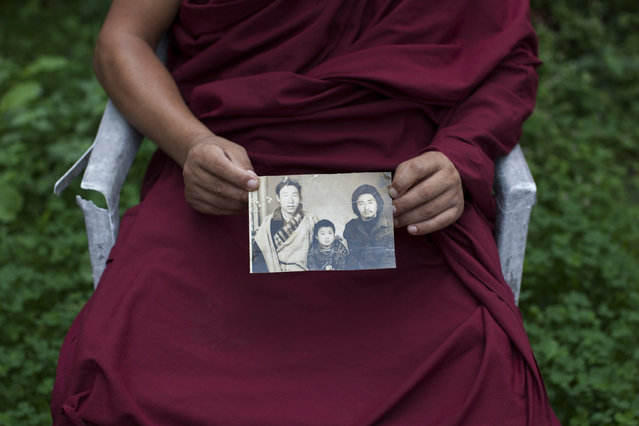
In this Saturday, September 27, 2014 photo, Tibetan monk Dorjee, 38, displays a photograph of his father, left, and himself, center, taken in Tibet, in Dharamsala, India. Dorjee said he held back his tears when he spoke with his parents on the phone after a separation period of 27 years. He exchanged a few words with his father but said his mother fainted on hearing his voice. (Photo by Tsering Topgyal/AP Photo)

“When I was 8 years old, my parents paid a smuggler to take me across the Himalayas, a weekslong walk over the mountains from Tibet to India. It was a trek that tens of thousands of other Tibetans have taken since the Dalai Lama fled a failed 1959 uprising against Chinese rule. My parents must have had their reasons to send me here; they must have had the best of intentions. But 18 years later, I still don't know why they did it. They are not political people. They are small farmers who raise barley and a few yak in a rural area not far from Lhasa, the Tibetan capital. I have not seen them since I left...”. – Tsering Topgyal via The Associated Press. (Photo by Tsering Topgyal/AP Photo)
Details
05 Nov 2014 12:27:00