Loading...
Done
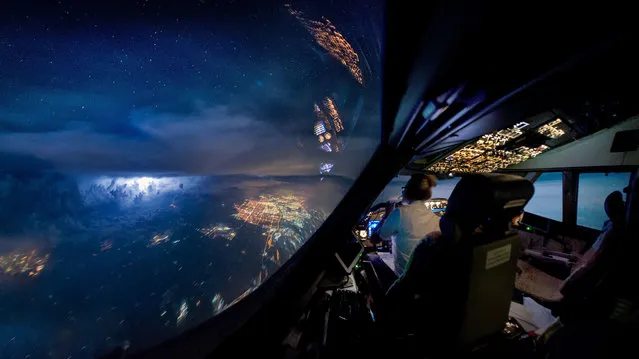
An incredible view of Thunderstorms light up the insides of clouds near a beautiful sky line. This is truly heavenly weather as pictures taken from an airplane cockpit reveal what pilots see from above. It looks like at cruising altitude the weather really hots up, with the flight deck revealing some amazing scenes. Thunderstorms light up the insides of clouds, lightening streaks across the sky like cracks in a windscreen, the northern lights sweep uninterrupted across the sky and the galaxy stretches on forever. The pictures were captured by senior first officer Christiaan van Heijst, a 33-year-old from the Netherlands, and his friend Daan Krans. (Photo by Christiaan van Heijst/Daan Krans/Caters News Agency)

An incredible view of Thunderstorms light up the insides of clouds near a beautiful sky line. This is truly heavenly weather as pictures taken from an airplane cockpit reveal what pilots see from above. It looks like at cruising altitude the weather really hots up, with the flight deck revealing some amazing scenes. Thunderstorms light up the insides of clouds, lightening streaks across the sky like cracks in a windscreen, the northern lights sweep uninterrupted across the sky and the galaxy stretches on forever. The pictures were captured by senior first officer Christiaan van Heijst, a 33-year-old from the Netherlands, and his friend Daan Krans. (Photo by Christiaan van Heijst/Daan Krans/Caters News Agency)
Details
22 Sep 2016 09:45:00
Galapagos – Rocking the Cradle: Four major ocean currents converge along the Galapagos archipelago, creating the conditions for an extraordinary diversity of animal life, April 25, 2016. The islands are home to at least 7,000 flora and fauna species, of which 97 percent of the reptiles, 80 percent of the land birds, 50 percent of the insects and 30 percent of the plants are endemic. The local ecosystem is highly sensitive to the changes in temperature, rainfall and ocean currents that characterize the climatic events known as El Niño and La Niña. These changes cause marked fluctuations in weather and food availability. Many scientists expect the frequency of El Niño and La Niña to increase as a result of climate change, making the Galapagos a possible early-warning location for its effects. (Photo by Thomas P. Peschak for National Geographic/World Press Photo)

Galapagos – Rocking the Cradle: Four major ocean currents converge along the Galapagos archipelago, creating the conditions for an extraordinary diversity of animal life, April 25, 2016. The islands are home to at least 7,000 flora and fauna species, of which 97 percent of the reptiles, 80 percent of the land birds, 50 percent of the insects and 30 percent of the plants are endemic. (Photo by Thomas P. Peschak for National Geographic/World Press Photo)
Details
16 Apr 2018 00:01:00
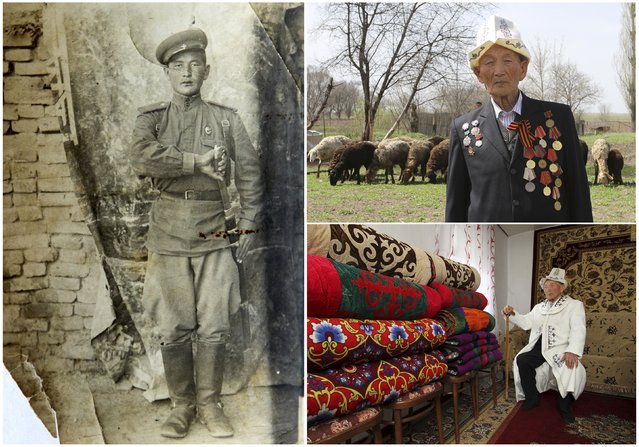
World War Two veteran Abla Begaliyev, 91, is seen in an undated handout picture (L), poses for a picture in Arashan (Top R) and at home in Kyrgyzstan April 14, 2015. Begaliyev served in the border guard cavalry from February 1942 until April 1947. Originally from Kyrgyzstan, he fought on the Ukrainian front and relocated to the border with Afghanistan at the end of World War Two. (Photo by Vladimir Pirogov/Reuters/Family handout (L))

World War Two veteran Abla Begaliyev, 91, is seen in an undated handout picture (L), poses for a picture in Arashan (Top R) and at home in Kyrgyzstan April 14, 2015. Begaliyev served in the border guard cavalry from February 1942 until April 1947. Originally from Kyrgyzstan, he fought on the Ukrainian front and relocated to the border with Afghanistan at the end of World War Two. As the world marks the 70th anniversary of the end of World War Two, Reuters photographers the length and breadth of the former Soviet republics (CCCP) captured portraits of Red Army veterans, mostly now in their 80s and 90s, today and through archive pictures at the time. More than 20 million Soviet citizens were killed in the war. (Photo by Vladimir Pirogov/Reuters/Family handout (L))
Details
08 May 2015 14:22:00
Members of Brazil's Movimento dos Sem-Teto (Roofless Movement) stand in the hallway of one of the 11 empty buildings that the movement took over recently, in the centre of Sao Paulo, November 6, 2012. According to City Hall, there are some 400,000 people in need of stable housing, including the 4,000 families of the Roofless Movement who are squatting in abandoned or vacant buildings that range from apartment blocks to hotels, in Sao Paulo, the largest city in South America. Picture taken November 6, 2012

Members of Brazil's Movimento dos Sem-Teto (Roofless Movement) stand in the hallway of one of the 11 empty buildings that the movement took over recently, in the centre of Sao Paulo, November 6, 2012. According to City Hall, there are some 400,000 people in need of stable housing, including the 4,000 families of the Roofless Movement who are squatting in abandoned or vacant buildings that range from apartment blocks to hotels, in Sao Paulo, the largest city in South America. (Photo by Nacho Doce/Reuters)
Details
18 Dec 2012 09:40:00
A model wearing the neon make up. (Photo by Hid Saib Neto/Caters News)

“Models decorated with glow-in-the-dark paint manage to stand out in a new series of pictures shot in the dark. Its well known that capturing beautiful photos without natural light is a tricky undertaking even for the most talented photographers but Hid Saib Neto has found a way to make the most of the darkness. The 26-year-old Brazilian photographer covered the group of models in neon paint before illuminating them with just a single ultra-violet light”. – Caters News. Photo: A model wearing the neon make up. (Photo by Hid Saib Neto/Caters News)
Details
02 Apr 2014 09:00:00
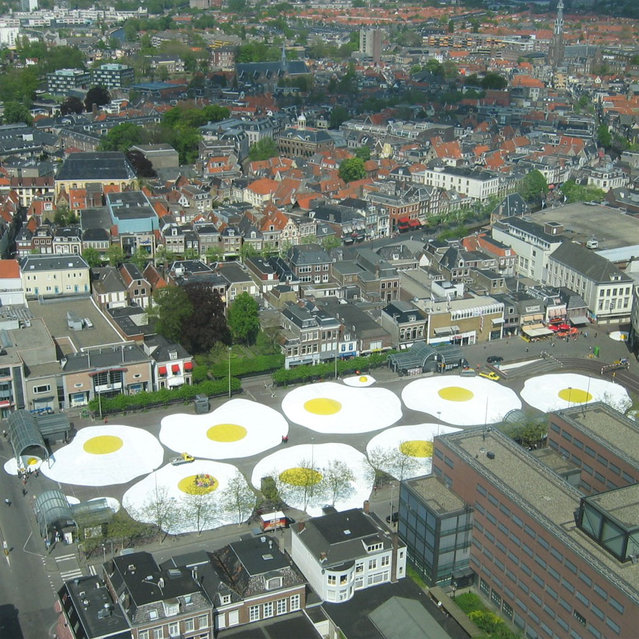
Art Eggcident By Henk Hofstra

With "Art Eggcident," Dutch artist Henk Hofstra demonstrates what it would look like if God threw giant eggs down at us. The eight large, sunny side up eggs measure almost 100 feet wide in diameter. The installation took place in Leeuwarden, a city in the north of the Netherlands.
"I hope it becomes a meeting place with room for art," says Henk. "Art that is different than a framed picture on the wall or a boring bronze sculpture. Art that shows us a different look, surprises us, or makes us angry or happy. Art that allows photographers to grab their cameras and arouses journalists. Art that evokes emotion, or provokes wild laughter."
Details
07 May 2014 10:54:00
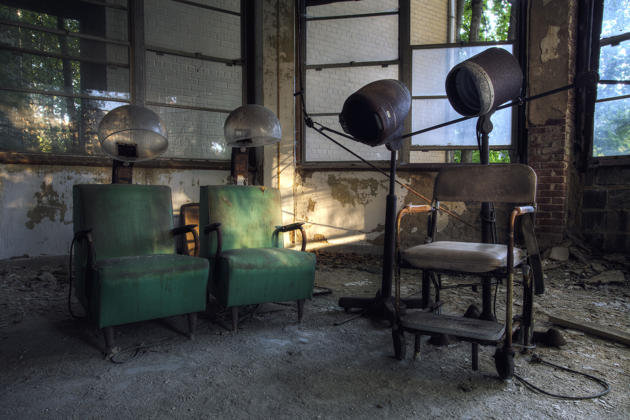
Salon equipment inside a sanatorium in New York. Daniel said: “We visited five states and several major cities, from New York City to Pittsburgh. It got pretty wild at times, so much so that in the more destitute areas, our guide carried a Glock”. (Photo by Daniel Barter/Caters News)

“These creepy pictures of abandoned asylums, prisons and schools give a sense of what life was like in institutions of 20th century America. Photographer Daniel Barter, 30, captured on film bowling alleys, theatres and hairdressing salons all completely intact. The Londoner was on travelling through Americas north eastern states when he had the chance to explore the derelict public buildings left untouched since their last inhabitants shut the doors”. – Caters News. Photo: Salon equipment inside a sanatorium in New York. (Photo by Daniel Barter/Caters News)
Details
09 May 2014 09:25:00
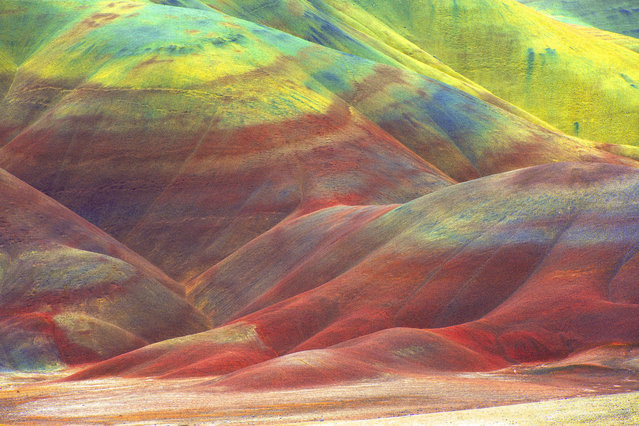
Layers of breathtaking colour streak the rolling hills of this vast desert, making the landscape appear as though it has been tie-dyed. The natural phenomenon, nicknamed the “Painted Desert”, was formed when the area was once a river floodplain. (Photo by Mark Brodkin/Solent News/SIPA Press)

Layers of breathtaking colour streak the rolling hills of this vast desert, making the landscape appear as though it has been tie-dyed. The natural phenomenon, nicknamed the “Painted Desert”, was formed when the area was once a river floodplain. Each colour corresponds to a different underground geological feature – rocks which have seemingly dyed the layers of earth above. Formed from volcanic activity, the hills at the John Day Fossil Beds National Monument in East Central Oregon, USA, are almost bursting with colour. Pictured: The colourful hills at the John Day Fossil Beds National Monument in East Central Oregon, USA. (Photo by Mark Brodkin/Solent News/SIPA Press)
Details
30 Jul 2014 11:00:00