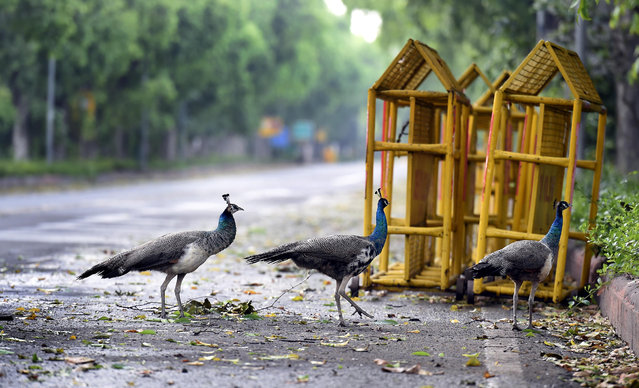
Peahens seen at Motilal Nehru Marg during lockdown to curb the spread of coronavirus, on April 19, 2020 in New Delhi, India. (Photo by Arvind Yadav/Hindustan Times via Getty Images)
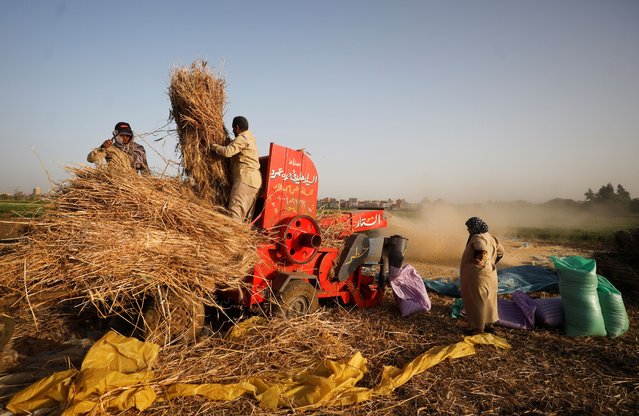
A farmer carries a bundle of wheat after harvesting it from a field in the Gharbia Governorate, as Egypt ramps up efforts to slow the spread of the coronavirus disease (COVID-19), Egypt on May 14, 2020. (Photo by Mohamed Abd El Ghany/Reuters)
A vendor pushes an improvised cart with a woman and merchandise along a rarely used rail track in Bangkok, Thailand, Thursday, June 25, 2020. Daily life in the capital slowly returns to normal as the Thai government eases many restrictions imposed weeks ago to combat the spread of COVID-19. Though emergency regulations require the use of face masks in public, some residents have become apathetic as Thailand has record zero local transmission for over three weeks. (Photo by Gemunu Amarasinghe/AP Photo)
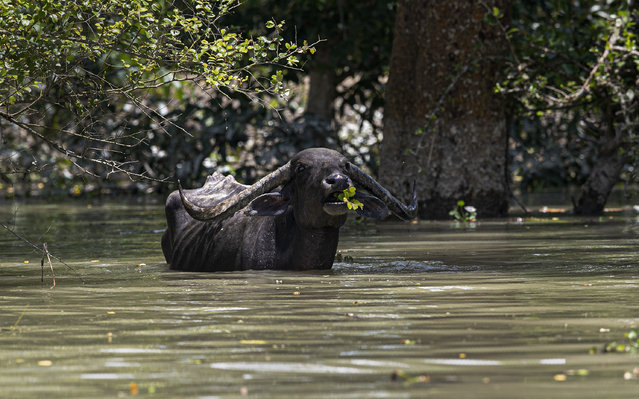
A wild water buffalo eats tree branches standing in flood water at the Pobitora wildlife sanctuary in Pobitora, Morigaon district, Assam, India, Thursday, July 16, 2020. Floods and landslides triggered by heavy monsoon rains have killed dozens of people in this northeastern region. The floods also inundated most of Kaziranga National Park, home to an estimated 2,500 rare one-horned rhinos. (Photo by Anupam Nath/AP Photo)
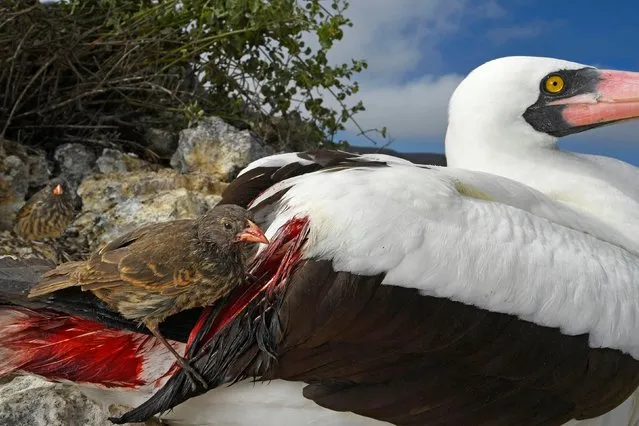
Bloodthirsty by Thomas P. Peschak, Germany/South Africa — winner, Behaviour: birds. When rations run short on Wolf Island, in the remote northern Galápagos, the sharp-beaked ground finches become vampires. Their sitting targets are Nazca boobies and other large birds. The finches rely on a scant diet of seeds and insects, which regularly dries up, so they drink blood to survive. ‘I’ve seen more than half a dozen finches drinking from a single Nazca booby,’ says Tom. Rather than leave their nests the boobies tolerate the vampires, and the blood loss doesn’t seem to cause permanent harm. (Photo by Thomas P. Peschak/2018 Wildlife Photographer of the Year)
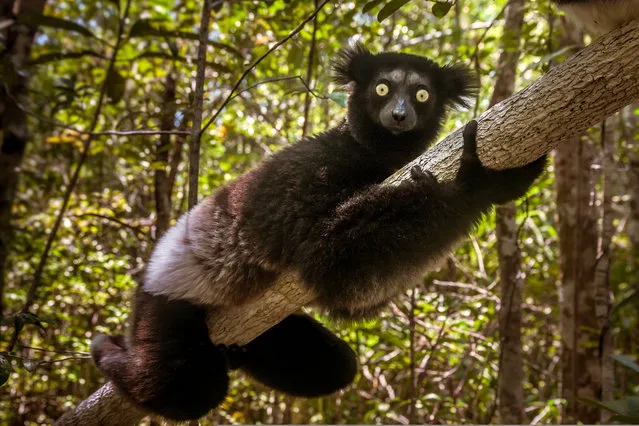
The secretive indri (Indri indri) of Madagascar, the largest living lemur. It is also critically endangered and highly evolutionarily distinct with no close relatives, which makes its branch one of most precarious on the mammal evolutionary tree. In the likely event that the indri goes extinct, we will lose 19m years of unique evolutionary history from the mammal tree of life. (Photo by Pierre-Yves Babelon/Aarhus University)
A protester gestures during a “Yellow vest” protest against higher fuel prices during clashes on the Champs-Elysees in Paris, France, November 24, 2018. (Photo by Benoit Tessier/Reuters)
PH Sport's driver Sebastian Loeb races against an airplane during a performance act at the Peru Dakar Rally in Lima, Peru on January 5, 2019. (Photo by Carlos Jasso/Reuters)