Loading...
Done
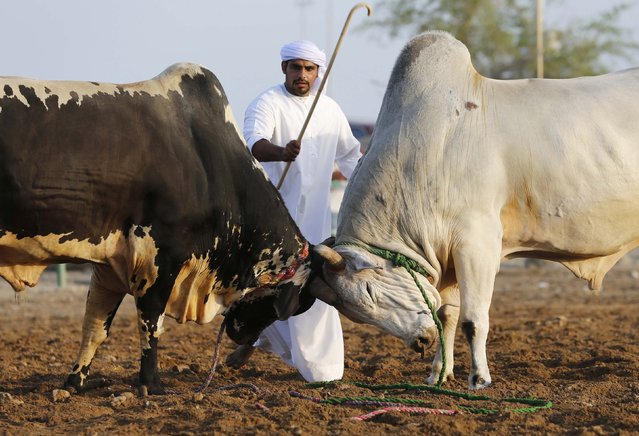
A man tries to stop two bulls from locking horns during a bullfight in the eastern emirate of Fujairah October 17, 2014. There are no matadors or picadors, but bulls locking horns with each other draw big crowds to bullfights in the United Arab Emirates (UAE). (Photo by Ahmed Jadallah/Reuters)

A man tries to stop two bulls from locking horns during a bullfight in the eastern emirate of Fujairah October 17, 2014. There are no matadors or picadors, but bulls locking horns with each other draw big crowds to bullfights in the United Arab Emirates (UAE). An hour's drive from the dancing water fountains of Dubai's glitzy downtown, hundreds of fans gather in Fujairah to watch bulls fighting, or perhaps more accurately head butting, with honour rather than money at stake. The UAE sport involves two bulls locking horns in a three-to-four minute Sumo-wrestling-like fight that usually ends with no bloodshed. (Photo by Ahmed Jadallah/Reuters)
Details
06 Nov 2014 09:26:00
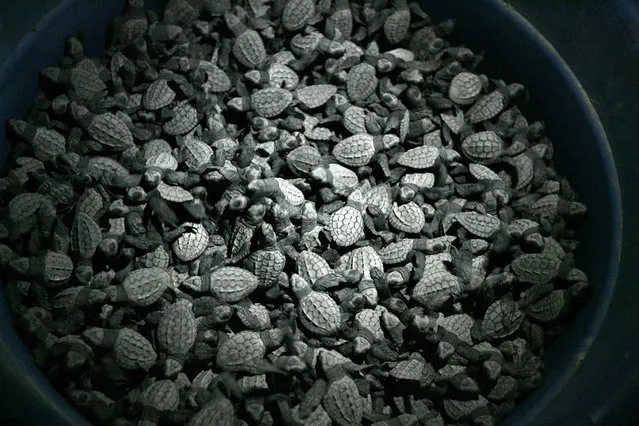
Olive Ridley turtle hatchlings (Lepidochelys olivacea) sit in baskets and trays at the turtle camp La Gloria, before their release into the ocean in Tomatlan November 15, 2013. (Photo by Alejandro Acosta/Reuters)

Olive Ridley turtle hatchlings (Lepidochelys olivacea) sit in baskets and trays at the turtle camp La Gloria, before their release into the ocean in Tomatlan November 15, 2013. Twenty years ago, Mexico's government implemented ecological plans to protect the sea turtles from being hunted for their leather and meat and established conservation areas and a pay system for local residents to protect turtle nests. Millions of baby turtles hatch on the shores in November and December, according to an environmental group. It is estimated that in 2012, there were 20 million newborns. Hatching season is still underway, but officials say they expect there will be even more turtles born this year. (Photo by Alejandro Acosta/Reuters)
Details
25 Nov 2013 08:54:00
GIF Art By James Kerr

James Kerr started his project “Scorpion Dagger” without any real direction, except for the intention to make one GIF everyday(ish) for one year. He had been making collages for some time and “Scorpion Dagger” started out to be a test of discipline and a way for him to learn how to animate. Making GIFs was a logical evolution to him. The project represents many different things to him, the works from which he draws upon are so powerful and inspirational to him, that he is now nearly obsessed with repurposing them to share his vision of the world, and perhaps inspire people to look at art differently. The project is tremendously personal to him, it’s a lot more than the humor that’s at its surface and he is still trying to work out what “Scorpion Dagger” really is.


Details
19 Dec 2013 10:31:00
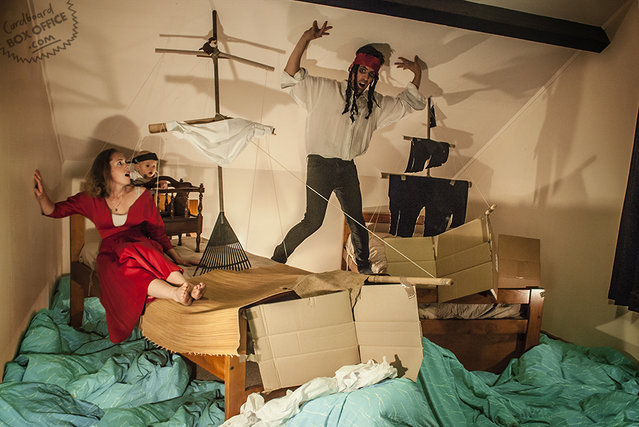
Cardboard Box Office By Lilly, Leon And Baby Orson

Welcome to Cardboard Box Office – our homemade creations of some of your favorite movie scenes built from some of our favorite domestic junk. The project began after finding that we had accumulated both a lot of cardboard boxes (due to moving to a new country) and a baby (due to giving birth). With our social lives drastically altered we decided to find a way to make some of those housebound weekends a little more fun. The costumes, props, and sets in Cardboard Box Office are created entirely out of everyday household items, toys, cardboard, and three individuals slowly losing their sanity. Enjoy!

Lilly, Leon, & (baby) Orson
Details
21 Jan 2014 17:53:00
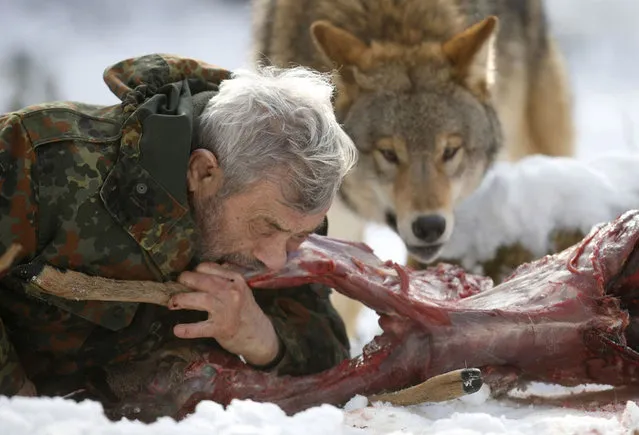
The Wolf Man

Wolfspark Werner Freund is a wolf sanctuary spread over 25 acres in western Germany. It is home to 29 wolves -- six distinct packs hailing from Europe, Siberia, Canada, the Arctic, and Mongolia. Researcher Werner Freund, 79, a former German paratrooper, established the sanctuary in 1972 and has raised more than 70 animals there over the last 40 years. He acquired the wolves as cubs from zoos or animal parks and has reared them mostly by hand. Werner has also taken to living closely with his wolves, behaving as an alpha male to earn their acceptance and respect. Reuters photographer Lisi Niesner recently spent some time with Freund and his wolves, capturing the interactions between these old friends.
Details
31 Jan 2013 15:50:00
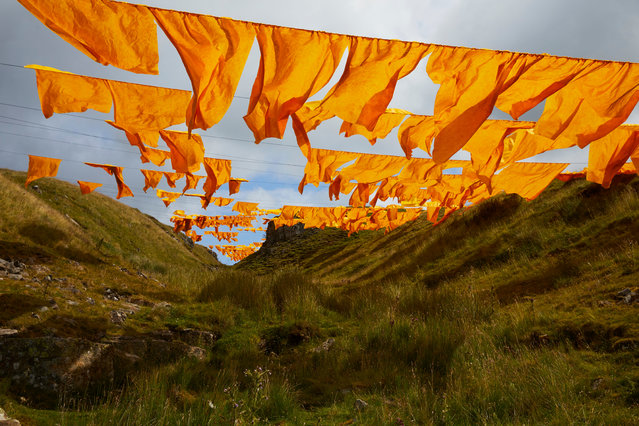
Monumental landscape artwork “Hush” by installation artist Steve Messam hangs in the moors of Teesdale on July 18, 2019 in Barnard Castle, England. The outdoor installation is inspired by the geology, mining history and landscape of the area. It hangs over Bales Hush, a deep gauge in the terrain created when miners flushed the area with water to reveal the geological riches below. Hundreds of metres of recyclable saffron yellow fabric blow in the wind. (Photo by Christopher Thomond/The Guardian)

Monumental landscape artwork “Hush” by installation artist Steve Messam hangs in the moors of Teesdale on July 18, 2019 in Barnard Castle, England. The outdoor installation is inspired by the geology, mining history and landscape of the area. It hangs over Bales Hush, a deep gauge in the terrain created when miners flushed the area with water to reveal the geological riches below. Hundreds of metres of recyclable saffron yellow fabric blow in the wind. (Photo by Christopher Thomond/The Guardian)
Details
20 Jul 2019 00:03:00
A man talks on his mobile phone in the village of Devmali in the desert state of Rajasthan, India June 14, 2016. (Photo by Himanshu Sharma/Reuters)

A man talks on his mobile phone in the village of Devmali in the desert state of Rajasthan, India June 14, 2016. (Photo by Himanshu Sharma/Reuters)
Details
16 Jun 2016 12:27:00


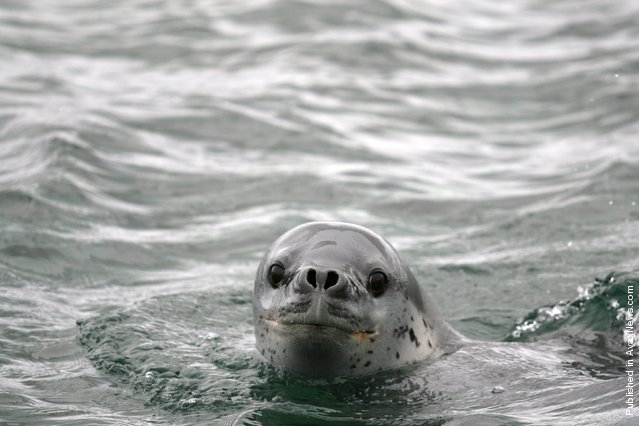
“The leopard seal (Hydrurga leptonyx), also referred to as the sea leopard, is the second largest species of seal in the Antarctic (after the southern elephant seal). It is most common in the southern hemisphere along the coast of Antarctica and on most sub-Antarctic islands, but can also be found on the coasts of southern Australia, Tasmania, South Africa, New Zealand, Lord Howe Island, Tierra del Fuego, the Cook Islands, and the Atlantic coast of South America. It can live twenty-six years, possibly more. Orcas and large sharks are the only natural predators of leopard seals”. – Wikipedia

Photo by: Gilad Rom; Source: Flickr
Details
13 Nov 2011 11:24:00