Loading...
Done
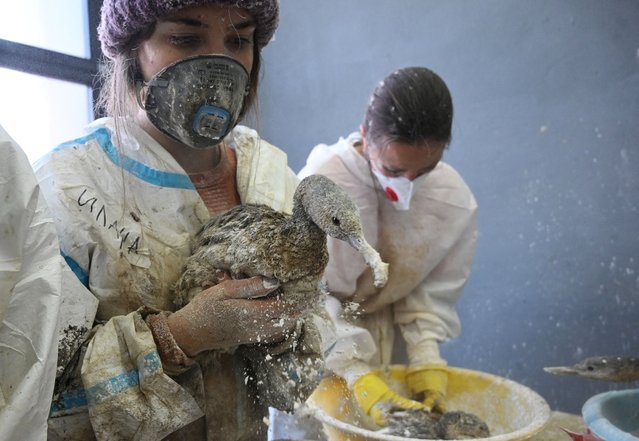
Volunteers use flour to clean birds following an oil spill caused by an incident involving two tankers damaged in a storm in the Kerch Strait, in the village of Vityazevo near the Black Sea resort of Anapa, Russia on December 20, 2024. (Photo by Sergey Pivovarov/Reuters)

Volunteers use flour to clean birds following an oil spill caused by an incident involving two tankers damaged in a storm in the Kerch Strait, in the village of Vityazevo near the Black Sea resort of Anapa, Russia on December 20, 2024. (Photo by Sergey Pivovarov/Reuters)
Details
24 Dec 2024 04:11:00
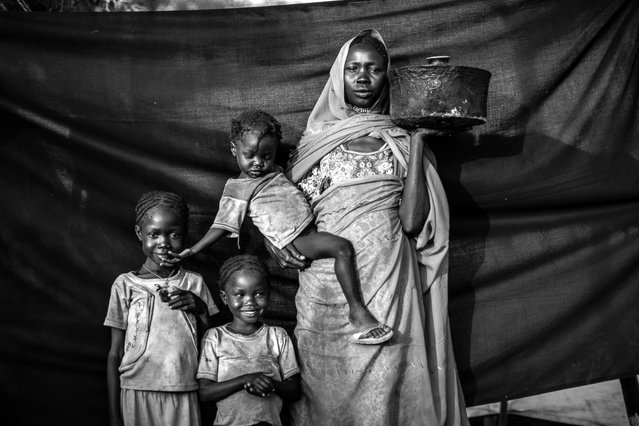
Magbola Alhadi, 20, and her three children pose for a portrait in Jamam refugee camp in Maban County, South Sudan on August 11th, 2012. Magboola and her family weathered aerial bombing raids for several months, but decided it was time to leave their village of Bofe the night that soldiers arrived and opened fire. (Photo by Brian Sokol/Panos Pictures)

Magbola Alhadi, 20, and her three children pose for a portrait in Jamam refugee camp in Maban County, South Sudan on August 11th, 2012. Magboola and her family weathered aerial bombing raids for several months, but decided it was time to leave their village of Bofe the night that soldiers arrived and opened fire. With her three children, she travelled for 12 days from Bofe to the town of El Fudj, on the South Sudanese border. The most important thing that Magboola was able to bring with her is the saucepan she holds in this photograph. It wasn't the largest pot that she had in Bofe, but it was small enough she could travel with it, yet big enough to cook sorghum for herself and her three daughters (from left: Aduna Omar, 6, Halima Omar, 4, and Arfa Omar, 2) during their journey. (Photo by Brian Sokol/Panos Pictures)

Details
18 Sep 2015 15:04:00
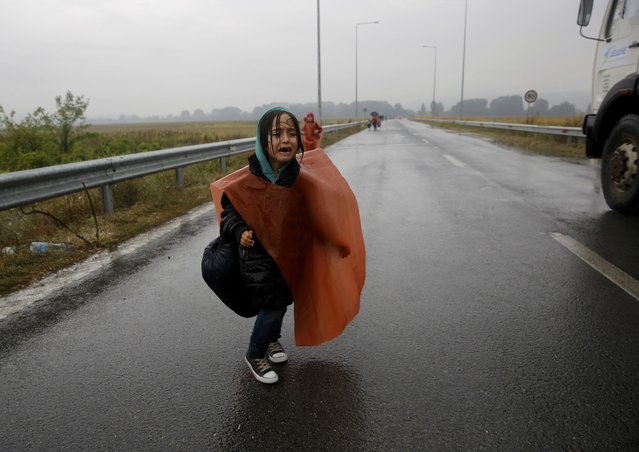
A Syrian refugee girl cries as she walks through a rainstorm towards Greece's border with Macedonia, near the Greek village of Idomeni, September 10, 2015. Most of the people flooding into Europe are refes fleeing violence and persecution in their home countries who have a legal right to seek asylum, the United Nations said on Tuesday. (Photo by Yannis Behrakis/Reuters)

A Syrian refugee girl cries as she walks through a rainstorm towards Greece's border with Macedonia, near the Greek village of Idomeni, September 10, 2015. Most of the people flooding into Europe are refes fleeing violence and persecution in their home countries who have a legal right to seek asylum, the United Nations said on Tuesday. (Photo by Yannis Behrakis/Reuters)
Details
11 Sep 2015 12:57:00
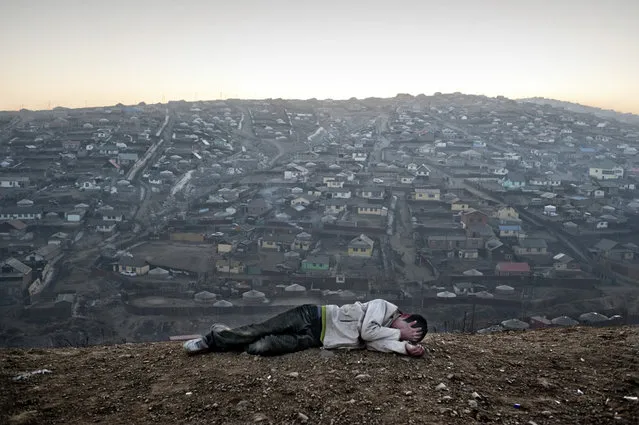
Asia, Mongolia, March 27, 2011. A view of Ulaan Baator over the shoulder of a slumbering drunk. Alcoholism is a huge problem in the city, home to almost half of Mongolia's people. The capital's population has doubled in the past two years, expanding outward in a haphazard sprawl, and many inhabitants live in slums known as the “Gher District”. (Photo by Alessandro Grassani)

“Environmental Migrants: The Last Illusion” by photographer Alessandro Grassani, documents the life of people in Kenya, Mongolia and Bangladesh who migrate to escape environmental stresses to the city of their own countries in hopes for a better life. Here: Asia, Mongolia, March 27, 2011. A view of Ulaan Baator over the shoulder of a slumbering drunk. Alcoholism is a huge problem in the city, home to almost half of Mongolia's people. The capital's population has doubled in the past two years. High levels of unemployment and poverty await herders who abandon rural areas and arrive in the city, illiterate and untrained in any skills necessary for urban jobs. (Photo by Alessandro Grassani)
Details
21 Jul 2015 10:10:00
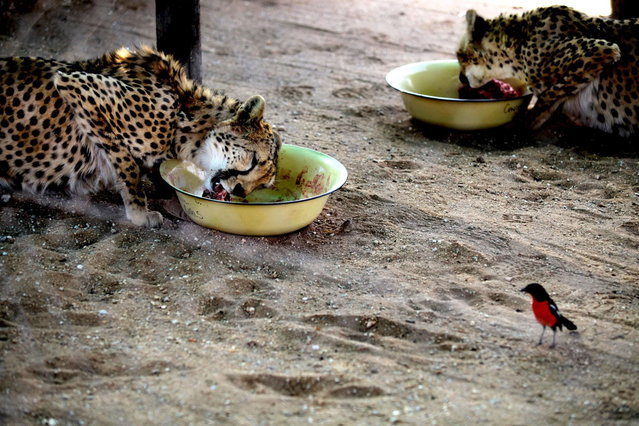
Young cheetahs eat meat at The Cheetah Conservation Fund (CCF) center in Otjiwarongo, Namibia, on August 13, 2013. The CCF started breeding Anatolian livestock dogs to promote cheetah-friendly farming after some 10,000 big cats – the current total worldwide population – were killed or moved off farms in the 1980s.  Up to 1,000 cheetahs were being killed a year, mostly by farmers who saw them as livestock killers. But the use of dogs has slashed losses for sheep and goat farmers and led to less retaliation against the vulnerable cheetah. (Photo by Jennifer Bruce/AFP Photo)

Young cheetahs eat meat at The Cheetah Conservation Fund (CCF) center in Otjiwarongo, Namibia, on August 13, 2013. The CCF started breeding Anatolian livestock dogs to promote cheetah-friendly farming after some 10,000 big cats – the current total worldwide population – were killed or moved off farms in the 1980s. Up to 1,000 cheetahs were being killed a year, mostly by farmers who saw them as livestock killers. But the use of dogs has slashed losses for sheep and goat farmers and led to less retaliation against the vulnerable cheetah. (Photo by Jennifer Bruce/AFP Photo)
Details
29 Aug 2013 10:56:00
A guard stands at Dityatki checkpoint, marking a 30 km (18-mile) zone around the Chernobyl nuclear power plant April 23, 2013. Ukraine will mark the 27th anniversary of the Chernobyl disaster, the world's worst civil nuclear accident, on April 26. (Photo by Gleb Garanich/Reuters)

A guard stands at Dityatki checkpoint, marking a 30 km (18-mile) zone around the Chernobyl nuclear power plant April 23, 2013. Ukraine will mark the 27th anniversary of the Chernobyl disaster, the world's worst civil nuclear accident, on April 26. (Photo by Gleb Garanich/Reuters)
Details
27 Apr 2013 09:27:00
A vendor (C) serves customers at a vegetable market as a commuter train passes in Jakarta October 2, 2015. Indonesia's high annual inflation rate cooled in September and should drop more by year-end, but it likely will be 2016 before the central bank can cut interest rates to help an economy growing at its slowest pace in six years. (Photo by Reuters/Beawiharta)

A vendor (C) serves customers at a vegetable market as a commuter train passes in Jakarta October 2, 2015. Indonesia's high annual inflation rate cooled in September and should drop more by year-end, but it likely will be 2016 before the central bank can cut interest rates to help an economy growing at its slowest pace in six years. (Photo by Reuters/Beawiharta)
Details
05 Oct 2015 08:02:00
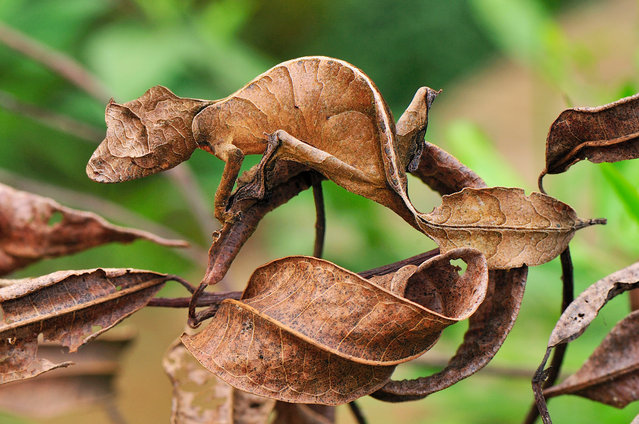
Is it a leaf? Is it tree bark? No, it’s the Satanic leaf-tailed gecko. Cleverly disguised as a rotting leaf, Madagascar’s camouflage king has red eyes, pointy horns and a taste for night hunting: it’s nature’s most devilish deceiver. (Photo by Thomas Marent/ARDEA)

Is it a leaf? Is it tree bark? No, it’s the Satanic leaf-tailed gecko. Cleverly disguised as a rotting leaf, Madagascar’s camouflage king has red eyes, pointy horns and a taste for night hunting: it’s nature’s most devilish deceiver. The twisted body and veiny skin echo the detail of a dry leaf, which ensures the gecko blends in with its forest home. The mottled tail appears to have sections missing, as though it has withered over time. This mini-monster epitomises survival of the fittest, having adapted gradually to become today’s extraordinary leaf impersonator. (Photo by Thomas Marent/ARDEA)
Details
20 Nov 2015 08:03:00