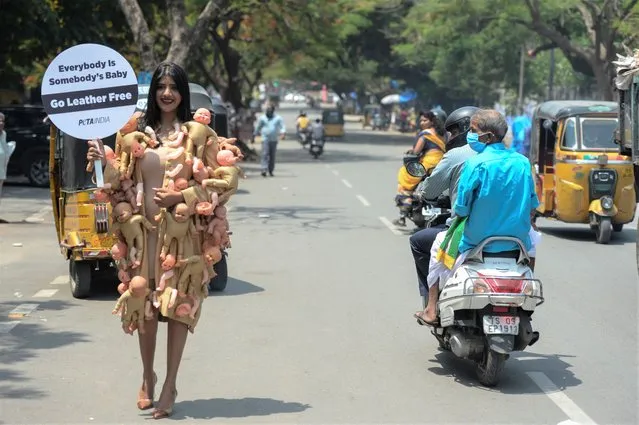
An activist of People for the Ethical Treatment of Animals (PETA) stands along a road wearing a coat with baby dolls to raise awareness about the leather industry, in Hyderabad, India on May 6, 2022. (Photo by Noah Seelam/AFP Photo)
Revellers wearing lanterns parade through the streets during the carnival procession of Basel, Switzerland, 15 February 2016. The traditional Morgestraich starting Monday morning after Ash Wednesday at 4 a.m. marks the kick-off of the Carnival of Basel. (Photo by Patrick Seeger/EPA)
Marco Antonio Eguchi of Brazil gets bucked off of Bottoms Up in the first round of the PBR Frontier Communications Iron Cowboy at AT& T Stadium on February 18, 2017 in Arlington, Texas. (Photo by Tom Pennington/Getty Images)
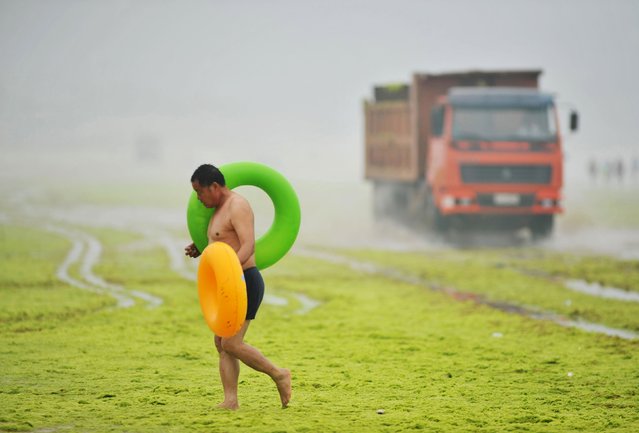
A man carries floats as he walks on an algae covered beach as a truck collecting algae passes by, along the coastline in Qingdao, Shandong province, July 6, 2015. (Photo by Reuters/China Daily)
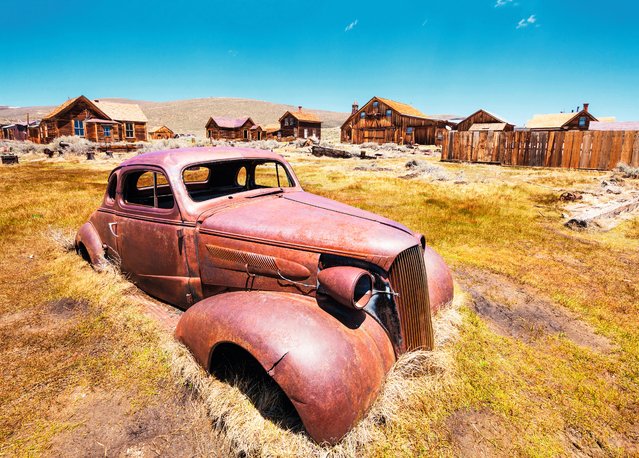
Kieron Connolly’s new book of photographs of more than 100 once-busy and often elegant buildings gives an idea of how the world might look if humankind disappeared. Here: Bodie, Mono County, California. Gold was discovered at Bodie in 1859 (just after the initial California gold rush) and it went from mining camp to boomtown. Its decline began in 1880, when word spread of new boomtowns elsewhere. The Standard Consolidated Mine closed in 1913, and four years later the Bodie Railway was abandoned. By 1940 the population was down to 40. Today, Bodie is maintained in a state of arrested decay as a visitor attraction. (Photo by Alamy Stock Photo)
Jeepney passengers are seated in between plastic barriers, wearing face masks and face shields mandatory in public transportation, in Quezon City, Metro Manila, Philippines, August 19, 2020. (Photo by Eloisa Lopez/Reuters)