Loading...
Done
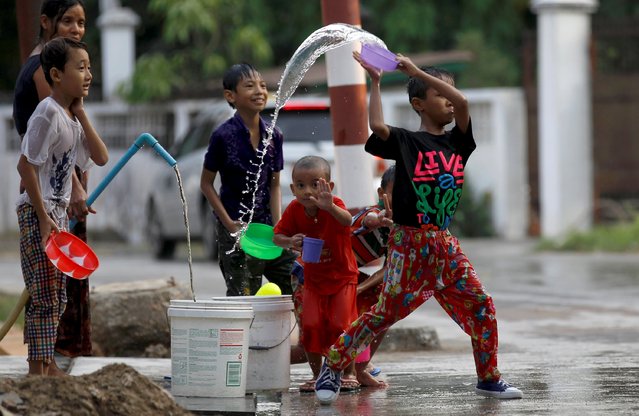
Boys play with water as they celebrate Myanmar's New Year Water Festival of Thingyan in Yangon, April 13, 2016. (Photo by Soe Zeya Tun/Reuters)

Boys play with water as they celebrate Myanmar's New Year Water Festival of Thingyan in Yangon, April 13, 2016. (Photo by Soe Zeya Tun/Reuters)
Details
05 May 2016 13:37:00
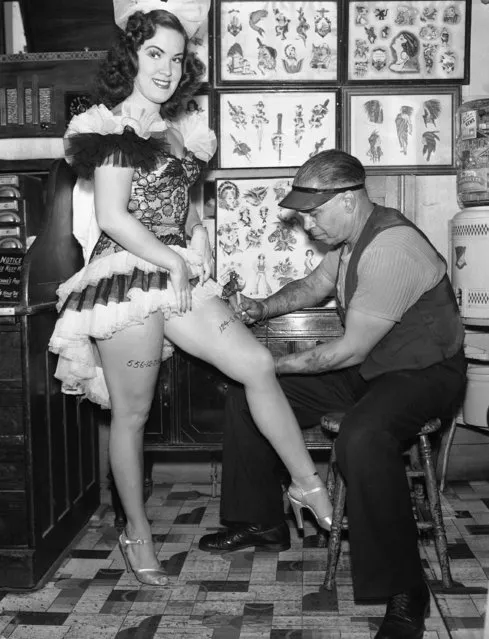
“Be prepared” is the motto of petite Doris Sherrell, vocalist and dancer with “Blackouts of 1942”. In the event of a bombing, the young lady had her social security number tattooed on one leg by artist Jack Julian, and address placed on the other limb for means of identification in Los Angeles, September 29, 1942. (Photo by AP Photo)

“Be prepared” is the motto of petite Doris Sherrell, vocalist and dancer with “Blackouts of 1942”. In the event of a bombing, the young lady had her social security number tattooed on one leg by artist Jack Julian, and address placed on the other limb for means of identification in Los Angeles, September 29, 1942. (Photo by AP Photo)
Details
11 Oct 2017 07:45:00
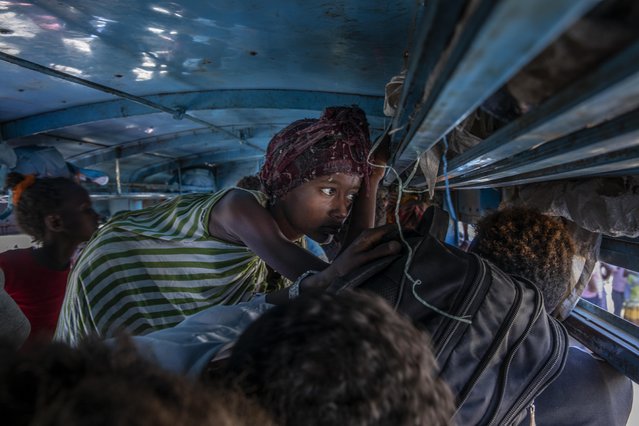
Tigray refugees who fled the conflict in the Ethiopia's Tigray ride a bus going to the Village 8 temporary shelter, near the Sudan-Ethiopia border, in Hamdayet, eastern Sudan, Tuesday, December 1, 2020. (Photo by Nariman El-Mofty/AP Photo)

Tigray refugees who fled the conflict in the Ethiopia's Tigray ride a bus going to the Village 8 temporary shelter, near the Sudan-Ethiopia border, in Hamdayet, eastern Sudan, Tuesday, December 1, 2020. (Photo by Nariman El-Mofty/AP Photo)
Details
11 Dec 2020 00:01:00
U.S. President Donald Trump holds news conference on the coronavirus outbreak at the White House in Washington, U.S., February 26, 2020. (Photo by Carlos Barria/Reuters)

U.S. President Donald Trump holds news conference on the coronavirus outbreak at the White House in Washington, U.S., February 26, 2020. (Photo by Carlos Barria/Reuters)
Details
28 Feb 2020 00:07:00
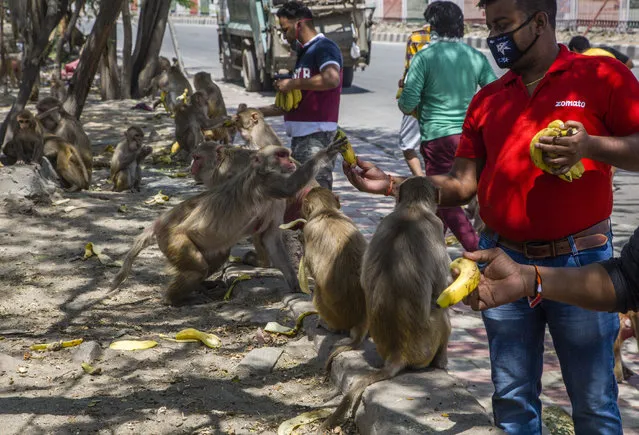
Men give bananas to monkeys gathered on the side of the road as India remains under an unprecedented lockdown over the highly contagious coronavirus (COVID-19) on April 08, 2020 in New Delhi, India. Wild animals, including monkeys, are roaming human settlements in India as people are staying indoors due to the 21-day lockdown. With India's 1.3 billion population and tens of millions of cars off the roads, wildlife is moving towards areas inhabited by humans. Wild animals in many countries have been seen roaming streets. A study says some 60 percent of the new diseases found around the globe every year are zoonotic, meaning they originate in animals and are passed on to humans. COVID-19 is a zoonotic disease that is suspected to have come from the wet markets of Wuhan, China. (Photo by Yawar Nazir/Getty Images)

Men give bananas to monkeys gathered on the side of the road as India remains under an unprecedented lockdown over the highly contagious coronavirus (COVID-19) on April 08, 2020 in New Delhi, India. Wild animals, including monkeys, are roaming human settlements in India as people are staying indoors due to the 21-day lockdown. (Photo by Yawar Nazir/Getty Images)
Details
12 Apr 2020 00:05:00
A participant tests his motorcycle ahead of the launch of the Rally of Morocco 2021, in the desert Zagora region, on October 7, 2021. The rally will be held from October 8 to 13, 2021. (Photo by Fadel Senna/AFP Photo)

A participant tests his motorcycle ahead of the launch of the Rally of Morocco 2021, in the desert Zagora region, on October 7, 2021. The rally will be held from October 8 to 13, 2021. (Photo by Fadel Senna/AFP Photo)
Details
19 Oct 2021 08:05:00
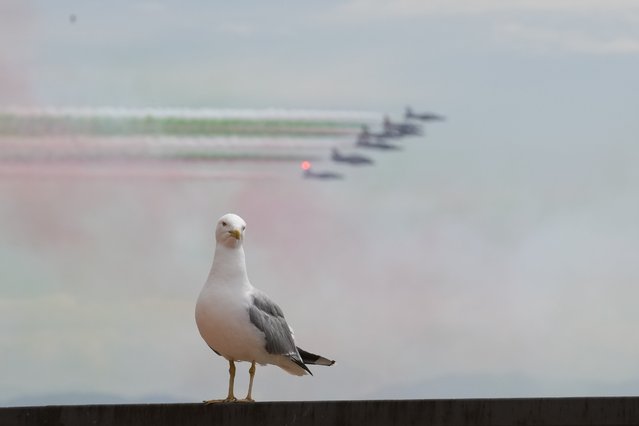
A seagull looks on as the Italian three-color special air force acrobatic team “Frecce Tricolori” flies over Rome and the Vatican Wednesday, June 2, 2021, as Italy celebrates the anniversary of its unification. (Photo by Andrew Medichini/AP Photo)

A seagull looks on as the Italian three-color special air force acrobatic team “Frecce Tricolori” flies over Rome and the Vatican Wednesday, June 2, 2021, as Italy celebrates the anniversary of its unification. (Photo by Andrew Medichini/AP Photo)
Details
06 Jun 2021 07:47:00
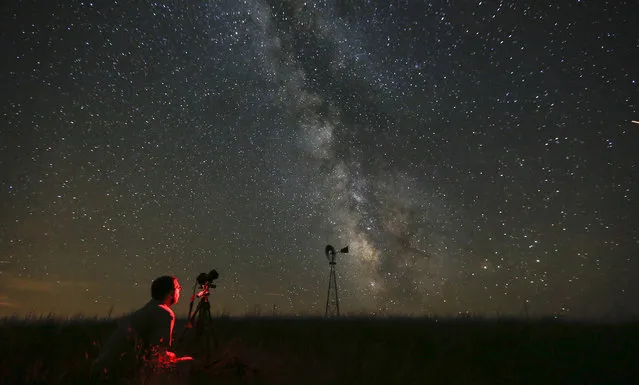
In this Wednesday, July 23, 2014 file photo, Omaha photographer Lane Hickenbottom photographs the night sky in a pasture near Callaway, Neb. With no moon in the sky, the Milky Way was visible to the naked eye. More than one-third of the world’s population can no longer see the Milky Way because of man-made lights, according to a scientific paper by Light Pollution Science and Technology Institute's Fabio Falchi and his team members, published on Friday, June 10, 2016. (Photo by Travis Heying/The Wichita Eagle via AP Photo)

In this Wednesday, July 23, 2014 file photo, Omaha photographer Lane Hickenbottom photographs the night sky in a pasture near Callaway, Neb. With no moon in the sky, the Milky Way was visible to the naked eye. More than one-third of the world’s population can no longer see the Milky Way because of man-made lights, according to a scientific paper by Light Pollution Science and Technology Institute's Fabio Falchi and his team members, published on Friday, June 10, 2016. (Photo by Travis Heying/The Wichita Eagle via AP Photo)
Details
11 Jun 2016 12:37:00