Loading...
Done
Gue(ho)st House In France

Architects Christophe Berdaguer and Marie Péjus get scary with this sculptural,bogey-inspired arts center in France. Situated behind the severe Synagogue de Delme, the center's design transforms an old house, which previously served as a prison, a school, and most recently a funeral home. The new intervention draws inspiration from the latter, cloaking the structure in a white veil of molded concrete that creates a "living body" which expands into the surrounding areas of the house.
Details
26 Jan 2014 12:05:00
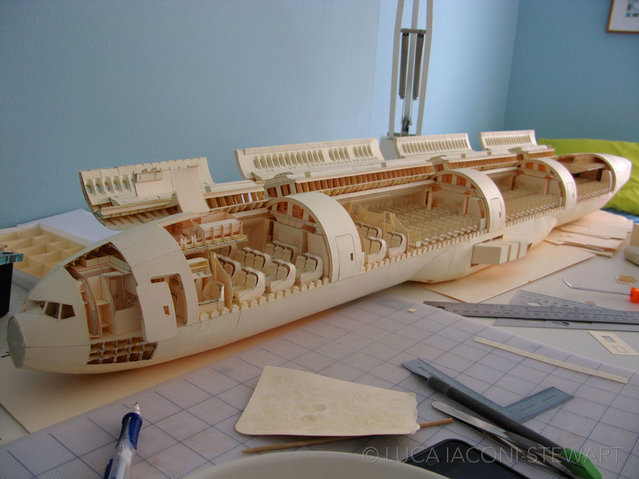
 Realistic Paper Boeing 777 By Luca Laconi Stewart

Inspired by high school architecture class where he was assigned to create simple paper models using cut paper manilla folders, San Francisco-based designer Luca Iaconi-Stewart went home to begin construction on an extremely ambitious project: a 1:60 scale reproduction of a Boeing 777 using some of the techniques he learned in class. That was in 2008, when Iaconi-Stewart was just a junior in high school.
Details
13 Feb 2014 12:29:00
HRP-4C, a five-foot humanoid robot developed at Japan's National Institute of Advanced Industrial Science and Technology, sings and dances with performers at the Digital Contents Expo in Tokyo on October 17, 2010. The robot runs entertainment software called Choreonoid, a name formed from the words “choreograph” and “humanoid”

HRP-4C, a five-foot humanoid robot developed at Japan's National Institute of Advanced Industrial Science and Technology, sings and dances with performers at the Digital Contents Expo in Tokyo on October 17, 2010. The robot runs entertainment software called Choreonoid, a name formed from the words “choreograph” and “humanoid”. (Yoshikazu Tsuno/AFP)
Details
15 Apr 2012 11:44:00
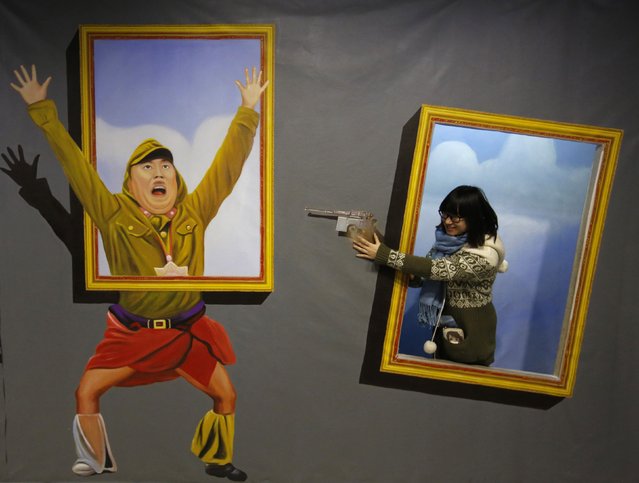
A visitor poses for a photograph in front of a 3D painting depicting a Japanese Imperial army soldier at a 3D art gallery in Beijing January 16, 2015. (Photo by Kim Kyung-Hoon/Reuters)

A visitor poses for a photograph in front of a 3D painting depicting a Japanese Imperial army soldier at a 3D art gallery in Beijing January 16, 2015. (Photo by Kim Kyung-Hoon/Reuters)
Details
17 Jan 2015 12:27:00
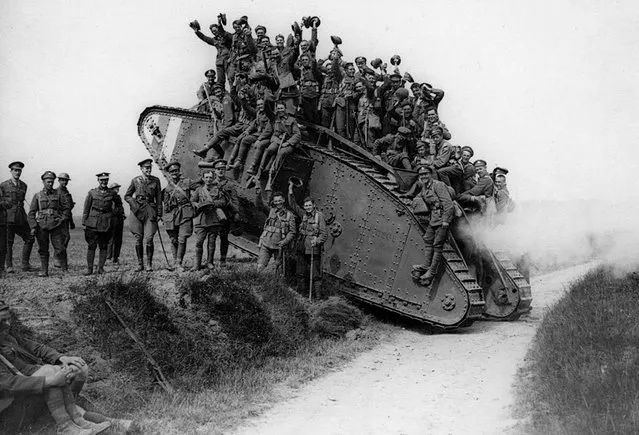
These black-and-white photos are taken from the new book “Armoured Warfare in the First World War 1916 – 1918” by Anthony Tucker-Jones and published by Pen & Sword Military. “Interestingly the British, French and Germans took completely different approaches with varying results”. The British military produced “Little Willie” in Autumn 1915 weighing 18 tonnes, which had a crew of two plus four gunners. “Inspired by a tracked artillery tractor “Little Willie” was referred to as a water tank – hence the name tank – to ensure secrecy”, said Anthony. “This led to the strange looking Mark I with its peculiar rhomboid shape, designed to cross trenches with guns in sponsons on either side. The Germans saw the tank as unchivalrous and were slow to grasp its utility. They favoured the Stormtrooper (specialist soldiers used to infiltrate enemy trenches) and artillery, not the tank”, said Anthony. “However, they didn’t hesitate to make use of captured British tanks. Although the tank helped secure victory and German soldiers dubbed it “Germany’s Downfall” the country was ultimately brought to its knees by the Allies blockade”. Here: British troops hitch a ride on a Mark IV after the massed tank fleet spearheading attack at Cambrai on November 20, 1917. (Photo by Anthony Tucker-Jones/Mediadrumworld.com)

These black-and-white photos are taken from the new book “Armoured Warfare in the First World War 1916 – 1918” by Anthony Tucker-Jones and published by Pen & Sword Military. Here: British troops hitch a ride on a Mark IV after the massed tank fleet spearheading attack at Cambrai on November 20, 1917. (Photo by Anthony Tucker-Jones/Mediadrumworld.com)
Details
23 Feb 2017 00:02:00
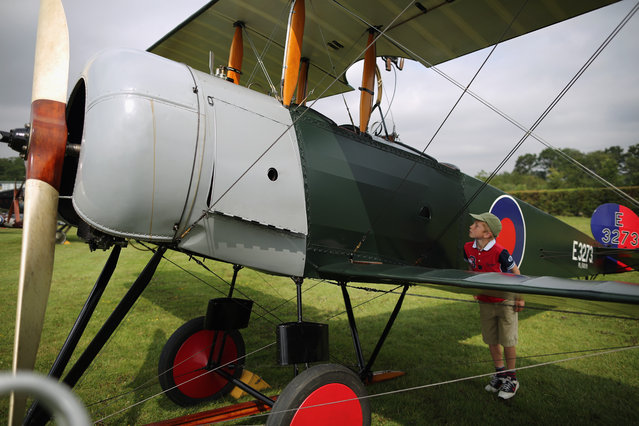
Aviation enthusiast Patrick Wilson 8, from Wetherby looks at  an Avro 504 k at “The Shuttlesworth Collection” at Old Warden on July 21, 2014 in Biggleswade, England. Of the 55,000 planes that were manufactured by the Royal Army Corps (RAC) during WWI, only around 20 remain in airworthy condition. (Photo by Dan Kitwood/Getty Images)

Aviation enthusiast Patrick Wilson 8, from Wetherby looks at an Avro 504 k at “The Shuttlesworth Collection” at Old Warden on July 21, 2014 in Biggleswade, England. Of the 55,000 planes that were manufactured by the Royal Army Corps (RAC) during WWI, only around 20 remain in airworthy condition. Six of these belong to The Shuttleworth Collection at Old Warden, Bedfordshire, making it the most complete collection of original airworthy WWI aircraft in the world. Amongst the collection is the SE5a. The SE5a is a single seater fighter aircraft. It is an original biplane designed by the Royal Aircraft Factory, with its engine built by Wolseley Motors Ltd, and it was issued to 84 Squadron in November 1918. The National Archive in Kew has recently verified that the plane saw action in France with 84 Squadron the day before Armistice, November 10, 1918. (Photo by Dan Kitwood/Getty Images)
Details
23 Jul 2014 10:00:00
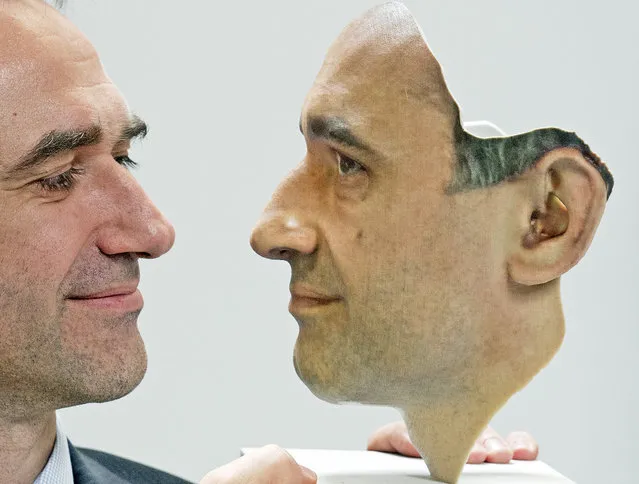
Mario Huettenhofer, chief of the German company 3D Fab, presents his own face as 3d print during the international fairs FabCon 3.D and Rapid.Tech in Erfurt, Germany, Thursday, May 15, 2014. 130 exhibitors from all over the world present the entire world of 3D printing. (Photo by Jens Meyer/AP Photo)

Mario Huettenhofer, chief of the German company 3D Fab, presents his own face as 3d print during the international fairs FabCon 3.D and Rapid.Tech in Erfurt, Germany, Thursday, May 15, 2014. 130 exhibitors from all over the world present the entire world of 3D printing. The trade fairs are accompanied by specialist programs featuring 80 scientists, practitioners and trend analysts from ten countries, who will explain the latest findings, trends and applications for additive processes in industry and for 3D printing in the private sector to newcomers, experts and consumers alike. (Photo by Jens Meyer/AP Photo)
Details
17 May 2014 13:06:00
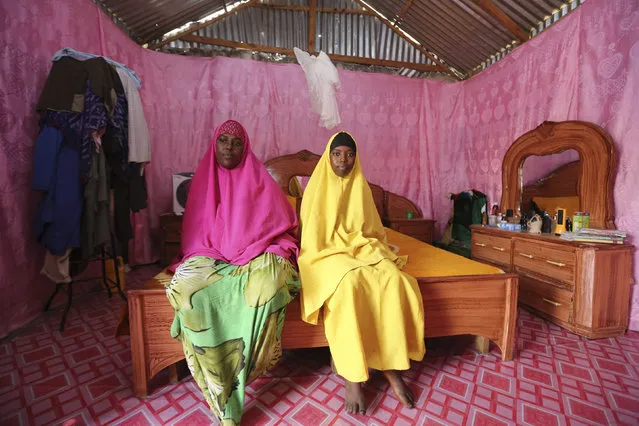
Saciido Sheik Yacquub, 34, poses for a picture with her daughter Faadumo Subeer Mohamed, 13, at their home in Hodan district IDP camp in Mogadishu February 11, 2014. Saciido, who runs a small business, wanted to be a business woman when she was a child. She studied until she was 20. She hopes that Faadumo will become a doctor. Faadumo will finish school in 2017 and hopes to be a doctor when she grows up. (Photo by Feisal Omar/Reuters)

“On March 8th activists celebrate International Women’s Day, which dates back to the early 20th century and has been observed by the United Nations since 1975. In the run-up to the event, Reuters photographers in countries around the globe took a series of portraits of women and their daughters. They asked each mother what her profession was, at what age she had finished education, and what she wanted her daughter to become when she grew up. They also asked each daughter at what age she would finish education and what she wanted to do in the future. The series of images offers an insight into the lives of women and girls around the world”. – Reuters. (Photo by Feisal Omar/Reuters)
Details
09 Mar 2014 04:33:00