Loading...
Done
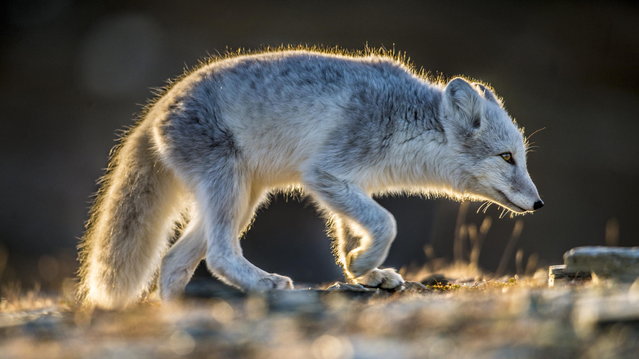
Arctic Fox. (Photo by Trond Eriksen)

“The arctic fox (Vulpes lagopus), also known as the white fox, polar fox, or snow fox, is a small fox native to the Arctic regions of the Northern Hemisphere and is common throughout the Arctic tundra biome. It is well adapted to living in cold environments. It has a deep thick fur which is brown in summer and white in winter. It averages in size at about 85.3 cm (33.6 in) in body length, with a generally rounded body shape to minimize the escape of body heat. – Wikipedia. (Photo by Trond Eriksen)
Details
26 May 2014 14:09:00
Belarusian workers works at a felt boot factory in Smilovichi, some 35km from Minsk, Belarus, 16 January 2012. (Photo by Tatyana Zenkovich/EPA)

The Smilovichi Felting Factory in Belarus was founded in 1928, when Smilovichi was a small Jewish settlement of craftsmen. Five of those craftsmen organized a small artel (a cooperative association of craftsmen who all live and work together), which produced warm boots called “valenki” for cold weather. Photo: Belarusian workers works at a felt boot factory in Smilovichi, some 35km from Minsk, Belarus, 16 January 2012. (Photo by Tatyana Zenkovich/EPA)
Details
18 Oct 2013 10:02:00
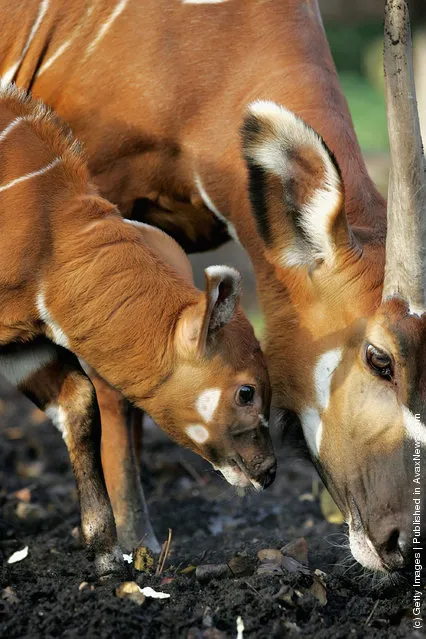
The one month old newborn Bongo Antelope

“The western or lowland bongo is a herbivorous, mostly nocturnal forest ungulate and among the largest of the African forest antelope species. Bongos are characterised by a striking reddish-brown coat, black and white markings, white-yellow stripes and long slightly spiralled horns”. – Wikipedia

Photo: The one month old newborn Bongo Antelope Calf ventures out in the cold with his mother in their enclosure at London Zoo on December 9, 2005 in London, England. (Photo by Christopher Lee/Getty Images)
Details
21 Feb 2012 12:17:00
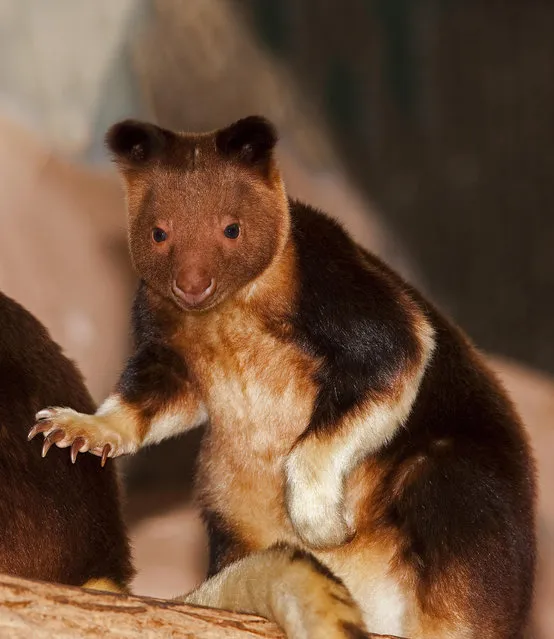
Goodfellow's Tree-Kangaroo

For some reason, everything that comes from Australia is either very cute or very poisonous; sometimes cute and poisonous at the same time. For example, Slow Loris, which you probably have seen eating a ball of rice on YouTube, is actually a very poisonous creature, despite its extreme cuteness. Goodfellow’s tree-kangaroos, on the other hand, are all cuteness and no poison. Just look at its cute little snout and furry paws, as it gingerly scratches its stomach, while sitting on its hind legs! If you don’t find this creature adorable, nothing will be able to thaw your stone-cold heart.
Details
30 Nov 2014 13:38:00
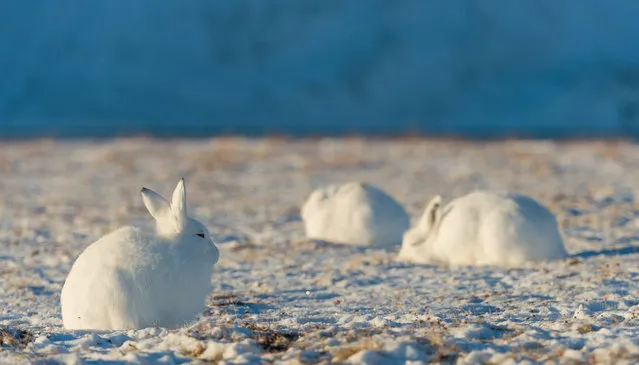
Arctic Hare

The arctic hare, or polar rabbit, is a species of hare which is adapted largely to polar and mountainous habitats. The arctic hare survives with a thick coat of fur and usually digs holes in the ground or under snow to keep warm and sleep. Arctic hares look like rabbits but have shorter ears, are taller when standing, and, unlike rabbits, can thrive in cold climates. They can travel together with many other hares, sometimes huddling with dozens or more, but are usually found alone, taking, in some cases, more than one partner. The arctic hare can run up to 60 kilometres per hour (40 mph). Its predators include the arctic wolf, arctic fox, and ermine.
Details
17 Mar 2014 13:56:00
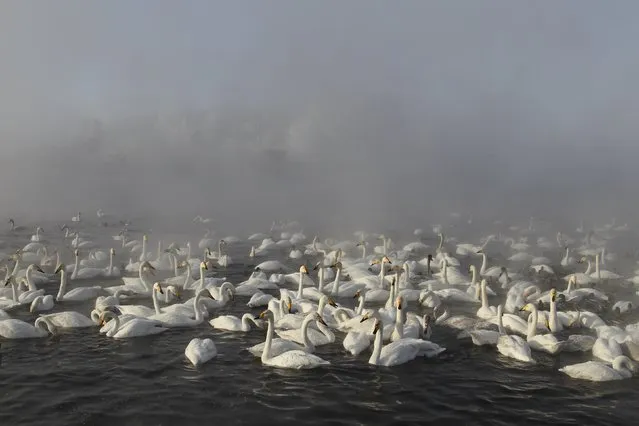
Swans swim over a lake, with the air temperature at about minus 35 degrees Celsius (minus 31 degrees Fahrenheit) as steam ascends above the water during sunset near the village of Urozhainy, Sovetsky district of Altai region, January 26, 2015. (Photo by Andrei Kasprishin/Reuters)

Swans swim over a lake, with the air temperature at about minus 35 degrees Celsius (minus 31 degrees Fahrenheit) as steam ascends above the water during sunset near the village of Urozhainy, Sovetsky district of Altai region, January 26, 2015. About 600 swans annually migrate to the lake, which is heated by warm springs, where they spend their winter being fed by yagers, which helps them to survive the severe cold. (Photo by Andrei Kasprishin/Reuters)
Details
28 Jan 2015 11:40:00
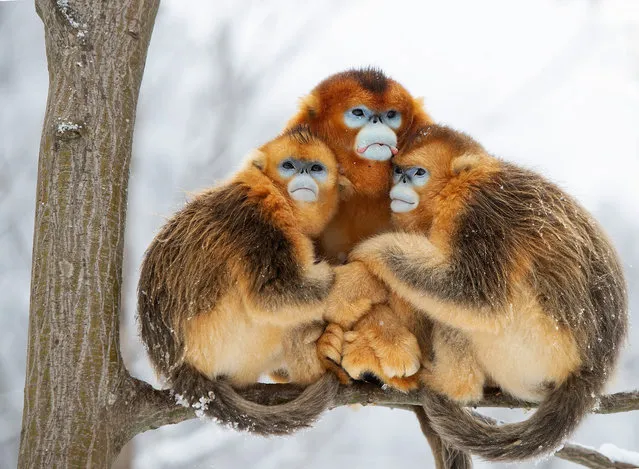
A golden huddle by Minqiang Lu, China. Two females and a male golden snub-nosed monkey huddle together to keep warm in the extreme cold. Threatened by forest loss and fragmentation, this endangered species is confined to central China. Restricted to living high up in the temperate forests, these monkeys – here in the Qinling mountains in Shaanxi province – feed mostly in the trees, on leaves, bark, buds and lichen. In heavy wind and snow, Minqiang walked up the mountain carrying his equipment. He stayed for half an hour in temperatures of –10C opposite the tree where the group was huddled before achieving this eye-level composition. (Photo by Minqiang Lu/Wildlife Photographer of the Year)

A golden huddle by Minqiang Lu, China. Two females and a male golden snub-nosed monkey huddle together to keep warm in the extreme cold. Threatened by forest loss and fragmentation, this endangered species is confined to central China. Restricted to living high up in the temperate forests, these monkeys – here in the Qinling mountains in Shaanxi province – feed mostly in the trees, on leaves, bark, buds and lichen. In heavy wind and snow, Minqiang walked up the mountain carrying his equipment. He stayed for half an hour in temperatures of –10C opposite the tree where the group was huddled before achieving this eye-level composition. (Photo by Minqiang Lu/Wildlife Photographer of the Year)
Details
12 Jan 2023 01:19:00
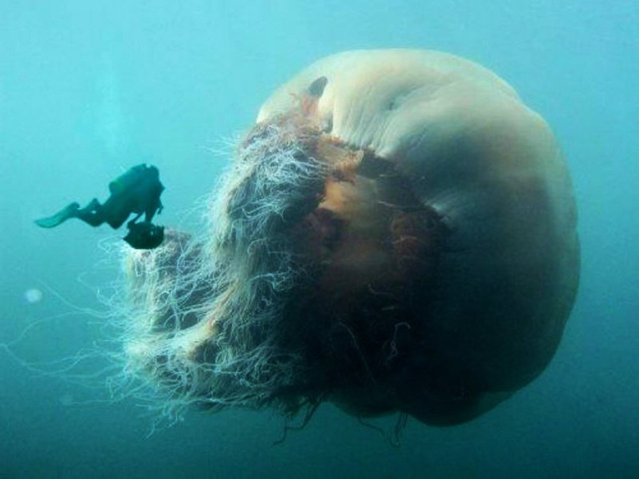
Giant Jellyfish Cyanea capillata

Cyanea capillata is the largest known species of jellyfish. Its range is confined to cold, boreal waters of the Arctic, northern Atlantic, and northern Pacific Oceans, seldom found farther south than 42°N latitude. Similar jellyfish, which may be the same species, are known to inhabit seas near Australia and New Zealand. The largest recorded specimen found, washed up on the shore of Massachusetts Bay in 1870, had a bell (body) with a diameter of 7 feet 6 inches (2.29 m) and tentacles 120 feet (37 m) long.Lion's mane jellyfish have been observed below 42°N latitude for some time—specifically in the larger bays of the east coast of the United States.
Details
24 Jul 2012 12:00:00