Loading...
Done
The floret of a Chamomile flower up close and personal. (Photo by Oliver Meckes/Barcroft Media)

These images have been created using a colour scanning electron microscope (SEM) by the award-winning Eye of Science, comprised of snapper Oliver Meckes and biologist Nicole Ottawa. For a decade the pair, based in Reutlingen in the south of Germany, worked with an old SEM they saved from the scrapheap, but for the last five years they have used a £250,000 FEI Quanta Series Field Emission SEM. Oliver said: “Flowers are beautiful in 'normal' view, but when you look closer, some parts get very bizarre and unexpected structures appear – flowers within flowers, worlds within worlds”. Photo: The floret of a Chamomile flower up close and personal. (Photo by Oliver Meckes/Barcroft Media)
Details
26 May 2014 13:51:00
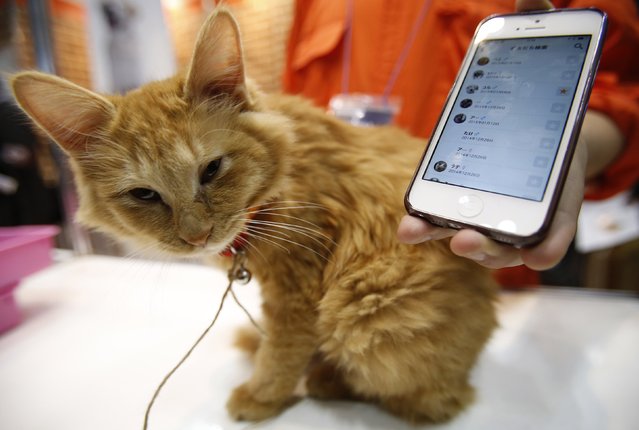
A cat wears a “Tsunagaru Col” gadget next to a smart phone displaying the connected app, at the Anicall Corp booth during the Wearable Device Technology Expo in Tokyo January 14, 2015. The gadget (“Tsunagaru” means connection) for animals tracks information about pets, such as the location and other animals the pet might be interacting with, with the purpose of providing “social networking” for animals. (Photo by Yuya Shino/Reuters)

A cat wears a “Tsunagaru Col” gadget next to a smart phone displaying the connected app, at the Anicall Corp booth during the Wearable Device Technology Expo in Tokyo January 14, 2015. The gadget (“Tsunagaru” means connection) for animals tracks information about pets, such as the location and other animals the pet might be interacting with, with the purpose of providing “social networking” for animals. The expo runs until January 16 as a part of Japan's largest electronic exhibition expected to attract around 77,000 visitors, according to organisers. (Photo by Yuya Shino/Reuters)
Details
16 Jan 2015 12:57:00
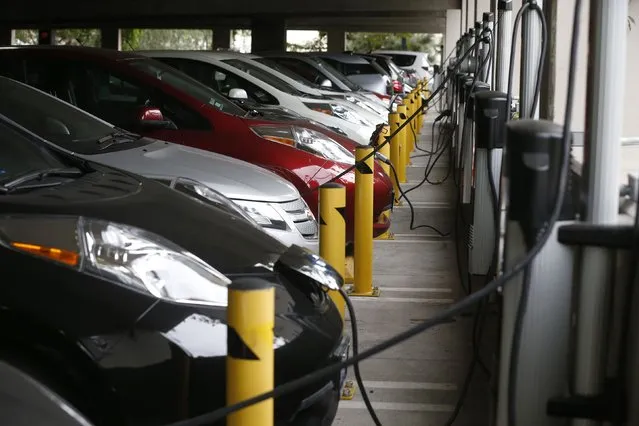
Electric cars sit charging in a parking garage at the University of California, Irvine January 26, 2015. “The Irvine Smart Grid Demonstration”, a $79 million project funded half by federal stimulus money and half by Edison and partners like UC Irvine, was launched in 2010. (Photo by Lucy Nicholson/Reuters)

Electric cars sit charging in a parking garage at the University of California, Irvine January 26, 2015. “The Irvine Smart Grid Demonstration”, a $79 million project funded half by federal stimulus money and half by Edison and partners like UC Irvine, was launched in 2010. The $12 billion utility's research team Southern California Edison is testing everything from charging electronic vehicles via cell phone to devices that smooth out the power created by rooftop solar panels. Those are some of the roughly 60 projects in the works at Edison's Advanced Technology division. It has a small $19 million annual budget, but its influence far exceeds that. (Photo by Lucy Nicholson/Reuters)
Details
28 Jan 2015 11:50:00
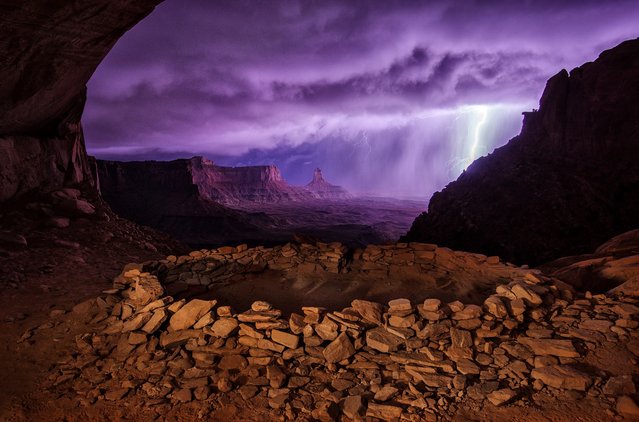
Second Place Winner: “Thunderstorm at False Kiva”. I hiked out to these ruins at night hoping to photograph them with the Milky Way, but instead a thunderstorm rolled through, creating this dramatic image. – Max Seigal. (Photo and caption by Max Seigal/National Geographic Traveler Photo Contest)

Second Place Winner: “Thunderstorm at False Kiva”. I hiked out to these ruins at night hoping to photograph them with the Milky Way, but instead a thunderstorm rolled through, creating this dramatic image. – Max Seigal. National Geographic Traveler Director of Photography Dan Westergren, one of this year's judges, shares his thoughts on the second place winner: “This photo combines two different scenes into one: the small kiva in a cliff dwelling and the grand vista of Canyonlands National Park across the valley. I really like the two different color palettes – warm inside and purple outside. This two-for-one scene was caused by the lightning storm outside the dwelling, which lit up the landscape like it was a huge electronic flash. Looking at this picture I can imagine what a wonderful sight it must have been for the ancient people who lived here. It doesn't seem too amazing now in our modern world, but might have been mind-blowing for the prehistoric residents”. Location: Utah. (Photo and caption by Max Seigal/National Geographic Traveler Photo Contest)
Details
02 Aug 2013 06:16:00
A serviceman of Ukraine's coast guard mans a gun on a patrol boat as a cargo ship passes by in the Black Sea, amid Russia’s attack on Ukraine, on February 7, 2024. (Photo by Thomas Peter/Reuters)

A serviceman of Ukraine's coast guard mans a gun on a patrol boat as a cargo ship passes by in the Black Sea, amid Russia’s attack on Ukraine, on February 7, 2024. (Photo by Thomas Peter/Reuters)
Details
17 Mar 2024 06:17:00
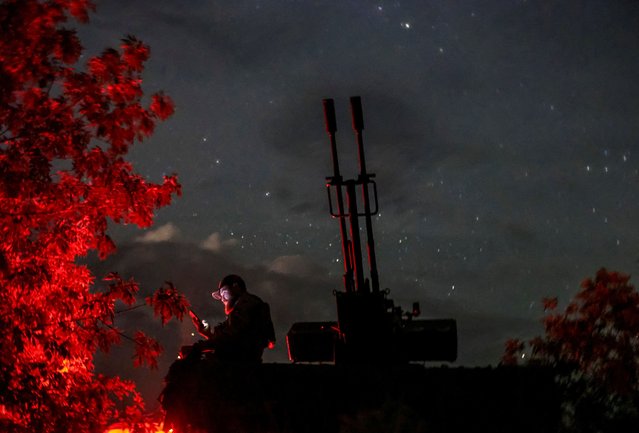
A Ukrainian serviceman from an anti-drone mobile air defence unit uses his mobile device near a ZU-23-2 anti aircraft cannon as he waits for Russian kamikaze drones, amid Russia's attack on Ukraine, in Kherson region, Ukraine on June 11, 2024. (Photo by Ivan Antypenko/Reuters)

A Ukrainian serviceman from an anti-drone mobile air defence unit uses his mobile device near a ZU-23-2 anti aircraft cannon as he waits for Russian kamikaze drones, amid Russia's attack on Ukraine, in Kherson region, Ukraine on June 11, 2024. (Photo by Ivan Antypenko/Reuters)
Details
01 Jul 2024 04:11:00
Russia – Back in the USSR

Russia – Back in the USSR. No comment.


Details
03 Sep 2014 15:40:00
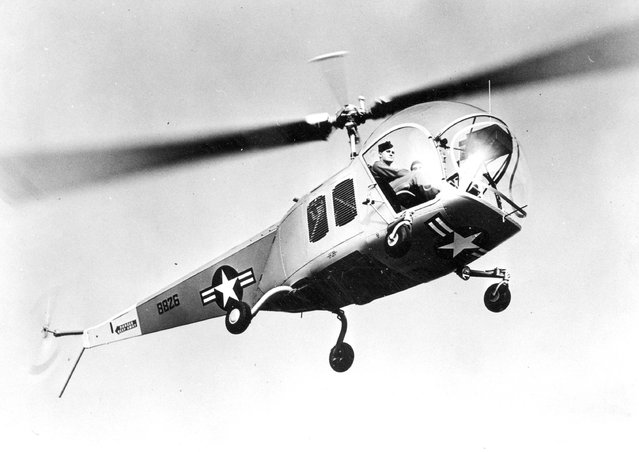
Number 10. BELL H-13 SIOUX was a two-bladed, single engine, light helicopter built by Bell Helicopter. Westland Aircraft manufactured the Sioux under license for the British military as the Sioux AH.1 and HT. (Photo by AP Photo)

Number 10. BELL H-13 SIOUX was a two-bladed, single engine, light helicopter built by Bell Helicopter. Westland Aircraft manufactured the Sioux under license for the British military as the Sioux AH.1 and HT. In 1947, the United States Air Force ordered the improved Bell Model 47A. Most were designated YR-13 and three winterized versions were designated YR-13A. The United States Army first ordered Bell 47s in 1948 under the designation H-13. These would later receive the name Sioux. The Bell-built H-13 B is seen airborne in this April 29, 1951 photo. The helicopter is equipped with a 173 horsepower engine, cruises at 85 miles per hour, climbs 900 feet in a minute and has a service ceiling of 11,500 feet. (Photo by AP Photo)
Details
08 Aug 2014 11:59:00