Loading...
Done


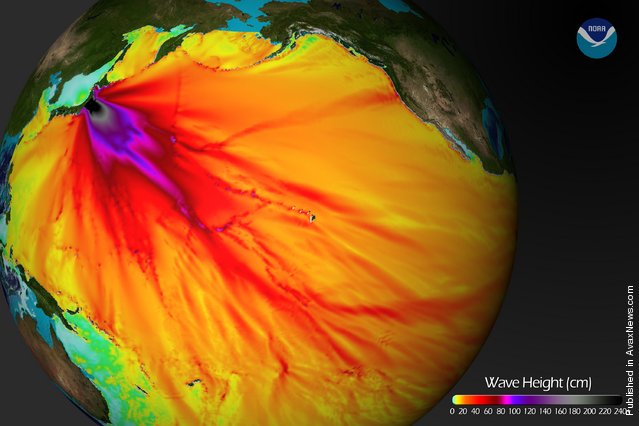
In this handout image provided by the National Oceanic and Atmospheric Administration (NOAA), model runs from the Center for Tsunami Research at the NOAA Pacific Marine Environmental Laboratory show the expected wave heights of the tsunami as it travels across the Pacific basin March 11, 2011. The largest wave heights are expected near the earthquake epicenter, off Japan. The wave will decrease in height as it travels across the deep Pacific but grow taller as it nears coastal areas. In general, as the energy of the wave decreases with distance, the near shore heights will also decrease (e.g., coastal Hawaii will not expect heights of that encountered in coastal Japan). (Photo by NOAA via Getty Images)
Details
13 Mar 2011 14:29:00
Trees

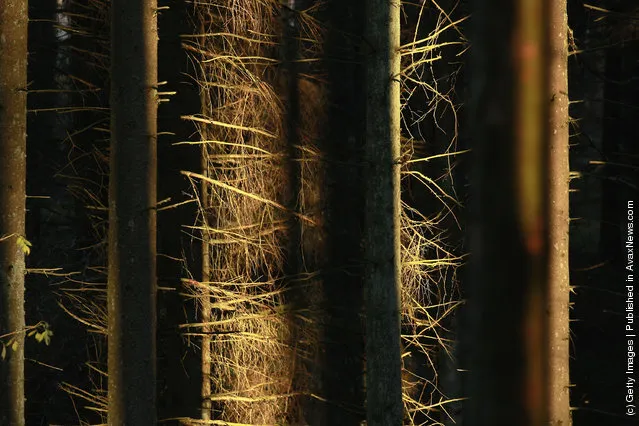
Tree trunks are seen in a forest on November 8, 2011 near Landau an der Isar, Germany. The German government is conducting a nationwide project to estimate the number, variety and geographic distribution of trees and forests in Germany, as well as their condition and health. Approximately a third of Germany is covered in woodlands, and though that territory has actually expanded since 1989, some analysts fear demand for wood will outstrip supply in coming years due to national growth in industry and bio-energy needs. (Photo by Johannes Simon/Getty Images)
Details
13 Nov 2011 11:07:00
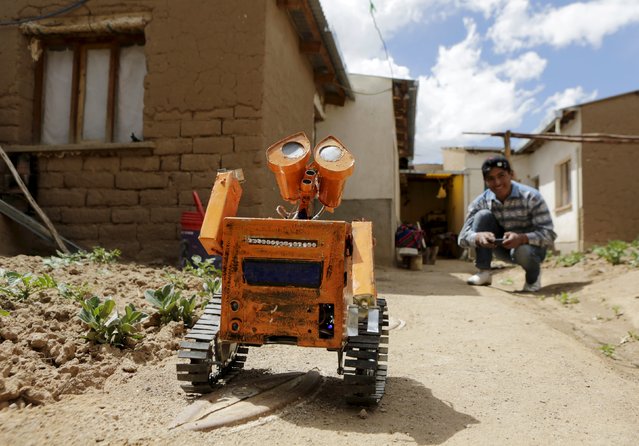
A replica of the Wall-E character is remotely controlled with a mobile phone by Bolivian student Esteban Quispe, 17, in Patacamaya, south of La Paz, December 10, 2015. (Photo by David Mercado/Reuters)

A replica of the Wall-E character is remotely controlled with a mobile phone by Bolivian student Esteban Quispe, 17, in Patacamaya, south of La Paz, December 10, 2015. Quispe built the Wall-E robot using materials he obtained from a rubbish dump in the town located in the Andean highland region. He hopes to mechanize agriculture in Patacamaya by making use of robots that operate on solar energy, Quispe told Reuters. (Photo by David Mercado/Reuters)
Details
13 Dec 2015 08:05:00
“Fish Love” Project by Photographer Denis Rouvre. Gillian Anderson. (Photo by Denis Rouvre)

The photo project was done for the organization Fishlove and included some other U.K.-based celebrities posing in the buff with critters ranging from bass fish to sharks. Its goal is to raise awareness of how overfishing is destroying the oceans. The release of Gillian's nearly nude pic, which was snapped by French portrait photographer Denis Rouvre, is timed with a European Parliament vote on banning destructive forms of deep-sea fishing in the Northeast Atlantic. The Fishlove organization is trying to rally voters to sign a petition ending deep-sea trawling – which, according to scientists, is negatively impacting the fish population and their habits – and Gillian solicited signatures in a Twitter post. Photo: “Fish Love” Project by Photographer Denis Rouvre. Gillian Anderson. (Photo by Denis Rouvre)
Details
04 Dec 2013 20:33:00
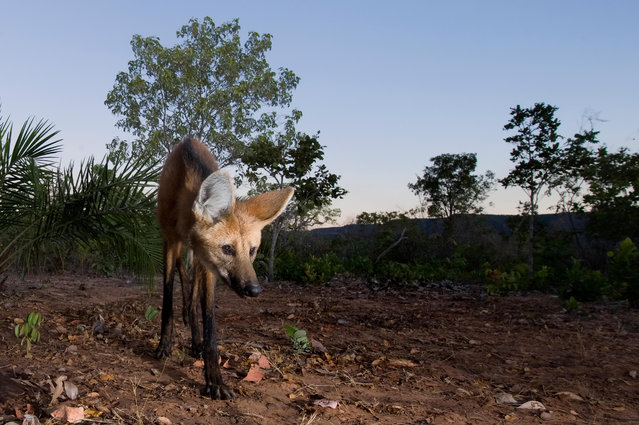
The maned wolf is among the large mammals in the Brazilian Cerrado that are threatened by the increasing conversion of grasslands into farmland for grazing and growing crops. (Photo by Ben Cranke/Nature Picture Library/Alamy Stock Photo)

Global wildlife populations will decline by 67% by 2020 unless urgent action is taken to reduce human impact on species and ecosystems, warns the biennial Living Planet Index report from WWF (World Wide Fund for Nature) and ZSL (Zoological Society of London). From elephants to eels, here are some of the wildlife populations most affected by human activity. Here: The maned wolf is among the large mammals in the Brazilian Cerrado that are threatened by the increasing conversion of grasslands into farmland for grazing and growing crops. (Photo by Ben Cranke/Nature Picture Library/Alamy Stock Photo)
Details
28 Oct 2016 10:47:00
In his series “Ballerinas of Cairo”, photographer Mohamed Taher documents Egyptian dancers making the city streets their stage – pirouetting, leaping and posing their way through their country’s sprawling capital. The photos are, at first glance, stunning snapshots of a city’s vibrant culture in motion. But considering the dangers Egyptian women face for roaming these same streets on a daily basis, their impact is far deeper. Sexual harassment continues to present not just a possibility but a terrifying reality in present-day Egypt. A 2013 United Nations report calculated that 99.3 percent of women in the country have experienced sexual harassment on the streets, a problem that’s sparked initiatives giving women a way to fight back. The violence is rooted in an extreme conservative perspective encouraging women to stay in the home. (Photo by Mohamed Taher/Ballerinas of Cairo)

In his series “Ballerinas of Cairo”, photographer Mohamed Taher documents Egyptian dancers making the city streets their stage – pirouetting, leaping and posing their way through their country’s sprawling capital. The photos are, at first glance, stunning snapshots of a city’s vibrant culture in motion. (Photo by Mohamed Taher/Ballerinas of Cairo)
Details
17 Jan 2017 12:30:00
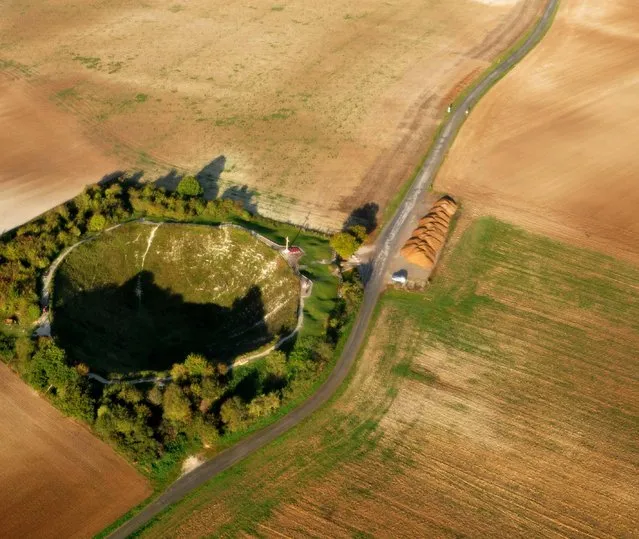
Lochnagar Crater Somme In France

It is amazing how much the humanity can change the face of the earth. Not only can it create huge craters, which look a lot like craters from meteors, they leave a big enough impact that it can be seen from space. Though this crater, caused by a massive explosion on 1 July 1916, looks large, being 90 feet deep and 300 feet across; it is nowhere big enough to be viewed for space. A common misconception is that the Great Wall of China can be seen from space. In reality, however, it is impossible. Not only is it of the same color as the earth near it, it is also not that wide. Deforestation, on the other hand, can be clearly seen from space. Also, at night, all the lights that the large cities produce are also very visible.
Details
17 Nov 2014 12:48:00


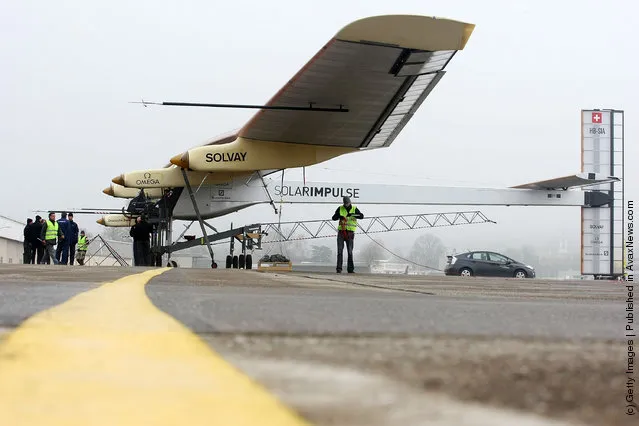
“Solar Impulse is a European long-range solar powered plane project being undertaken by Bertrand Piccard and André Borschberg. The project eventually hopes to succeed in the first circling of the earth with a piloted fixed-wing aircraft using only solar power. The first aircraft, bearing the Swiss aircraft registration code of HB-SIA, is a single-seater, capable of taking off under its own power, and intended to remain airborne up to 36 hours. This aircraft first flew an entire diurnal solar cycle, including nearly 9 hours of night flying, in a 26-hour flight on 7–8 July 2010”. – Wikipedia


Photo: Workers prepare the Solar Impulse airplane HB-SIA for a first runway test on November 19, 2009 in Dubendorf, Switzerland. Solar Impulse chairman Bertrand Piccard, psychatrist and aeronaut, who made the first non-stop round-the-world balloon flight, and CEO and former fighter pilot Andrй Borschberg plan a round-the-world flight, driven only by solar energy, for 2012. (Photo by Johannes Simon/Getty Images)
Details
16 May 2011 08:13:00