Loading...
Done
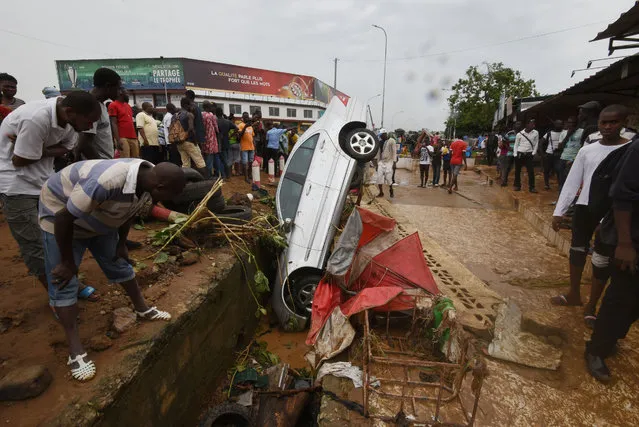
Pedestrians look at the wreckage of a vehicle lodged in a storm drain on a street in Abidjan on June 19, 2018, in which a man was reportedly found dead after floodwaters receded following an overnight downpour in the city. Fifteen people have died in Abidjan, Ivory Coast' s economic capital, during flooding caused by torrential rain overnight, Interior Minister Sidiki Diakite said. Rain poured down overnight on June 19, causing flash floods up to 2.5 metres (more than eight feet) deep, he said. (Photo by Sia Kambou/AFP Photo)

Pedestrians look at the wreckage of a vehicle lodged in a storm drain on a street in Abidjan on June 19, 2018, in which a man was reportedly found dead after floodwaters receded following an overnight downpour in the city. Fifteen people have died in Abidjan, Ivory Coast' s economic capital, during flooding caused by torrential rain overnight, Interior Minister Sidiki Diakite said. Rain poured down overnight on June 19, causing flash floods up to 2.5 metres (more than eight feet) deep, he said. (Photo by Sia Kambou/AFP Photo)
Details
22 Jun 2018 09:17:00
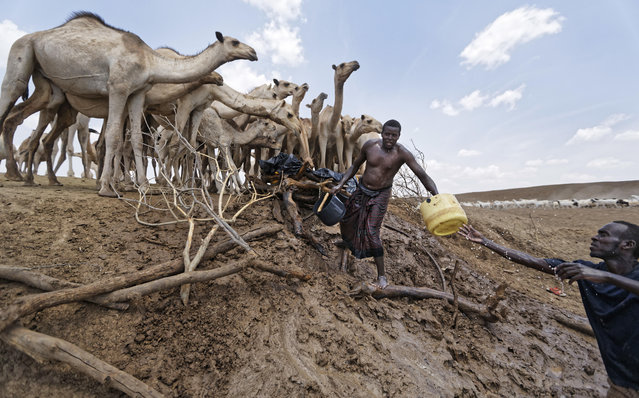
Camel herders scoop up water in plastic buckets from one of the few watering holes in the area, to water their animals near the drought-affected village of Bandarero, near Moyale town on the Ethiopian border, in northern Kenya, Friday, March 3, 2017. The U.N. humanitarian chief, Stephen O'Brien, toured Bandarero village on Friday and called on the international community to act to “avert the very worst of the effects of drought and to avert a famine to make sure we don't go from what is deep suffering to a catastrophe”. (Photo by Ben Curtis/AP Photo)

Camel herders scoop up water in plastic buckets from one of the few watering holes in the area, to water their animals near the drought-affected village of Bandarero, near Moyale town on the Ethiopian border, in northern Kenya, Friday, March 3, 2017. The U.N. humanitarian chief, Stephen O'Brien, toured Bandarero village on Friday and called on the international community to act to “avert the very worst of the effects of drought and to avert a famine to make sure we don't go from what is deep suffering to a catastrophe”. (Photo by Ben Curtis/AP Photo)
Details
05 Mar 2017 00:03:00
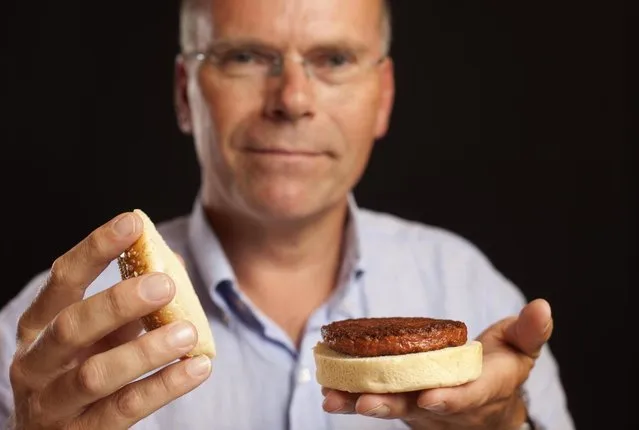
In this handout image provided by Ogilvy, a burger made from cultured beef, which has been developed by Professor Mark Post of Maastricht University in the Netherlands (pictured) is shown to the media during a press conference on August 5, 2013 in London, England. Cultured Beef could help solve the coming food crisis and combat climate change with commercial production of Cultured Beef beginning within ten to twenty years. (Photo by David Parry via Getty Images)

In this handout image provided by Ogilvy, a burger made from cultured beef, which has been developed by Professor Mark Post of Maastricht University in the Netherlands (pictured) is shown to the media during a press conference on August 5, 2013 in London, England. The in-vitro burger, cultured from cattle stem cells, the first example of what its creator says could provide an answer to global food shortages and help combat climate change, was fried in a pan and tasted by two volunteers. The burger is the result of years of research by Dutch scientist Mark Post, a vascular biologist at the University of Maastricht, who is working to show how meat grown in petri dishes might one day be a true alternative to meat from livestock.The meat in the burger has been made by knitting together around 20,000 strands of protein that has been cultured from cattle stem cells in Post's lab. (Photo by David Parry)
Details
06 Aug 2013 08:48:00
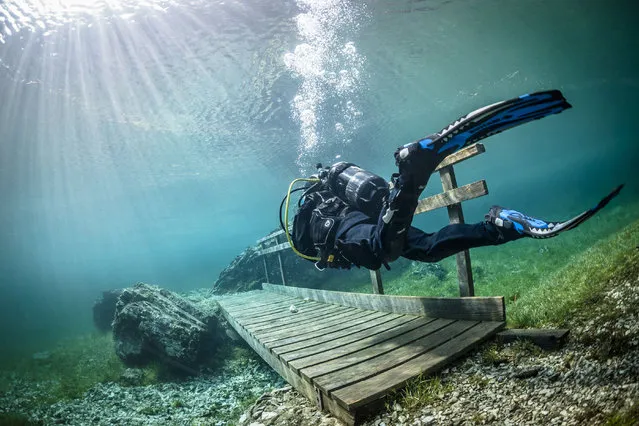
A diver crossing a bridge in the flood water. Green Lake in Tragoess, Austria. (Photo by Solnet/The Grosby Group)

These photographs appear to show a spectacular underwater world making it ideal for scuba divers – in central Europe. Twelve metres of water covers trees, footpaths, benches and bridges that are usually accessible throughout the year. Visitors to the Green Lake in Tragoess, Austria, that is normally only one metre deep, can leisurely stroll around the picturesque lagoon. Photo: A diver crossing a bridge in the flood water. (Photo by Solnet/The Grosby Group)
Details
29 Nov 2013 12:41:00
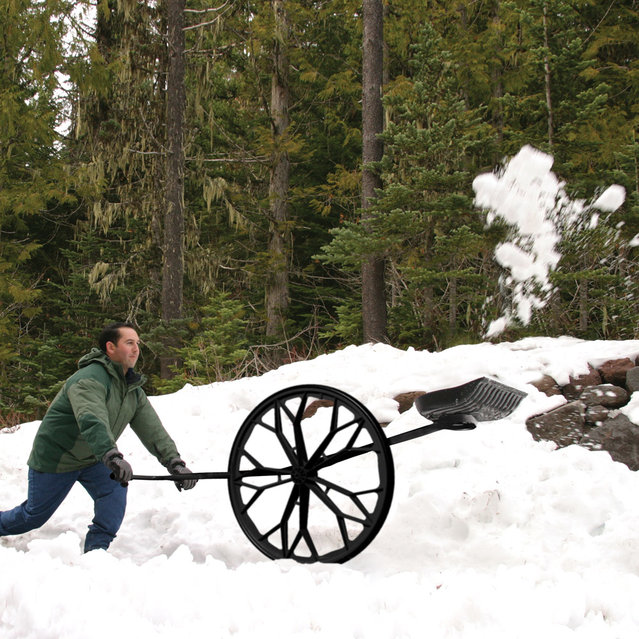
Wovel - The Ultimate Snow Shovel

The Wovel could possibly be the most advanced human snow removal machine ever created, next to simply getting someone else to do it. The revolutionary wheel design reduces the risks associated with heart attacks and back injuries because it uses adjustable leverage and your own body weight to push, lift, and throw snow up to 18" deep. The best feature about the Wovel is compared to a gas-powered snow blower, this one will always start.
Details
22 Dec 2013 11:17:00
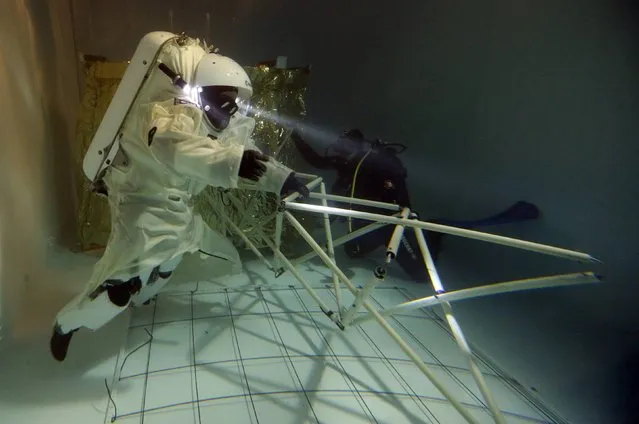
National Diving School director Jerome Vincent, wearing a Gandolfi space suit, executes training procedures in a swimming pool in Marseille October 22, 2014. (Photo by Jean-Paul Pelissier/Reuters)

National Diving School director Jerome Vincent, wearing a Gandolfi space suit, executes training procedures in a swimming pool in Marseille October 22, 2014. The underwater test session develops European expertise in spacewalk simulations under partial gravity for exploring the Moon, asteroids and Mars.The training is organised by Comex, a French company specializing in engineering and deep sea diving operations, in collaboration with the European Space Agency (ESA) and with Apollo XI “Under the sea”. (Photo by Jean-Paul Pelissier/Reuters)
Details
26 Oct 2014 12:47:00
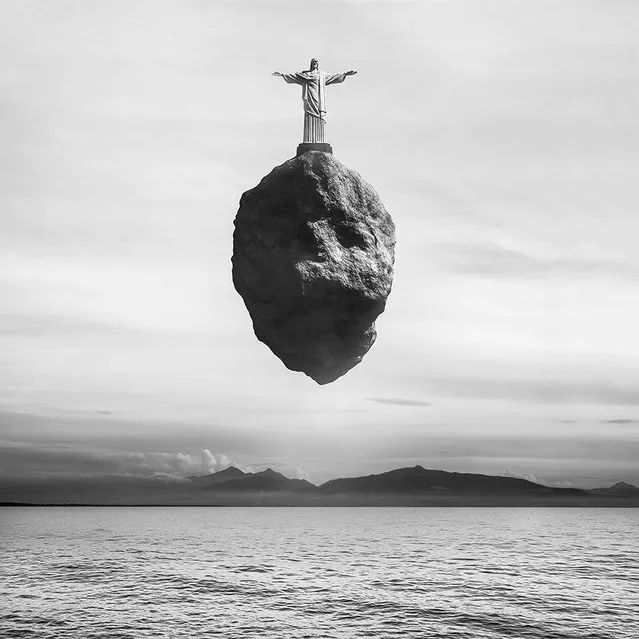
Levitation By Giuseppe Lo Schiavo

The essence of the “masterpieces” created by Giuseppe Lo Schiavo is in taking a famous architectural landmark placing it on a rock, and making it float over some body of water. Well… that’s pretty much it. Of course there will be some people who will look deep within these works of art, and catch the true meaning and intentions of the mastermind who created them, and maybe even purchase them for unreasonable amounts of money. But the rest of us, the common folk, will stare at it for a while, cringe, and move on without a second thought. (Photo by Giuseppe Lo Schiavo)
Details
04 Dec 2014 11:25:00


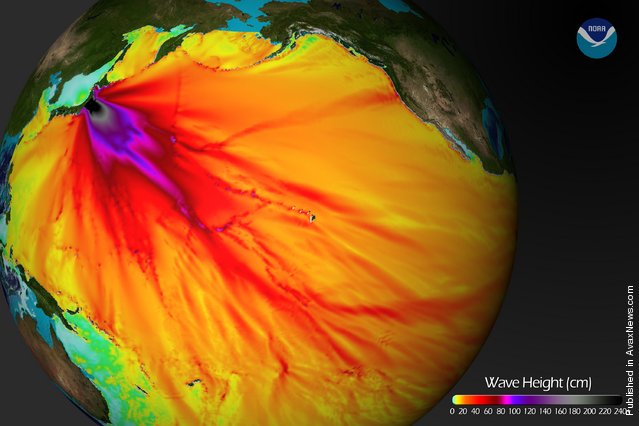
In this handout image provided by the National Oceanic and Atmospheric Administration (NOAA), model runs from the Center for Tsunami Research at the NOAA Pacific Marine Environmental Laboratory show the expected wave heights of the tsunami as it travels across the Pacific basin March 11, 2011. The largest wave heights are expected near the earthquake epicenter, off Japan. The wave will decrease in height as it travels across the deep Pacific but grow taller as it nears coastal areas. In general, as the energy of the wave decreases with distance, the near shore heights will also decrease (e.g., coastal Hawaii will not expect heights of that encountered in coastal Japan). (Photo by NOAA via Getty Images)
Details
13 Mar 2011 14:29:00