Loading...
Done
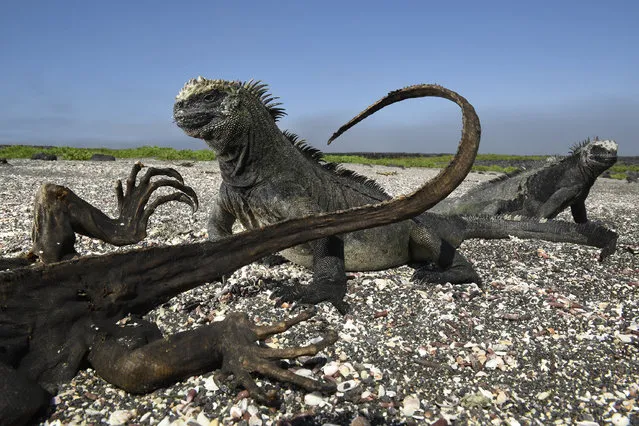
Galapagos – Rocking the Cradle: Four major ocean currents converge along the Galapagos archipelago, creating the conditions for an extraordinary diversity of animal life, April 25, 2016. The islands are home to at least 7,000 flora and fauna species, of which 97 percent of the reptiles, 80 percent of the land birds, 50 percent of the insects and 30 percent of the plants are endemic. The local ecosystem is highly sensitive to the changes in temperature, rainfall and ocean currents that characterize the climatic events known as El Niño and La Niña. These changes cause marked fluctuations in weather and food availability. Many scientists expect the frequency of El Niño and La Niña to increase as a result of climate change, making the Galapagos a possible early-warning location for its effects. (Photo by Thomas P. Peschak for National Geographic/World Press Photo)

Galapagos – Rocking the Cradle: Four major ocean currents converge along the Galapagos archipelago, creating the conditions for an extraordinary diversity of animal life, April 25, 2016. The islands are home to at least 7,000 flora and fauna species, of which 97 percent of the reptiles, 80 percent of the land birds, 50 percent of the insects and 30 percent of the plants are endemic. (Photo by Thomas P. Peschak for National Geographic/World Press Photo)
Details
16 Apr 2018 00:01:00
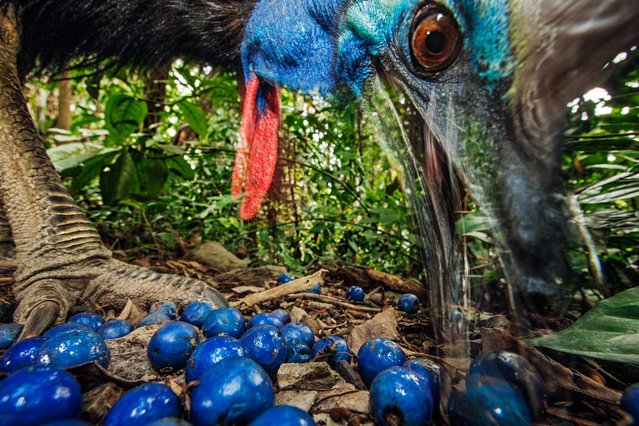
“Cassowaries are large, flightless birds related to emus and (more distantly) to ostriches, rheas, and kiwis”, writes Olivia Judson in the September issue of National Geographic magazine. (Photo by Christian Ziegler/National Geographic)

“Cassowaries are large, flightless birds related to emus and (more distantly) to ostriches, rheas, and kiwis”, writes Olivia Judson in the September issue of National Geographic magazine. How large? People-size: Adult males stand well over five foot five and top 110 pounds. Females are even taller, and can weigh more than 160 pounds. Dangerous when roused, they’re shy and peaceable when left alone. But even birds this big and tough are prey to habitat loss. The dense New Guinea and Australia rain forests where they live have dwindled. Today cassowaries might number 1,500 to 2,000. And because they help shape those same forests – by moving seeds from one place to another – “if they vanish”, Judson writes, “the structure of the forest would gradually change” too. (Photo by Christian Ziegler/National Geographic)
Details
06 Jan 2014 12:21:00
An empty cell block is pictured within Joint Task Force Guantanamo's Camp VI at the U.S. Naval Base in Guantanamo Bay, Cuba March 22, 2016. (Photo by Lucas Jackson/Reuters)

An empty cell block is pictured within Joint Task Force Guantanamo's Camp VI at the U.S. Naval Base in Guantanamo Bay, Cuba March 22, 2016. (Photo by Lucas Jackson/Reuters)
Details
24 Mar 2016 12:02:00
Models wait backstage during the Ukrainian Fashion Week in Kiev, October 16, 2015. (Photo by Valentyn Ogirenko/Reuters)

Models wait backstage during the Ukrainian Fashion Week in Kiev, October 16, 2015. (Photo by Valentyn Ogirenko/Reuters)
Details
19 Oct 2015 08:08:00
21 year-old Chanel Tapper, with the amazing tongue and 35 year-old Aevin Dugas, with the beautiful hair was certified as world record breakers for the world’s longest tongue and the world’s biggest afro in the Guinness Book of World Records. (Photo by Guinness World Records)

21 year-old Chanel Tapper, with the amazing tongue and 35 year-old Aevin Dugas, with the beautiful hair was certified as world record breakers for the world’s longest tongue and the world’s biggest afro in the Guinness Book of World Records. (Photo by Guinness World Records)
Details
10 Jan 2013 14:45:00
Indian Air Force soldiers toss their rifles as they perform during the full-dress rehearsal for Indian Air Force Day at the Hindon air force station on the outskirts of New Delhi October 6, 2015. (Photo by Anindito Mukherjee/Reuters)

Indian Air Force soldiers toss their rifles as they perform during the full-dress rehearsal for Indian Air Force Day at the Hindon air force station on the outskirts of New Delhi October 6, 2015. (Photo by Anindito Mukherjee/Reuters)
Details
08 Oct 2015 08:07:00
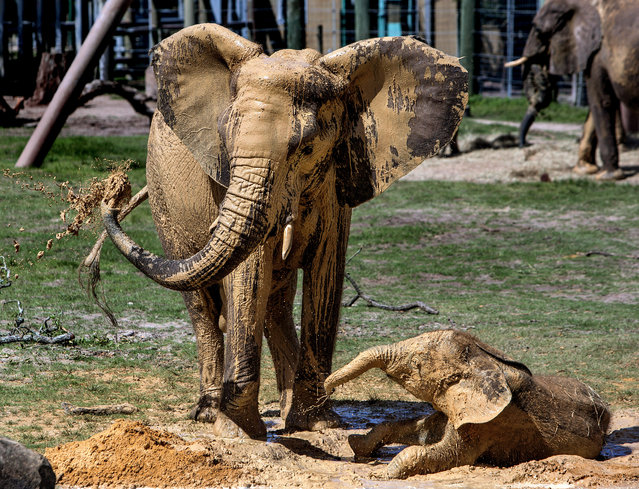
Lowry Park Zoo elephants Matjeka, 23, and her 1-year-old daughter, Mavi, apply a liberal coating of “sunscreen”  to themselves in a clay mud wallow at the park Tuesday, August 12, 2014, in Tampa, Fla., on the park's first observation of World Elephant Day to raise awareness of the wild African elephant crisis. (Photo by Cherie Diez/AP Photo/The Tampa Bay Times)

Lowry Park Zoo elephants Matjeka, 23, and her 1-year-old daughter, Mavi, apply a liberal coating of “sunscreen” to themselves in a clay mud wallow at the park Tuesday, August 12, 2014, in Tampa, Fla., on the park's first observation of World Elephant Day to raise awareness of the wild African elephant crisis. “Elephants are prone to being sunburned”, said associate curator Chris Massaro. “What they need is lot of mud or clay to roll around in and cover up their skin so it will protect it from the sun”. (Photo by Cherie Diez/AP Photo/The Tampa Bay Times)
Details
16 Aug 2014 11:38:00
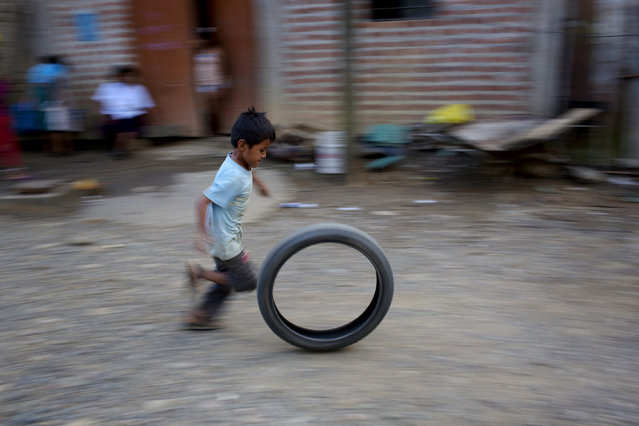
In this Saturday, June 20, 2015 photo, a boy runs while playing with a motorcycle wheel in Samugari, Ayacucho, Peru. (Photo by Rodrigo Abd/AP Photo)

In a simpler time all a child or an adult needed to enjoy the outdoors was a ball and a stick. Or maybe an old tire tied to a high branch to fashion a swing. And the only instruction given to children was to “be home before dark”. Now there are iPads and computers and television screens and shrinking safe public spaces. But despite the distractions and limitations of space, these images show the charm of kicking a ball or skipping rope endures. Sometimes with modifications as a nod to changing times. Here: in this Saturday, June 20, 2015 photo, a boy runs while playing with a motorcycle wheel in Samugari, Ayacucho, Peru. (Photo by Rodrigo Abd/AP Photo)
Details
20 Jul 2015 10:26:00