Loading...
Done
A bullied student with vitiligo is celebrating learning to love her skin by turning it into art  making a world map, flowers and even a Van Gogh painting. Ashley Soto, 21, from Orlando in Florida, USA, has found turning her white patches of skin into art has empowered her and helped her to embrace her vitiligo. Here are some of the art pieces Ashleys made to celebrate and embrace her vitiligo from a world map to simply tracing her vitiligo and also Van Goghs Starry Night. (Photo by Ashley Soto/Caters News Agency)

A bullied student with vitiligo is celebrating learning to love her skin by turning it into art making a world map, flowers and even a Van Gogh painting. Ashley Soto, 21, from Orlando in Florida, USA, has found turning her white patches of skin into art has empowered her and helped her to embrace her vitiligo. Here are some of the art pieces Ashleys made to celebrate and embrace her vitiligo from a world map to simply tracing her vitiligo and also Van Goghs Starry Night. (Photo by Ashley Soto/Caters News Agency)
Details
16 Mar 2017 00:02:00


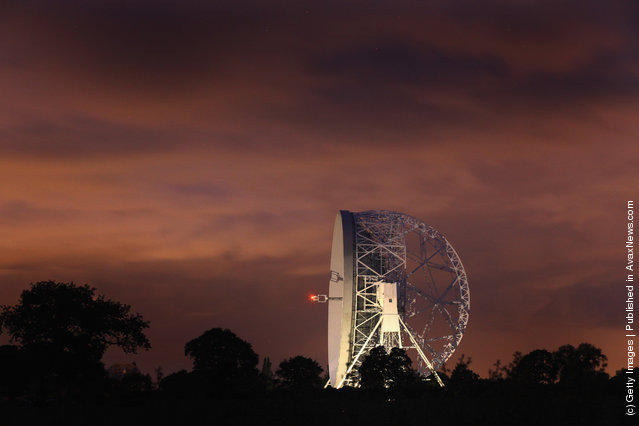
“The Lovell Telescope is a radio telescope at Jodrell Bank Observatory, near Goostrey, Cheshire in the north-west of England. When it was constructed in 1955, the telescope was the largest steerable dish radio telescope in the world at 76.2 m (250 ft) in diameter; it is now the third largest, after the Green Bank telescope in West Virginia, USA, and the Effelsberg telescope in Germany. It was originally known as the 250 ft (76 m) telescope or the Radio Telescope at Jodrell Bank, before becoming the Mark I telescope around 1961 when future telescopes (the Mark II, III, and IV) were being discussed. It was renamed to the Lovell Telescope in 1987 after Bernard Lovell, and became a Grade I listed building in 1988. The telescope forms part of the MERLIN and European VLBI Network arrays of radio telescopes”. – Wikipedia

Photo: The Lovell Telescope listens to the night sky for radio signals from space at Jodrell Bank on June 22, 2011 in Holmes Chapel, England. Jodrell Bank Centre for Astrophysics and it's world famous Lovell Telescope is on the shortlist of Britain's submission for Unesco World Heritage Site status. (Photo by Christopher Furlong/Getty Images)
Details
24 Jun 2011 09:34:00
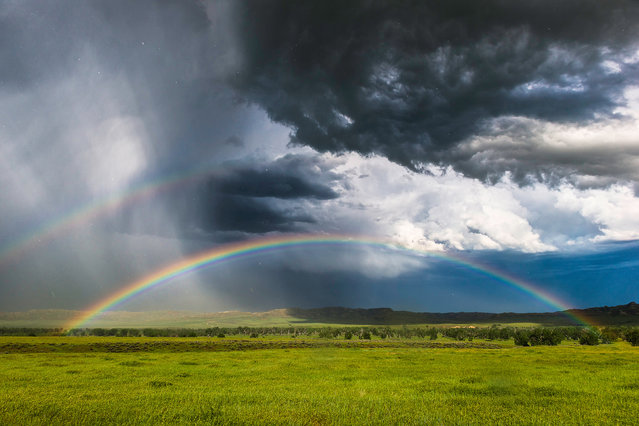
A photographer has weathered some of Americas most violent storms to capture these stunning snaps. (Photo by Caters News)

A photographer has weathered some of Americas most violent storms to capture these stunning snaps. Storm chaser Mike Mezeul II, 30, has travelled all over the US to shoot the likes of mammoth thunderstorms and surreal cloud patterns. His incredible collection of storm images are the result of more than 15 years of photography and thousands of miles of travel. The photographer, from Frisco in Texas, USA, became interested in storm chasing aged 16 when he got his first car. He has since shot ferocious storms as far north as the Canadian border and as far south as Mexico. (Photo by Caters News)
Details
04 Dec 2014 12:16:00
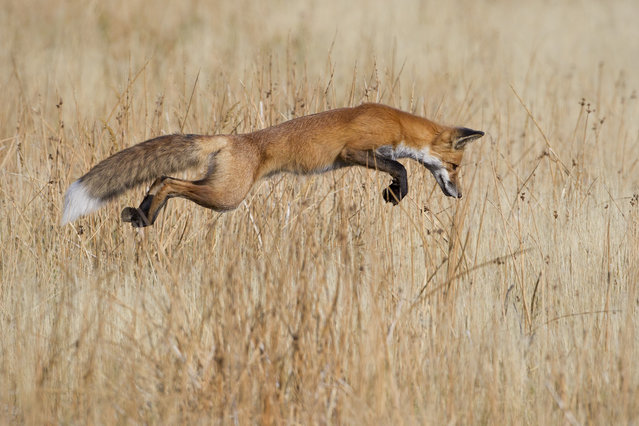
Canada: “Lucky pounce”. (Photo by Connor Stefanison/Wildlife Photographer of the Year 2013)

The winners of The London’s Natural History Museum's prestigious Wildlife Photographer of the Year for 2013 have finally been unveiled. Selected from almost 43,000 entries from 96 countries, the winners offer a glimpse of the stunning array of natural beauty on our planet. Photo: Canada: “Lucky pounce”. “Anticipating the pounce – that was the hardest part”, says Connor, who had come to Yellowstone National Park, Wyoming, USA, in search of wildlife as much as the spectacular landscape. He had found this fox, his first ever, on his last day in the park. It was so absorbed in hunting that Connor had plenty of time to get out of the car and settle behind a rock. It quartered the grassland, back and forth, and then started staring intently at a patch of ground, giving Connor just enough warning of the action to come. When it sprung up, Connor got his shot. And when it landed, the fox got his mouse. (Photo by Connor Stefanison/Wildlife Photographer of the Year 2013)
Details
17 Oct 2013 08:12:00
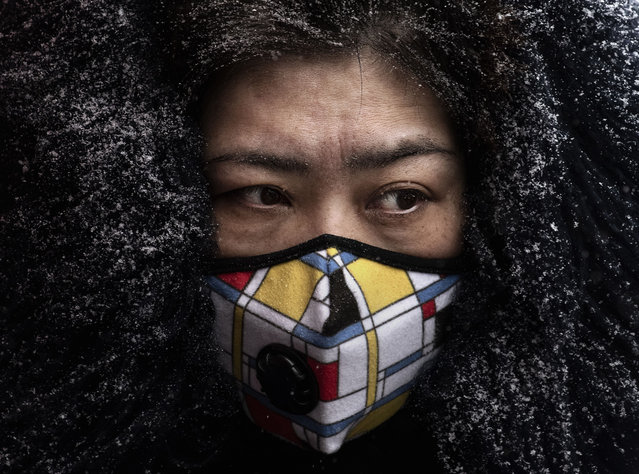
A Chinese woman wears a protective mask as she shops in a market on February 6, 2020 in Beijing, China. The number of cases of a deadly new coronavirus rose to more than 28000 in mainland China Thursday, days after the World Health Organization (WHO) declared the outbreak a global public health emergency. China continued to lock down the city of Wuhan in an effort to contain the spread of the pneumonia-like disease which medicals experts have confirmed can be passed from human to human. In an unprecedented move, Chinese authorities have put travel restrictions on the city which is the epicenter of the virus and municipalities in other parts of the country affecting tens of millions of people. The number of those who have died from the virus in China climbed to over 564 on Thursday, mostly in Hubei province, and cases have been reported in other countries including the United States, Canada, Australia, Japan, South Korea, India, the United Kingdom, Germany, France and several others. The World Health Organization has warned all governments to be on alert and screening has been stepped up at airports around the world. Some countries, including the United States, have put restrictions on Chinese travelers entering and advised their citizens against travel to China. (Photo by Kevin Frayer/Getty Images)

A Chinese woman wears a protective mask as she shops in a market on February 6, 2020 in Beijing, China. The number of cases of a deadly new coronavirus rose to more than 28000 in mainland China Thursday, days after the World Health Organization (WHO) declared the outbreak a global public health emergency. (Photo by Kevin Frayer/Getty Images)
Details
09 Feb 2020 00:07:00
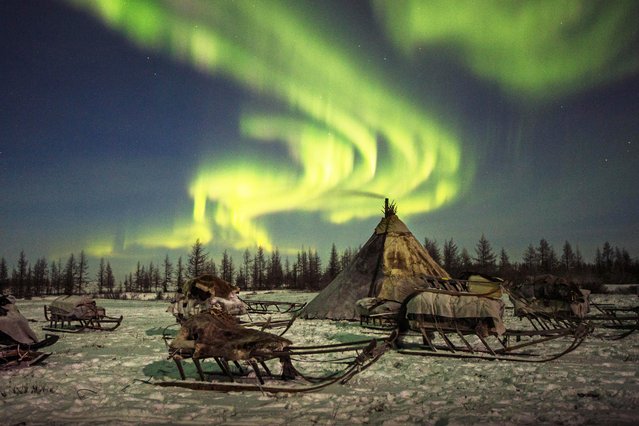
An empty camp is shown beneath a colourful sky in Siberia, December 2016. (Photo by Timothy Allen/Barcroft Productions)

A British photographer has captured life at the “edge of the world”. Timothy Allen, best known for his work on BBC's Human Planet, trekked through the freezing Siberian wilderness for 16 days as he joined part of an 800km migration of reindeer in the Yamal-Nenets region – a name that roughly translates to “edge of the world”. The stunning pictures feature the nomadic Nenets tribe, who drink blood to survive in -45°C temperatures. Timothy's epic journey, which will be revealed in an eight-minute documentary on Animal Planet USA, saw him travel across the bleak terrain of the frozen Ob River with the Nenets people in December last year. Here: An empty camp is shown beneath a colourful sky in Siberia, December 2016. (Photo by Timothy Allen/Barcroft Productions)
Details
19 Sep 2017 07:48:00
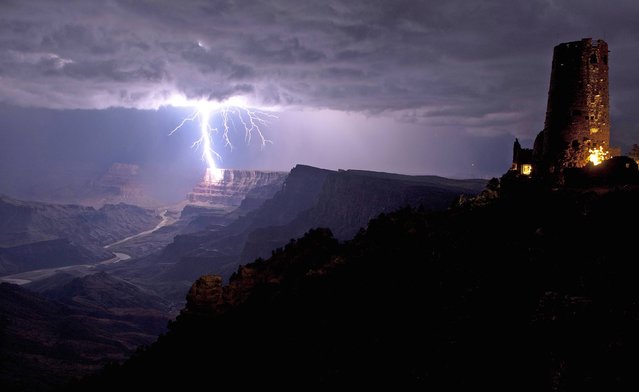
This is the incredible moment a fierce lightning bolt crashed against the Grand Canyon illuminating the steep canyon walls. Shrouded in darkness, the breath-taking landscape was shocked into life as mother nature sent the bolt storming down to Earth. (Photo by Travis Roe/U.S. Dept. of the Interior/Caters News)

This is the incredible moment a fierce lightning bolt crashed against the Grand Canyon illuminating the steep canyon walls. Shrouded in darkness, the breath-taking landscape was shocked into life as mother nature sent the bolt storming down to Earth. As it cracked against the rocks the bright blue bolt illuminated the South Rim of the canyon, considered one of the Seven Natural Wonders of the World. With just the Desert View Watchtower in the foreground, the lightning was perfectly framed by the canyon which is located in Arizona, USA. (Photo by Travis Roe/U.S. Dept. of the Interior/Caters News)
Details
14 May 2013 11:00:00
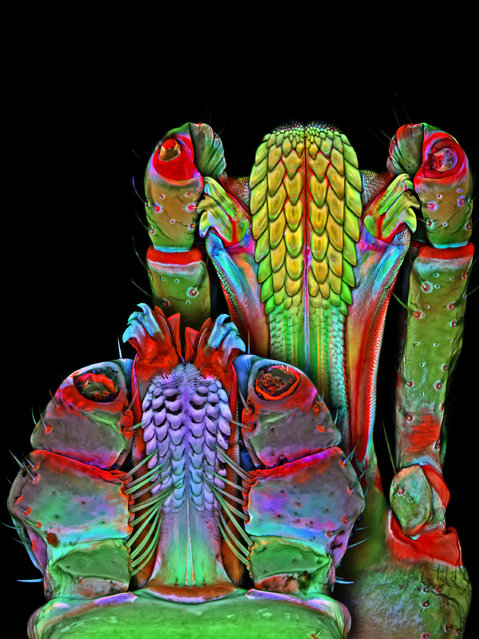
Underside of the Brown dog tick and Lonestar tick mouthparts; Confocal, 100X. Janelia Farm Research Campus, Howard Hughes Medical Institute (HHMI), Ashburn, Virginia, USA. (Photo by Dr. Igor Robert Siwanowicz/Nikon Small World 2014)

Now celebrating its 40th year, Nikon Small World is widely regarded as the leading forum to recognize proficiency and photographic excellence of photography taken under the microscope. To select the winners, competition judges analyzed entries from all over the world covering subjects ranging from chemical compounds to up-close-and-personal looks at biological specimens. The 2014 winners will be revealed on October 30th. In 2014, the competition received over 1,200 entries from more than 79 countries around the world. (Photo by Dr. Igor Robert Siwanowicz/Nikon Small World 2014)
Details
17 Oct 2014 13:10:00