Loading...
Done
Old Roller Skate Sandals

Throughout time, people invented and reinvented rollerblades. Of course everyone’s dream was to combine them with regular footwear, so that at one moment you’re riding down the road, and in 5 seconds you’re walking into a shopping mall, without the mall cop chasing after you. The most resent inventions were heelys (sneakers with a wheel located in the heels) and Xsjados (aggressive skates, the exterior of which could be removed to reveal regular sneakers). In the past, people made similar attempts, however, these inventions were very inefficient and the trend never caught on. Omnia’C has found and made photos of one of such inventions: pop out roller skate sandals all the way from 1970s. Though their design is pretty cool, it seems like they would be very uncomfortable, since they totally lack ankle support.
Details
02 Nov 2014 11:04:00
Giant's Causeway

Legend has it that the Irish warrior Fionn mac Cumhaill (Finn McCool) built the causeway to walk to Scotland to fight his Scottish counterpart Benandonner. One version of the legend tells that Fionn fell asleep before he got to Scotland. When he did not arrive, the much larger Benandonner crossed the bridge looking for him. To protect Fionn, his wife Oonagh laid a blanket over him so he could pretend that he was actually their baby son. In a variation, Fionn fled after seeing Benandonner's great bulk, and asked his wife to disguise him as the baby. In both versions, when Benandonner saw the size of the 'infant', he assumed the alleged father, Fionn, must be gigantic indeed. Therefore, Benandonner fled home in terror, ripping up the Causeway in case he was followed by Fionn.
Details
11 May 2015 10:45:00
Tibetan Mastiff

“The Tibetan Mastiff also known as Do-khyi (variously translated as “home guard”, “door guard”, “dog which may be tied”, “dog which may be kept”), reflects its use as a guardian of herds, flocks, tents, villages, monasteries, and palaces, much as the old English ban-dog (also meaning tied dog) was a dog tied outside the home as a guardian. However, in nomad camps and in villages, the Do-khyi is traditionally allowed to run loose at night and woe be unto the stranger who walks abroad after dark”. – Wikipedia

Photo: A man displays a Tibetan Mastiff he raised during the Tibetan Mastiff exposition on April 7, 2007 in Langfang of Hebei Province, China. (Photo by China Photos/Getty Images)
Details
05 Oct 2011 14:27:00
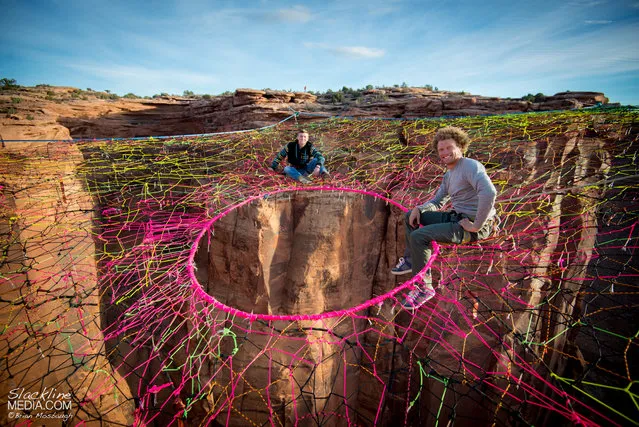
Stupefying Hand-Knitted Hammock Is Suspended

Exhilaration beyond imaginable, intense concentration on a single point, and complete freedom of soul – all these things very accurately describe the art of highlining. Highlining is a branch of a new sport called slacklining, which involves walking on special webbing secured between two points. Andi Lewis is one of the most famous slackliners in the world, particularly due to his performance during Superbowl Halftime Show in 2012. He never fails to surprise people with an amazing stunt or a project. This time he and his friends have created a completely incredible hand-knitted hammock located hundreds of feet above the ground. Just getting to this hammock requires immense skills and bravery. But once you’re finally there, you can rest a while, before mustering up the courage to go back across a narrow line with nothing but thin air beneath your feet.

Details
27 Feb 2015 18:38:00
In this February 19, 2014 photo, a skate seller puts slices of skate into styrofoam boxes for shipment to customers around South Korea at a fish market in Mokpo, a port city on the southwestern tip of the Korean Peninsula. The aroma of one of southwestern South Korea's most popular delicacies regularly gets compared to rotting garbage and filthy bathrooms. (Photo by Ahn Young-joon/AP Photo)

In this February 19, 2014 photo, a skate seller puts slices of skate into styrofoam boxes for shipment to customers around South Korea at a fish market in Mokpo, a port city on the southwestern tip of the Korean Peninsula. The aroma of one of southwestern South Korea's most popular delicacies regularly gets compared to rotting garbage and filthy bathrooms. And that's by fans. The unusual dish is typically made by taking dozens of fresh skate, a cartilage-rich fish that looks like a stingray, stacking them up in a walk-in refrigerator and waiting. Up to a month in some cases. (Photo by Ahn Young-joon/AP Photo)
Details
11 Apr 2014 07:41:00
A scene showing one of the first trench battles is prepared for the opening of the 3D Panorama exhibition “Memory talks. The road through war” in the former Sevcabel port in St. Petersburg, Russia, 16 September 2019. (Photo by Anatoly Maltsev/EPA/EFE)

A scene showing one of the first trench battles is prepared for the opening of the 3D Panorama exhibition “Memory talks. The road through war” in the former Sevcabel port in St. Petersburg, Russia, 16 September 2019. Various 3D dioramas – containing genuine wartime items such as aircraft, tanks and artillery in original size – allow visitors to walk through scenes from the beginning to the end of WWII without any museum barriers. The exhibition opens from 19 September 2019 to May 2020. (Photo by Anatoly Maltsev/EPA/EFE)
Details
19 Sep 2019 00:01:00
Tardigrades (commonly known as waterbears or moss piglets). (Photo by SPL/East News)

“Tardigrades (commonly known as waterbears or moss piglets) are small, water-dwelling, segmented animals with eight legs. Tardigrades were first discovered in 1773 by Johann August Ephraim Goeze, who called them kleiner Wasserbär, meaning “little water bear” in German. The name Tardigrada means “slow walker” and was given by Lazzaro Spallanzani in 1777. The name water bear comes from the way they walk, reminiscent of a bear's gait. The biggest adults may reach a body length of 1.5 millimetres (0.059 in), the smallest below 0.1 mm. Freshly hatched tardigrades may be smaller than 0.05 mm”. – Wikipedia. Photo: Tardigrades. (Photo by SPL/East News)
Details
26 Sep 2012 09:55:00
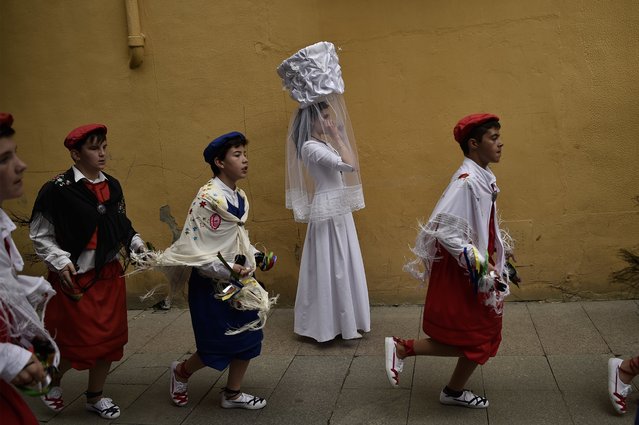
A participant of  “Bread Procession of the Saint”, takes part in the ceremony in honor of Domingo de La Calzada Saint (1019-1109) who helped poor people and pilgrimage, in Santo Domingo de La Calzada, northern Spain, Wednesday, May 11, 2016. (Photo by Alvaro Barrientos/AP Photo)

A participant of “Bread Procession of the Saint”, takes part in the ceremony in honor of Domingo de La Calzada Saint (1019-1109) who helped poor people and pilgrimage, in Santo Domingo de La Calzada, northern Spain, Wednesday, May 11, 2016. Every year during spring season, “Las Doncellas” (White Virgins), hold on their head a basket cover with white cloth while they walk past along of this old village in honor of the saint. (Photo by Alvaro Barrientos/AP Photo)
Details
12 May 2016 14:59:00