Loading...
Done
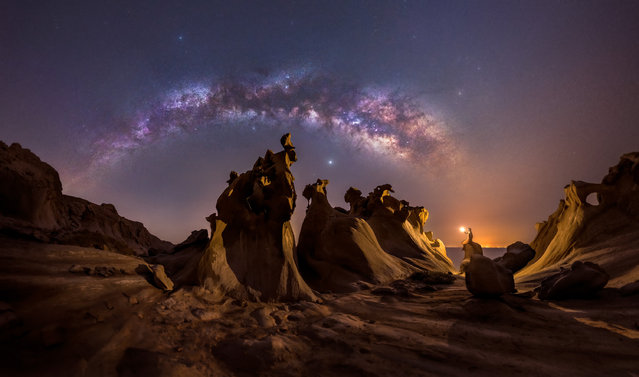
Night lovers; Hormozgan province, Iran. “In this picture, you can see the Milky Way rising on a fascinating spring night on the Persian Gulf coast. The stunning cliffs of this area make every viewer imagine and even talk to them! The light pollution from a faraway city was quite strong, so it was a challenging post-processing process. I’m a nightscaper who tries to achieve an artistic look in my images, and in this image, I tried to convey and capture the magic of this location”. (Photo by Mohammad Hayati/Milky Way Photographer of the Year)

Night lovers; Hormozgan province, Iran. “In this picture, you can see the Milky Way rising on a fascinating spring night on the Persian Gulf coast. The stunning cliffs of this area make every viewer imagine and even talk to them! The light pollution from a faraway city was quite strong, so it was a challenging post-processing process. I’m a nightscaper who tries to achieve an artistic look in my images, and in this image, I tried to convey and capture the magic of this location”. (Photo by Mohammad Hayati/Milky Way Photographer of the Year)
Details
01 Jun 2021 09:42:00
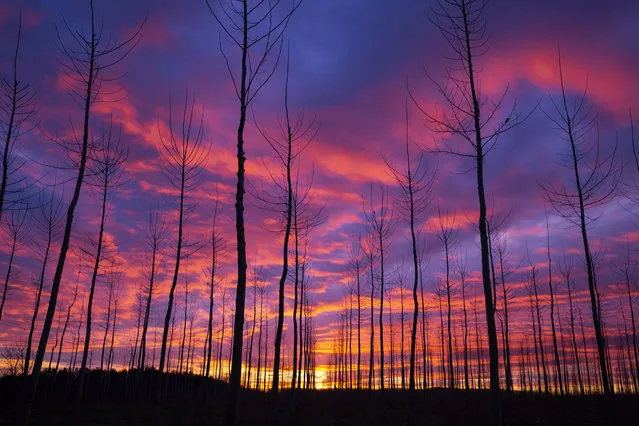
The Sun rises above the forest near Kiskorpad, Hungary, 02 January 2021. (Photo by Gyorgy Varga/EPA/EFE)

The Sun rises above the forest near Kiskorpad, Hungary, 02 January 2021. (Photo by Gyorgy Varga/EPA/EFE)
Details
24 Feb 2021 09:13:00
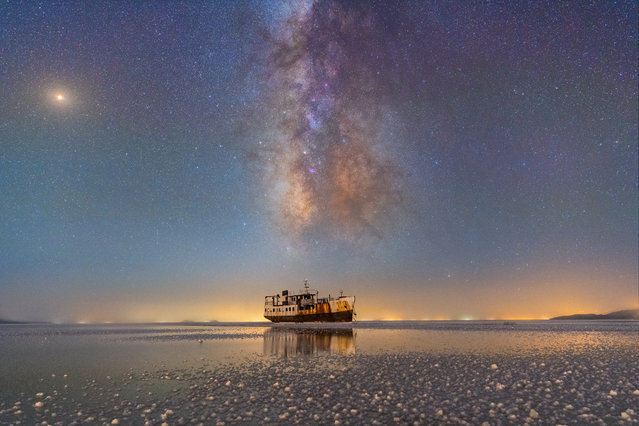
Sharafkhaneh port and lake Urmia. Masoud Ghadiri (Iran). The summer Milky Way is very prominent in this photo. On the galaxy zone, Saturn is located besides the Lagoon nebula. On the right of the horizon, you can see the extreme light pollution of Urmia, which is caused by ever-increasing city development. (Photo by Masoud Ghadiri/National Maritime Museum)

Sharafkhaneh port and lake Urmia. Masoud Ghadiri (Iran). The summer Milky Way is very prominent in this photo. On the galaxy zone, Saturn is located besides the Lagoon nebula. On the right of the horizon, you can see the extreme light pollution of Urmia, which is caused by ever-increasing city development. (Photo by Masoud Ghadiri/National Maritime Museum)
Details
20 Jun 2019 00:01:00
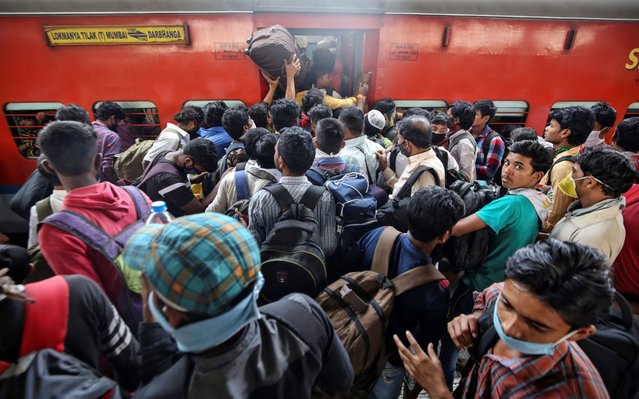
Migrant workers and their families board an overcrowded passenger train, after government imposed restrictions on public gatherings in attempts to prevent spread of coronavirus disease (COVID-19), in Mumbai, India, March 21, 2020. (Photo by Prashant Waydande/Reuters)

Migrant workers and their families board an overcrowded passenger train, after government imposed restrictions on public gatherings in attempts to prevent spread of coronavirus disease (COVID-19), in Mumbai, India, March 21, 2020. (Photo by Prashant Waydande/Reuters)
Details
29 Mar 2020 00:01:00
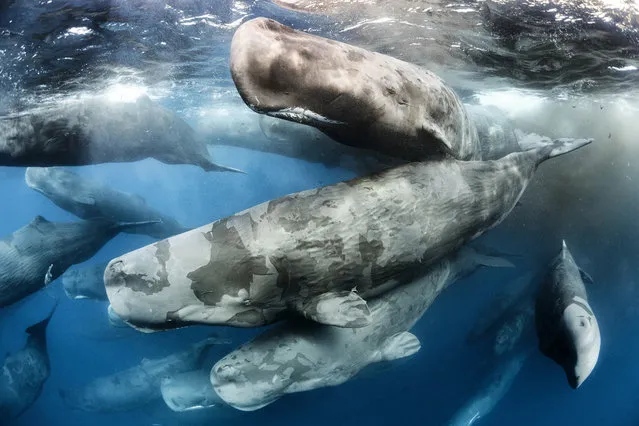
Giant gathering by Tony Wu. “The first indication that something extraordinary was going on were the blows, huge numbers of them – the exhalations of huge numbers of whales. Entering the water, the photographer witnessed an extraordinary scene. Hundreds, possibly thousands, of sperm whales were twirling and twisting through the water, bumping and rubbing against each other, and there was a cacophony of sound – the pulsation, buzz, creak and crackle of whale communication. The picture shows just a fraction of the scene, with the whales stacked up below. Undoubtedly, this was a clan gathering”. (Photo by Tony Wu/Unforgettable Underwater Photography/NHM)

A new book published by the UK Natural History Museum showcases some of the most memorable underwater photographs taken over the last few decades in its annual wildlife photographer of the year competition. Here: Giant gathering by Tony Wu. “The first indication that something extraordinary was going on were the blows, huge numbers of them – the exhalations of huge numbers of whales. Entering the water, the photographer witnessed an extraordinary scene”. (Photo by Tony Wu/Unforgettable Underwater Photography/NHM)
Details
17 Apr 2018 00:03:00
Creative imagery bronze winner. Make-up by Chengbo Sun, China. (Photo by BPOTY/Cover Images)

Creative imagery bronze winner. Make-up by Chengbo Sun, China. (Photo by BPOTY/Cover Images)
Details
22 Aug 2020 00:03:00
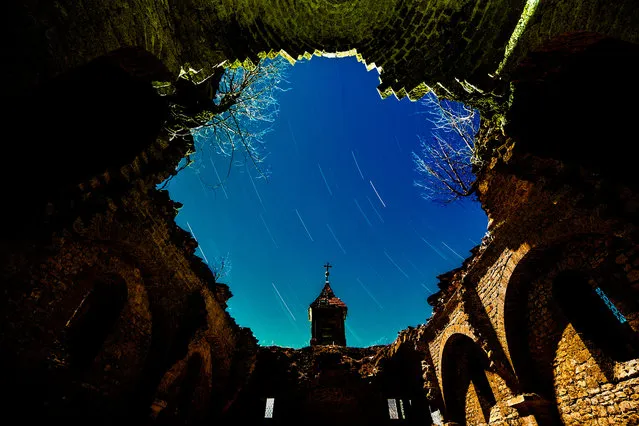
A long exposure image shows star trails from the abandoned submerged orthodox church of St. Nicholas without roof, submerged in the Mavrovo Lake, near Mavrovi Anovi, North Macedonia, 17 March 2019. Constructed in 1850 and submerged in 1952 due to the construction of the hydro system Mavrovo, the church St. Nicholas continues to attract the attention of almost every visitor as it peaks from the water. (Photo by Georgi Licovski/EPA/EFE)

A long exposure image shows star trails from the abandoned submerged orthodox church of St. Nicholas without roof, submerged in the Mavrovo Lake, near Mavrovi Anovi, North Macedonia, 17 March 2019. Constructed in 1850 and submerged in 1952 due to the construction of the hydro system Mavrovo, the church St. Nicholas continues to attract the attention of almost every visitor as it peaks from the water. (Photo by Georgi Licovski/EPA/EFE)
Details
19 Mar 2019 00:03:00
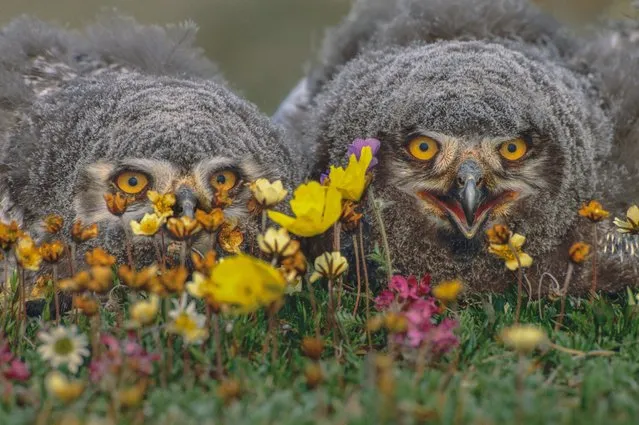
Snowy owlets (Bubo scandiacus), Arctic National Wildlife Refuge, Alaska, USA. “A pair of gray-feathered snowy owlets hunker down in the abundant flowers that flourish in the dropping-enriched soil of their nest mound”. (Photo by Art Wolfe/Art Wolfe Stock)

The photography of Art Wolfe covers the globe, capturing landscapes, wildlife, and cultures from every continent; here he talks through a selection of his favourite images. Art Wolfe is an American photographer and conservationist. His photographs have been noted by environmental advocacy groups for their “stunning” visual impact. Here: Snowy owlets (Bubo scandiacus), Arctic National Wildlife Refuge, Alaska, USA. (Photo by Art Wolfe/Art Wolfe Stock)
Details
19 Mar 2018 00:05:00