Loading...
Done
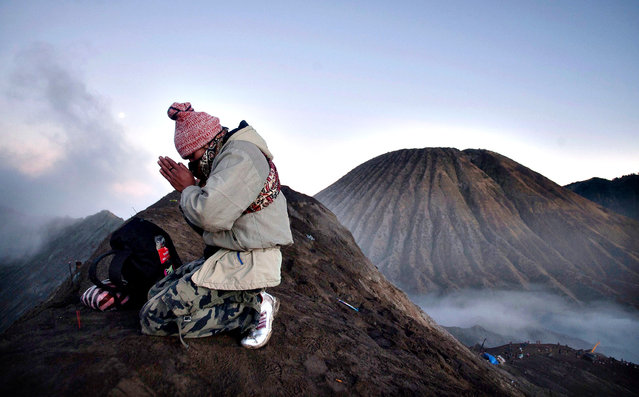
A Tengger tribesman prays at Mount Bromo during the annual Kasada ceremony in East Java on August 12, 2014. The Kasada ceremony is a festival held every 14th day of the Kasada month in the traditional Hindu lunar calender to honour Sang Hyang Widhi (God Almighty) and is based on the legend of Roro Anteng and Joko Seger from the Majapahit Kingdom, from which their Tengger tribe name originates. (Photo by Juni Kriswanto/AFP Photo)

A Tengger tribesman prays at Mount Bromo during the annual Kasada ceremony in East Java on August 12, 2014. The Kasada ceremony is a festival held every 14th day of the Kasada month in the traditional Hindu lunar calender to honour Sang Hyang Widhi (God Almighty) and is based on the legend of Roro Anteng and Joko Seger from the Majapahit Kingdom, from which their Tengger tribe name originates. Hundreds of worshippers from the Tengger tribe offer food and livestock as a symbolic sacrifice which they throw into the crater for the blessings of safety and prosperity to their familyies and community. (Photo by Juni Kriswanto/AFP Photo)
Details
16 Aug 2014 11:19:00
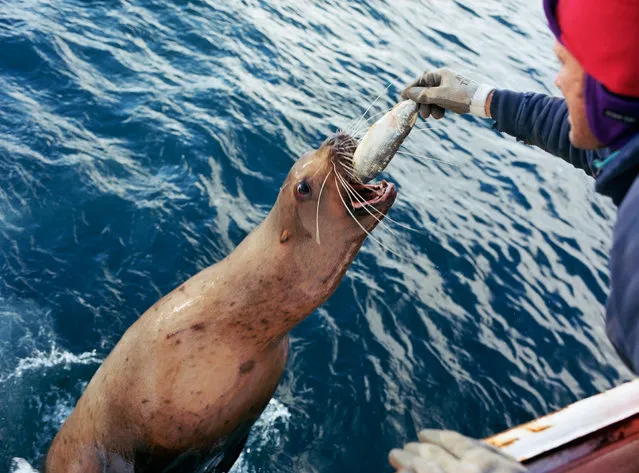
Before heading up to Alaska, the ship loads up with 3 months worth of food. Even so, it's hardly necessary. The ship's cook is constantly steaming fresh crab legs and seafood caught during the day. The hard labour of fishing requires a diet heavy in fat, protein, and omega-3s. Here, a sea lion gets a bite of the grub. (Photo by Corey Arnold)

In 2002 photographer Corey Arnold left behind a poor economy in San Francisco and headed up to Alaska to try his luck at his longtime passion of fishing. Arnold, who had worked summers during college on a salmon boat in Alaska, signed onto the f/v Rollo, a crabbing boat that fishes in the dangerous Bering Sea. While working long, strenuous hours on the Rollo, Arnold often stole away with the captain’s permission to grab his camera and photograph the crew and the ship. Arnold eventually put together “Fish Work: Bering Sea”, a documentation of his seven adventurous and dicey crab seasons aboard the Rollo. (Photo by Corey Arnold)
Details
20 Aug 2014 10:05:00
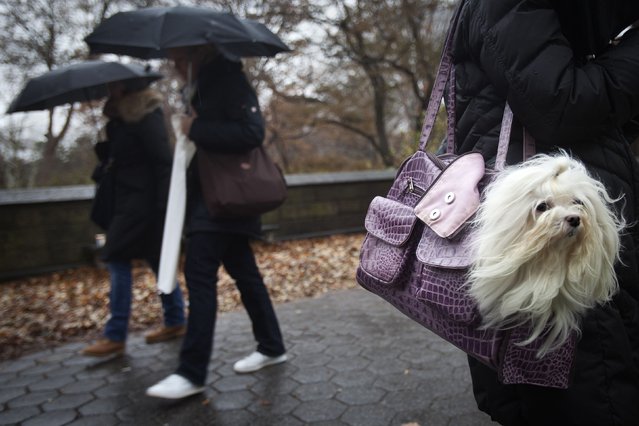
Emma the Maltese's fur blows in the wind as she rides in her owner's purse on 5th Avenue at Central Park in New York December 2, 2014. (Photo by Carlo Allegri/Reuters)

Emma the Maltese's fur blows in the wind as she rides in her owner's purse on 5th Avenue at Central Park in New York December 2, 2014. (Photo by Carlo Allegri/Reuters)
Details
06 Dec 2014 13:07:00
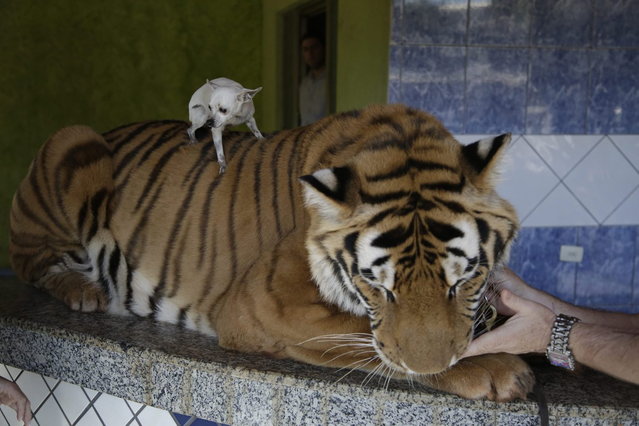
The Borges' family pet dog, Little, is placed on the back of Tom, their tiger, for a photo to be taken, in Maringa, Brazil, Friday, September 27, 2013. The Brazilian family is now locked in a legal dispute for the big cats, they have eight tigers and two lions, with federal wildlife officials working to take them away. While Borges does have a license to raise the animals, Brazilian wildlife officials say he illegally bred the cats, creating a public danger. (Photo by Renata Brito/AP Photo)

“Ary Borges and his family live in southern Brazil like most families the Borges' love animals and have an array of cats living in their home. The only difference between the cats owned by the Borges family and the cat that is cuddled up on your lap as you read this is the Borges' cats weigh over 700 pounds and could kill you just as soon as look at you. The Borges family shares their home with nine tigers, two lionesses, a chimp and a Chihuahua”. – Amanda Schiavo via Latin Times. Photo: The Borges' family pet dog, Little, is placed on the back of Tom, their tiger, for a photo to be taken, in Maringa, Brazil, Friday, September 27, 2013. (Photo by Renata Brito/AP Photo)
Details
04 Oct 2013 11:51:00
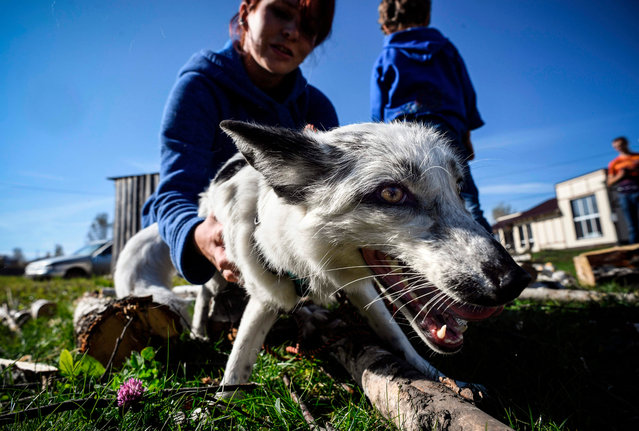
Tatyana Abramova, 33, plays with her home fox Plombir at her countryside house outside Siberian city of Novosibirsk on September 12, 2020. The official start of the Soviet experiment to better understand the domestication of animals by humans began in 1959, and was initiated by geneticists Dmitri Beliaiev and Lioudmila Trout on a farm in Akademgorodok, the scientific center of excellence in Siberia. Their primary objective was to domesticate foxes, to understand how the ancestor of wolves, another canine, evolved into a loyal and loving dog. And understand what this domestication tells us about the genetic evolution of species. (Photo by Alexander Nemenov/AFP Photo)

Tatyana Abramova, 33, plays with her home fox Plombir at her countryside house outside Siberian city of Novosibirsk on September 12, 2020. The official start of the Soviet experiment to better understand the domestication of animals by humans began in 1959, and was initiated by geneticists Dmitri Beliaiev and Lioudmila Trout on a farm in Akademgorodok, the scientific center of excellence in Siberia. Their primary objective was to domesticate foxes, to understand how the ancestor of wolves, another canine, evolved into a loyal and loving dog. And understand what this domestication tells us about the genetic evolution of species. (Photo by Alexander Nemenov/AFP Photo)
Details
25 Oct 2020 00:05:00
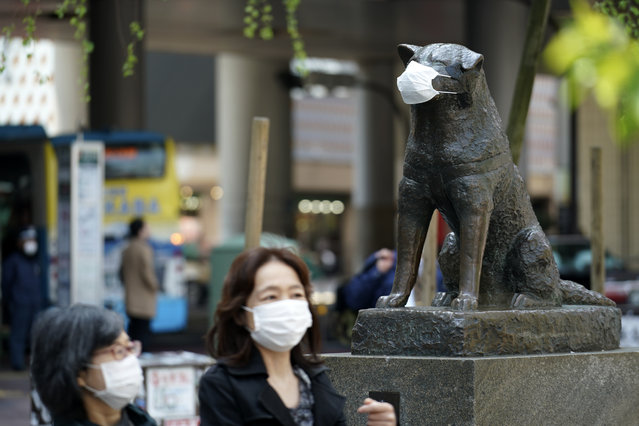
A statue of a Japanese Akita dog named “Hachiko” wearing a face mask is seen near Shibuya Station Wednesday, April 8, 2020, in Tokyo. Japanese Prime Minister Shinzo Abe declared a state of emergency on Tuesday for Tokyo and six other prefectures to ramp up defenses against the spread of the new coronavirus. Hachiko has waited for his owner University of Tokyo Prof. Eizaburo Ueno at the same place by the station every afternoon, expecting him to return home for nearly 11 years even after Ueno's death at work. (Photo by Eugene Hoshiko/AP Photo)

A statue of a Japanese Akita dog named “Hachiko” wearing a face mask is seen near Shibuya Station Wednesday, April 8, 2020, in Tokyo. Japanese Prime Minister Shinzo Abe declared a state of emergency on Tuesday for Tokyo and six other prefectures to ramp up defenses against the spread of the new coronavirus. Hachiko has waited for his owner University of Tokyo Prof. Eizaburo Ueno at the same place by the station every afternoon, expecting him to return home for nearly 11 years even after Ueno's death at work. (Photo by Eugene Hoshiko/AP Photo)
Details
15 Apr 2020 00:05:00
Happy dog (..?) – Pannonian spring fantasy

“I am not a photo reporter, so I don’t feel obligated to honour every detail. What I’m trying to achieve is to emphasize the whole potential of a shot, creating a sight that I'd like if existed.. And since it’s impossible in real life, I do it in virtual :) My work is maybe more similar to ‘photo-painting’ than photography”. – Katarina Stefanović

Photo: Pannonian spring fantasy. (Photo by by Katarina Stefanović)
Details
17 Aug 2012 10:17:00
Yoandri Hernandez 24 fingers

Yoandri Hernandez Garrido, 37, proudly displays his 12 fingers in Baracoa, Guantanamo province, Cuba. His condition, known as polydactyly, is relatively common, but it's rare for extra digits to be so perfect.

Polydactyly or polydactylism (from Ancient Greek πολύς (polus) "many" + δάκτυλος (daktulos) "finger"), also known as hyperdactyly, is a congenital physical anomaly in humans, dogs, and cats having supernumerary fingers or toes. Polydactyly is the opposite of oligodactyly (fewer fingers or toes).

wikipedia
Details
14 Dec 2012 13:56:00