Loading...
Done
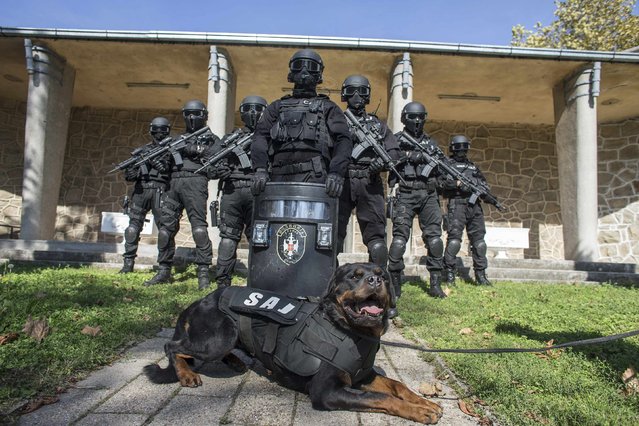
Serbian police officers of the Special Anti-Terrorist Unit pose for a picture in their base outside Belgrade October 8, 2014. (Photo by Marko Djurica/Reuters)

Serbian police officers of the Special Anti-Terrorist Unit pose for a picture in their base outside Belgrade October 8, 2014. When the killing of an unarmed black teenager by a white policeman in Ferguson, Missouri, in August sparked sometimes violent protests, the response of police in camouflage gear and armoured vehicles wielding stun grenades and assault rifles seemed more like a combat operation than a public order measure. Some U.S. police departments have recently acquired U.S. military-surplus hardware from wars abroad, but there are many law enforcers around the world whose rules of engagement also allow the use of lethal force with relatively few restrictions. But for every regulation that gives police wide scope to use firearms, there is another code that sharply limits their use. In Serbia, police may use measures ranging from batons to special vehicles, water cannon and tear gas on groups of people who have gathered illegally and are behaving in a way that is violent or could cause violence, but they may use firearms only when life is endangered. (Photo by Marko Djurica/Reuters)
Details
27 Nov 2014 14:53:00
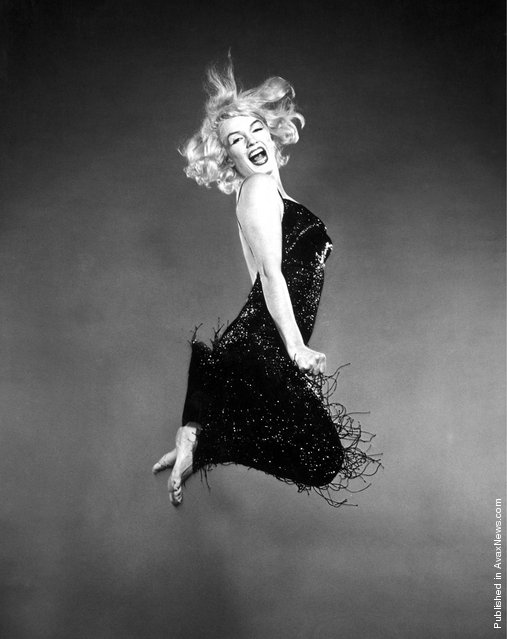
Marilyn Monroe, 'Jumpology', 1959. Photo by Philippe Halsman

“Philippe Halsman (2 May 1906 Riga, Russian Empire – 25 June 1979 New York City) was a Latvian-born American portrait photographer. Many celebrities photographed by Halsman include Alfred Hitchcock, Judy Garland, Winston Churchill, Marilyn Monroe, Dorothy Dandridge, and Pablo Picasso. Many of those photographs appeared on the cover of Life. In such photos, he utilizes a variety of his rules of photography. For example, in one of his photos of Winston Churchill, the omission of his face makes Halsman's photo even more powerful at making Churchill more human”. – Wikipedia

Photo: Marilyn Monroe, “Jumpology”, 1959. Photo by Philippe Halsman
Details
12 Apr 2012 13:18:00
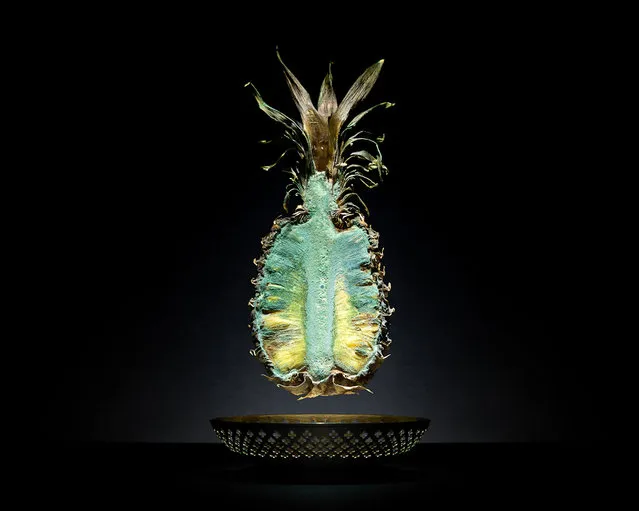
Pineapple

“One Third” – a project on food waste by an Austrian photography Klaus Pichler. According to a UN study one third of the world's food goes to waste – the largest part thereof in the industrialized nations of the global north. Equally, 925 million people around the world are threatened by starvation. The series “One Third” describes the connection between individual wastage of food and globalized food production.

Photo: Pineapple. Place of production: Guayaquil, Ecuador. Cultivation method: Outdoor plantation • Time of harvest: All- season. Transporting distance: 10.666 km (linear distance) • Means of transportation: Aircraft, truck. Carbon footprint (total) per kg: 11,94 kg • Water requirement (total) per kg: 360 l. Price: 2,10 € / kg. (Photo by Klaus Picher)
Details
02 May 2012 11:01:00
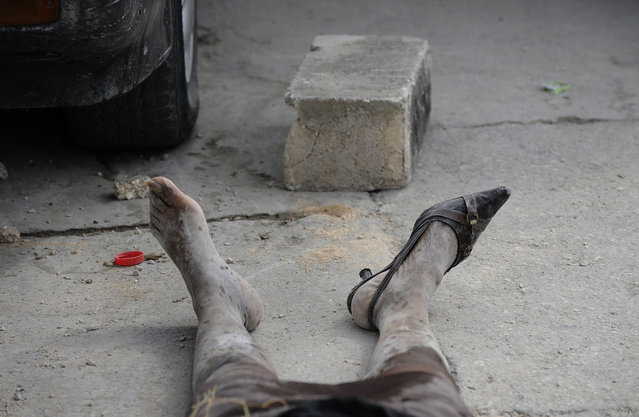
In this photo submitted by the Washington Post tilted “The Moment Time Stopped”, survivors piled bodies of the dead outside for weeks after earthquake on January 14, 2010 in Port-au-Prince, Haiti. The Washington Post has won a Pulitzer Prize for breaking news photography on Monday, April 18, 2011 for images taken in Haiti following the earthquake there.(Photo by Carol Guzy/AP Photo/The Washington Post)

In this photo submitted by the Washington Post tilted “The Moment Time Stopped”, survivors piled bodies of the dead outside for weeks after earthquake on January 14, 2010 in Port-au-Prince, Haiti. The 7.0 magnitude earthquake struck in 2010, and the Haitian government has said more than 300,000 people were killed. The exact toll is unknown because there was no systematic effort to count bodies among the chaos and destruction. (Photo by Carol Guzy/AP Photo/The Washington Post)
Details
13 Jan 2015 14:17:00
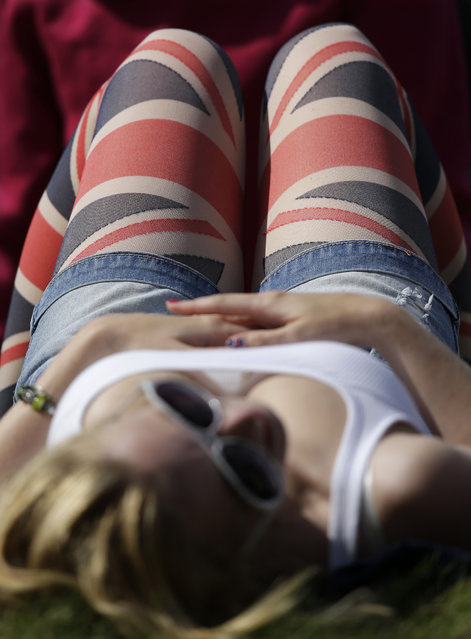
A fan wearing leggings marked with the stripes of Great Britain's flag rests on the grass at the rowing venue in Eton Dorney, near Windsor, England, at the 2012 Summer Olympics, Monday, July 30, 2012. (Photo by Natacha Pisarenko/AP Photo)

“Natacha Pisarenko was born in Buenos Aires and studied photography at that city’s School of Photographic Arts. Pisarenko currently works out of Buenos Aires, Argentina. She started her career in 1988 as a photographer for La Nación, one of Argentina’s largest newspapers, then joined the AP in Buenos Aires in 2002”. – Associated Press. Photo: A fan wearing leggings marked with the stripes of Great Britain's flag rests on the grass at the rowing venue in Eton Dorney, near Windsor, England, at the 2012 Summer Olympics, Monday, July 30, 2012. (Photo by Natacha Pisarenko/AP Photo)
Details
25 May 2014 13:11:00
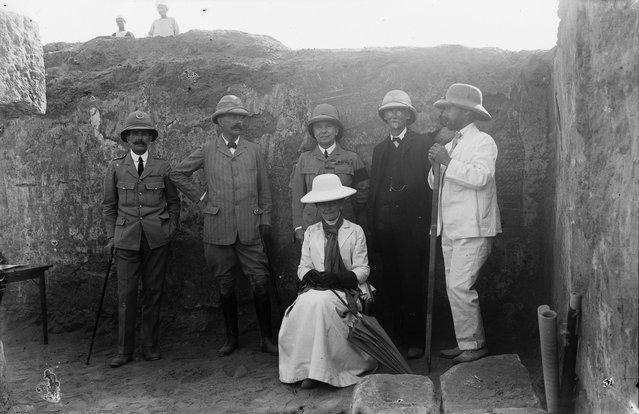
Remarkable discoveries were made, like the decapitated head of a bronze statue of Roman emperor Augustus, sacked from a raid on Roman garrisons further north in Egypt. Here: A group visiting the excavations at Meroë, including (from left) Midwinter Bey, director of Sudan Railways; Lord Kitchener; General Sir Francis Reginald Wingate, Sirdar of the Egyptian Army; Professor Archibald Sayce; John Garstang; and Lady Catherine Wingate, 1911. (Photo by Garstang Museum of Archaeology)

The city of Meroë laid undiscovered for two millennia before British archaeologist John Garstang excavated it in the early 20th century. Garstang took the radical decision to document his discoveries with photography – and immortalised an ancient world. “Meroë: Africa’s Forgotten Empire” is being shown until 14 September at Garstang Museum of Archaeology, Liverpool. Here: A group visiting the excavations at Meroë, including (from left) Midwinter Bey, director of Sudan Railways; Lord Kitchener; General Sir Francis Reginald Wingate, Sirdar of the Egyptian Army; Professor Archibald Sayce; John Garstang; and Lady Catherine Wingate, 1911. (Photo by Garstang Museum of Archaeology)
Details
15 Jun 2016 14:49:00
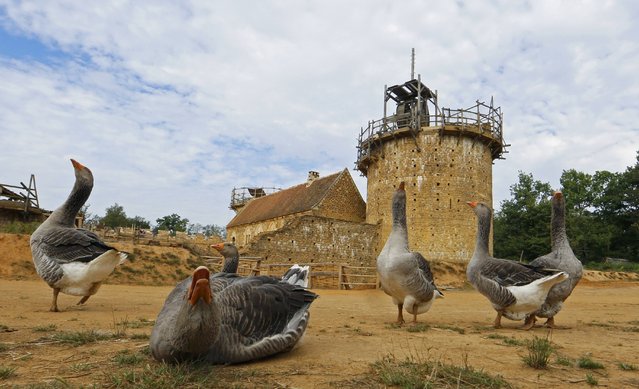
A view of the construction site of the Chateau de Guedelon near Treigny in the Burgundy region of France, September 13, 2016. Blacksmiths, stonemasons and quarry men are hard at work in a Burgundy forest building a 13th-century-style castle using the most basic tools and materials, replicating the methods used hundreds of years ago to better understand them. Forgoing all modern technology, workers use hammers to break stones and forge iron, operate wooden wheels to hoist their materials up to where they are needed, and rely on a quarry for stone, clay and sand as they build up a castle from scratch. Construction on Guedelon Castle in central France began in 1997 after an archaeological survey revealed a medieval fortress hidden inside the walls of nearby Chateau de Saint-Fargeau. Those behind the project hope to answer questions about medieval construction and provide lessons on sustainable building. (Photo by Jacky Naegelen/Reuters)

A view of the construction site of the Chateau de Guedelon near Treigny in the Burgundy region of France, September 13, 2016. Blacksmiths, stonemasons and quarry men are hard at work in a Burgundy forest building a 13th-century-style castle using the most basic tools and materials, replicating the methods used hundreds of years ago to better understand them. (Photo by Jacky Naegelen/Reuters)
Details
15 Sep 2016 09:43:00
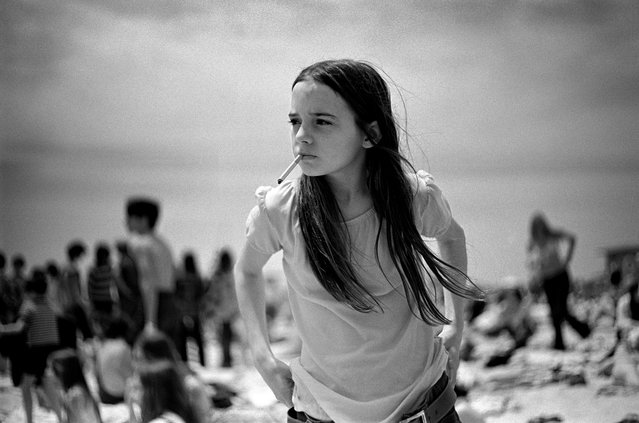
“Priscilla”, 1969. He has described this image as one of his own favourites: “It expresses something about girlhood as well as something about a certain kind of maturity and experience”. It became the cover for Dinosaur Jr’s album Green Mind. (Photo by Joseph Szabo/Courtesy of Michael Hoppen Gallery/The Guardian)

Joseph Szabo was a frustrated high-school teacher in need of inspiration – so he started photographing his students, and captured all the angst and excitement of being caught between childhood and adulthood. Here: “Priscilla”, 1969. (Photo by Joseph Szabo/Courtesy of Michael Hoppen Gallery/The Guardian)
Details
16 Apr 2017 11:02:00