Loading...
Done
Venezuelan migrant and rap singer, Alfonso Mendoza aka "Alca", 25, practice with his skateboard in a park in Barranquilla, Colombia on September 28, 2018. Alca -who arrived in Colombia nine months ago due to the crisis in his country- was born without legs and changed the wheelchair for a skateboard. At present, he is an example of overcoming adversity, practicing extreme sports, singing rap and giving conferences to young people in vulnerable situations. (Photo by Raul Arboleda/AFP Photo)

Venezuelan migrant and rap singer, Alfonso Mendoza aka “Alca”, 25, practice with his skateboard in a park in Barranquilla, Colombia on September 28, 2018. Alca -who arrived in Colombia nine months ago due to the crisis in his country- was born without legs and changed the wheelchair for a skateboard. At present, he is an example of overcoming adversity, practicing extreme sports, singing rap and giving conferences to young people in vulnerable situations. (Photo by Raul Arboleda/AFP Photo)
Details
07 Oct 2018 00:07:00
A stroller walks his dogs in an autumnally colored forest in Cuxhaven, nothern Germany on November 7, 2018. (Photo by Patrik Stollarz/AFP Photo)

A stroller walks his dogs in an autumnally colored forest in Cuxhaven, nothern Germany on November 7, 2018. (Photo by Patrik Stollarz/AFP Photo)
Details
20 Dec 2018 00:01:00
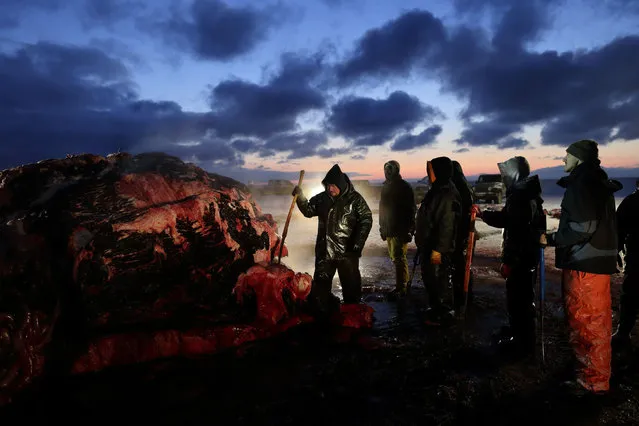
In this October 7, 2014, photo, Fredrick Brower, center, helps cut up a bowhead whale caught by Inupiat subsistence hunters on a field near Barrow, Alaska. Drawing on tradition, and keeping within the closely monitored Aboriginal subsistence whaling guidelines, a bowhead whale is carved and divided by a crew armed with knives and hooks, and then shared according to custom. (Photo by Gregory Bull/AP Photo)

In this October 7, 2014, photo, Fredrick Brower, center, helps cut up a bowhead whale caught by Inupiat subsistence hunters on a field near Barrow, Alaska. Drawing on tradition, and keeping within the closely monitored Aboriginal subsistence whaling guidelines, a bowhead whale is carved and divided by a crew armed with knives and hooks, and then shared according to custom. (Photo by Gregory Bull/AP Photo)
Details
07 Nov 2014 12:58:00
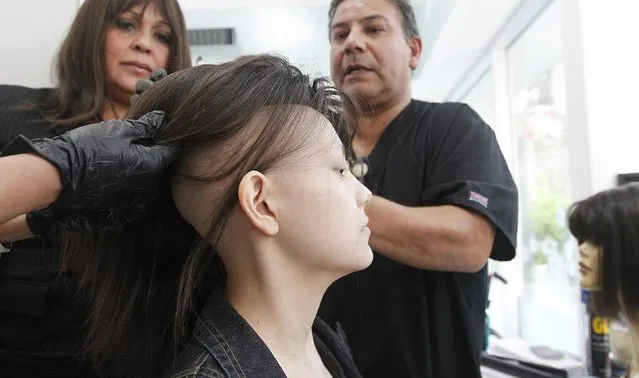
Hair stylist Marcelo Avatte (R) prepares to fit Isidora Serrano, a 14-year-old who lost her hair due to chemotherapy to treat her bone cancer, with a natural hair wig in the cancer ward of the Luis Calvo Mackenna Hospital in Santiago, October 23, 2014. (Photo by Rodrigo Garrido/Reuters)

Hair stylist Marcelo Avatte (R) prepares to fit Isidora Serrano, a 14-year-old who lost her hair due to chemotherapy to treat her bone cancer, with a natural hair wig in the cancer ward of the Luis Calvo Mackenna Hospital in Santiago, October 23, 2014. The wigs, handmade by Italian-Chilean hair stylist Marcelo Avatte and his team, have helped the children regain their self-esteem and confidence during cancer treatment. Renowned for making customised wigs, Avatte has donated more than 300 wigs since 2009 and says he was motivated to begin the project by the pain he felt when his own son lost his hair during chemotherapy. (Photo by Rodrigo Garrido/Reuters)
Details
18 Nov 2014 11:33:00
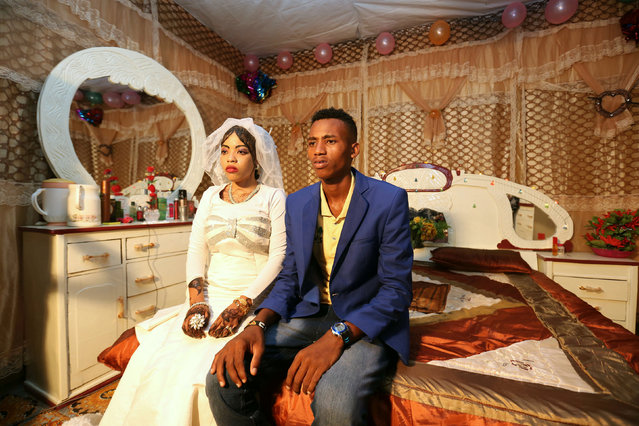
Somali couple Mohamed Noor (L) and Huda Omar pose for a photograph at their makeshift home during their wedding ceremony in Mogadishu's Rajo camp, Somalia August 17, 2016. Having met two years ago, the pair have just married at Rajo camp, where some 400 families live. Most, like Noor's parents, came here in the early 1990s to flee famine. They stayed on as years of conflict ravaged the Horn of Africa nation. As at any wedding, there is plenty of dancing and sweet treats for the young couple as they start married life in Noor's simple home, made of iron and plastic sheets. Noor works as a mason with his father. Others here are builders or sell sweets, nuts and stick toothbrushes to make money. Some beg around the seaside city, which like the rest of Somalia has been gripped by violence since the toppling of dictator Mohamed Siad Barre in 1991. (Photo by Feisal Omar/Reuters)

Somali couple Mohamed Noor (L) and Huda Omar pose for a photograph at their makeshift home during their wedding ceremony in Mogadishu's Rajo camp, Somalia August 17, 2016. Having met two years ago, the pair have just married at Rajo camp, where some 400 families live. Most, like Noor's parents, came here in the early 1990s to flee famine. (Photo by Feisal Omar/Reuters)
Details
14 Sep 2016 10:35:00
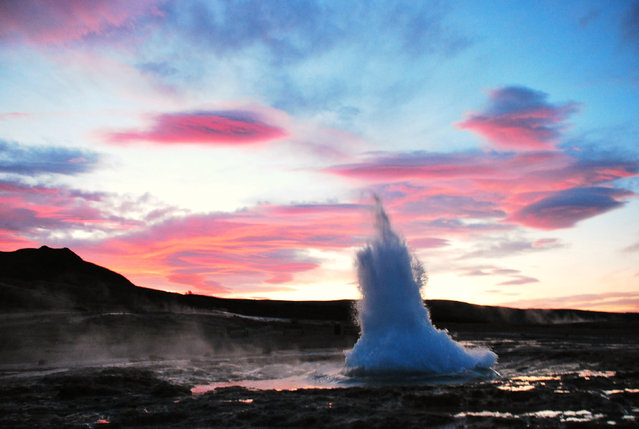
Strokkur geyser against cloudy sky at sunset. Strokkur is a fountain geyser located in a geothermal area beside the Hvítá River in Iceland in the southwest part of the country, east of Reykjavík. It is one of Iceland's most famous geysers, erupting once every 6–10 minutes. Its usual height is 15–20 m, although it can sometimes erupt up to 40 m high. (Photo by Teatsche Dijkhuis/Getty Images/EyeEm)

Strokkur geyser against cloudy sky at sunset. Strokkur is a fountain geyser located in a geothermal area beside the Hvítá River in Iceland in the southwest part of the country, east of Reykjavík. It is one of Iceland's most famous geysers, erupting once every 6–10 minutes. Its usual height is 15–20 m, although it can sometimes erupt up to 40 m high. (Photo by Teatsche Dijkhuis/Getty Images/EyeEm)
Details
18 Oct 2016 12:43:00
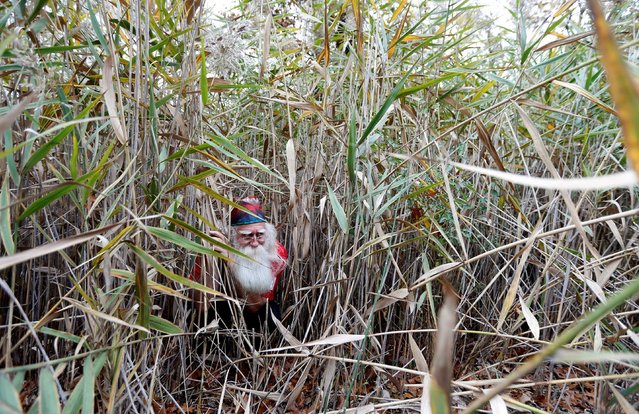
Santa Jerry Julian of Colorado Springs, Colorado hides in the grass following a ride on the Polar Express during a field trip from the Charles W. Howard Santa Claus School in Midland, Michigan, U.S. October 28, 2016. (Photo by Christinne Muschi/Reuters)

Santa Jerry Julian of Colorado Springs, Colorado hides in the grass following a ride on the Polar Express during a field trip from the Charles W. Howard Santa Claus School in Midland, Michigan, U.S. October 28, 2016. (Photo by Christinne Muschi/Reuters)
Details
19 Nov 2016 11:24:00
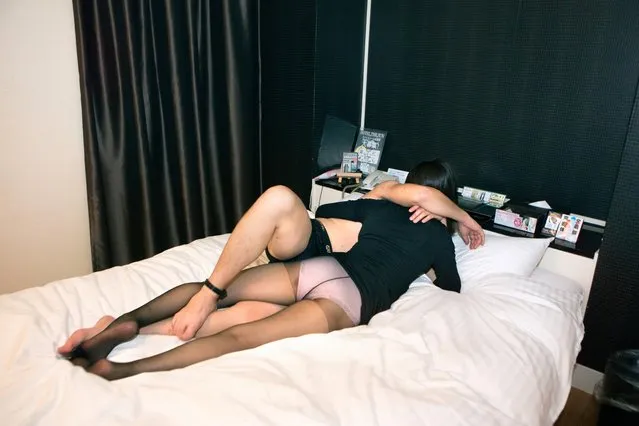
For her series “Japanese Whispers”, Belgian photographer Zaza Bertrand headed inside the intimate world of rabuhos – Japanese love hotels. Love hotels became popular in Japan from the 1960s onwards, due to a lack of privacy in many family homes. There are now around 37,000 of these hotels in Japan, allowing short daytime “rests” or overnight stays. (Photo by Zaza Bertrand/The Guardian)

For her series “Japanese Whispers”, Belgian photographer Zaza Bertrand headed inside the intimate world of rabuhos – Japanese love hotels. Love hotels became popular in Japan from the 1960s onwards, due to a lack of privacy in many family homes. There are now around 37,000 of these hotels in Japan, allowing short daytime “rests” or overnight stays. (Photo by Zaza Bertrand/The Guardian)
Details
02 Dec 2016 11:30:00