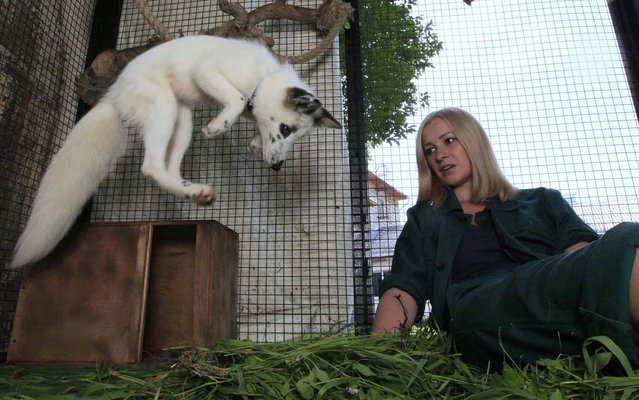
A four-month-old snow fox cub named “Vesna” (“Spring”) leaps next to a Zoo employee at the Royev Ruchey Zoo in Krasnoyarsk, Russia, on August 6, 2013. (Photo by Ilya Naymushin/Reuters)
Bangladeshi fisherman feed their otters as they catch fish in Narail some 208 kms from Dhaka on March 11, 2014. The fishermen are using a rare technique that relies on coordination between man and trained otters, a centuries-old fishing partnership that has already long died out in other parts of Asia. (Photo by Munir Uz Zaman/AFP Photo)
I know, this answer was a little too short, so let me explain in a little more detail.
Imagine tossing a coin. Normally, any normal coin toss has two possible outcomes - heads or tails - with each one having a 50% chance of happening. Ideally, that is, because factors like the force of your finger tossing the coin, gravity, the wind, the moon phase and a passing TARDIS can all influence the outcome of the toss - but I have deviated from the subject.
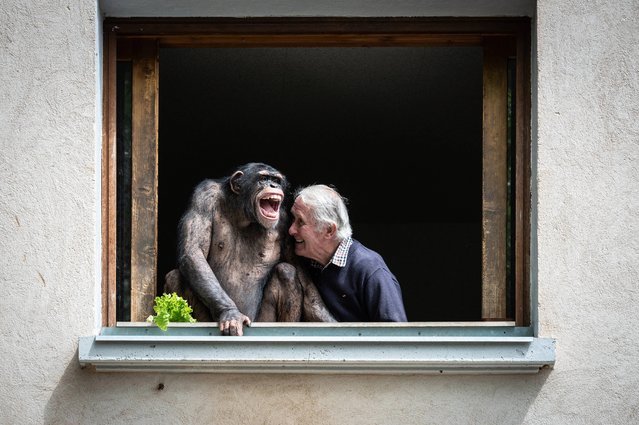
The owner of the zoo Pierre Thivillon laughs next to a chimpanzee on May 17, 2021, at the zoological park of Saint-Martin-la-Plaine, two days ahead of its reopening as part of France's latest step toward the ending of its third nationwide Covid-19 lockdown. (Photo by Jean-Philippe Ksiazek/AFP Photo)
Participants compete in a wife-carrying championship in Tapiobicske, Hungary, August 7, 2021. Some 40 Hungarian husbands, with their wives on their backs, clambered over rough terrain on Saturday in the nation's second wife-carrying contest. (Photo by Marton Monus/Reuters)
British singer and songwriter Ella Eyre performing on stage at Capital's Summertime Ball 2022 at Wembley Stadium in London, United Kingdom on June 12, 2022. (Photo by David Fisher/Rex Features/Shutterstock)