Loading...
Done
Art By Thomas Barbey

Thomas Barbèy grew up in Geneva, Switzerland, across the street from the “Caran D'ache” factory, the largest manufacturer of art supplies. He started drawing seriously at the age of 13, using black “encre de Chine” and gouaches for color. His influences were Philippe Druillet, Roger Dean and H.R. Giger. After living in Geneva for 17 years and designing posters for musical bands, he decided to move to Italy, where he lived in Milan for 15 years making a living as a successful recording artist, lyricist and fashion photographer.
Details
26 Sep 2013 10:31:00
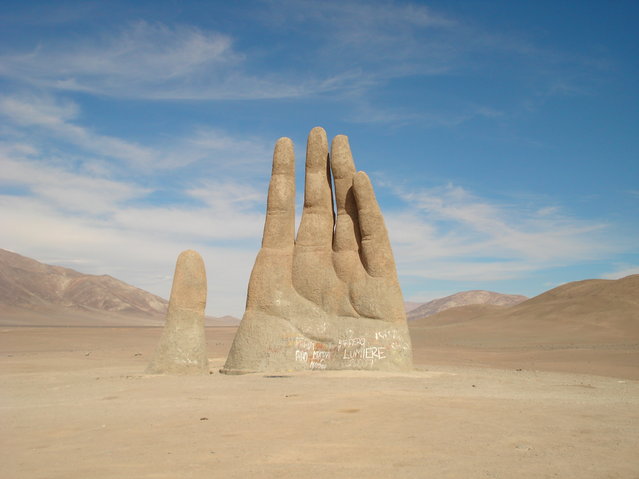
The Giant Hand of Atacama

The Mano de Desierto is a large-scale sculpture of a hand located in the Atacama Desert in Chile, 75 km to the south of the city of Antofagasta, on the Panamerican Highway. The nearest point of reference is the “Ciudad Empresarial La Negra” (La Negra Business City). The sculpture was constructed by the Chilean sculptor Mario Irarrázabal at an altitude of 1,100 meters above sea level. Irarrázabal used the human figure to express emotions like injustice, loneliness, sorrow and torture. Its exaggerated size is said to emphasize human vulnerability and helplessness. The work has a base of iron and cement, and stands 11 metres (36 ft) tall. Funded by Corporación Pro Antofagasta, a local booster organization, the sculpture was inaugurated on March 28, 1992.
Details
21 Dec 2013 10:18:00
Argentina's Francisco Cerundolo falls as he plays against Germany's Alexander Zverev during a Davis Cup quarterfinal singles tennis match between Germany and Argentina, in Bologna, Italy, Thursday, November 20, 2025. (Photo by Luca Bruno/AP Photo)

Argentina's Francisco Cerundolo falls as he plays against Germany's Alexander Zverev during a Davis Cup quarterfinal singles tennis match between Germany and Argentina, in Bologna, Italy, Thursday, November 20, 2025. (Photo by Luca Bruno/AP Photo)
Details
02 Dec 2025 05:42:00
Kika-evolution, 5, an Auguste clown, poses for a photo during Mexico’s 17th annual clown convention, La Feria de la Risa, in Mexico City, October 23, 2012. Approximately 500 clowns gathered at two local theaters in the capital city to exchange ideas, compete for laughs and show off their comedy performances. (Photo by Anita BacaAP Photo)

Kika-evolution, 5, an Auguste clown, poses for a photo during Mexico’s 17th annual clown convention, La Feria de la Risa, in Mexico City, October 23, 2012. Approximately 500 clowns gathered at two local theaters in the capital city to exchange ideas, compete for laughs and show off their comedy performances. (Photo by Anita Baca/AP Photo)
Details
27 Oct 2012 07:51:00
An employee of Paris city Hall removes padlocks clipped by lovers on the fence of the Pont des Arts over the River Seine in Paris, December 9, 2014. For years, visiting couples have hung brass padlocks on the iron grills lining the city's bridges to symbolise their undying love – they write their names on the locks, then toss the key into the Seine below. (Photo by Philippe Wojazer/Reuters)

An employee of Paris city Hall removes padlocks clipped by lovers on the fence of the Pont des Arts over the River Seine in Paris, December 9, 2014. For years, visiting couples have hung brass padlocks on the iron grills lining the city's bridges to symbolise their undying love – they write their names on the locks, then toss the key into the Seine below. About 700,000 love locks are added every few months and Paris officials say they are damaging the bridges and threatening safety because of the added weight. (Photo by Philippe Wojazer/Reuters)
Details
10 Dec 2014 12:24:00
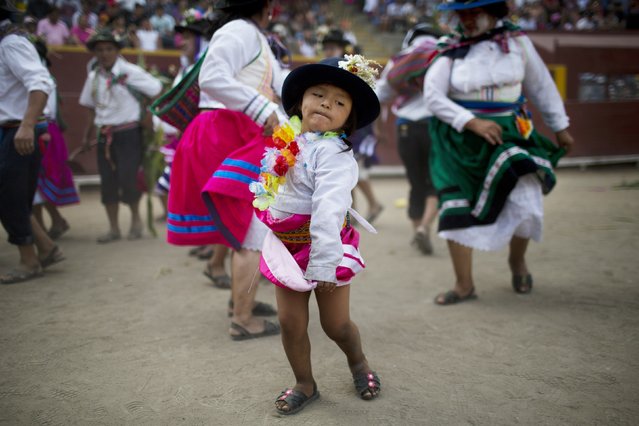
In this Sunday, March 29, 2015 photo, a young performer from the Parinacochas district of Ayacuhco dances in the Vencedores de Ayacucho dance festival, in the Acho bullring in Lima, Peru. The performers sang in the Quechua language, portraying the planting of corn and potatoes. From very young children to elderly people dressed as farmers, tigers, and foxes, as well as members of auto-defense groups, soldiers and police officers, to portray the violence that tore apart their families and communities. (Photo by Rodrigo Abd/AP Photo)

In this Sunday, March 29, 2015 photo, a young performer from the Parinacochas district of Ayacuhco dances in the Vencedores de Ayacucho dance festival, in the Acho bullring in Lima, Peru. The performers sang in the Quechua language, portraying the planting of corn and potatoes. From very young children to elderly people dressed as farmers, tigers, and foxes, as well as members of auto-defense groups, soldiers and police officers, to portray the violence that tore apart their families and communities. (Photo by Rodrigo Abd/AP Photo)
Details
01 Apr 2015 12:07:00
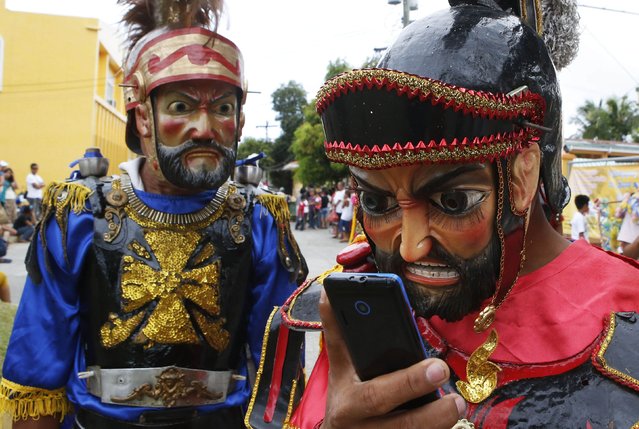
A penitent called “Morion” checks his mobile phone in Mogpog town on Marinduque island in central Philippines April 14, 2014. During the annual festival, masked and costumed penitents called “Moriones” dress in attire that is the local interpretation of what Roman soldiers wore during biblical times. Holy Week is celebrated in many Christian traditions during the week before Easter. (Photo by Erik De Castro/Reuters)

A penitent called “Morion” checks his mobile phone in Mogpog town on Marinduque island in central Philippines April 14, 2014. During the annual festival, masked and costumed penitents called “Moriones” dress in attire that is the local interpretation of what Roman soldiers wore during biblical times. Holy Week is celebrated in many Christian traditions during the week before Easter. (Photo by Erik De Castro/Reuters)
Details
19 Apr 2014 11:52:00
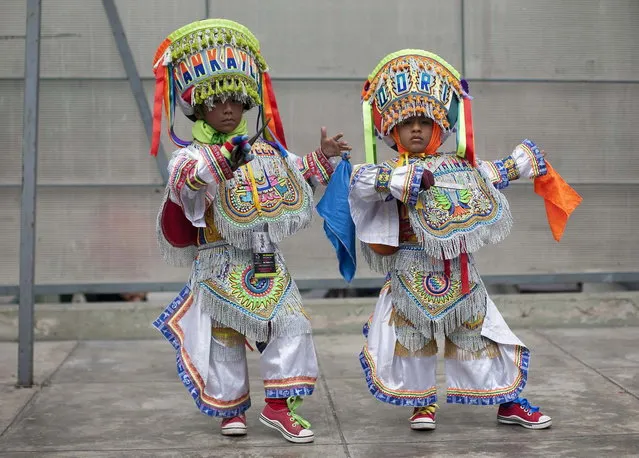
Young “scissors” dancers pose after performing in a national scissors dance competition at Lima's Exposition Park, May 18, 2014. The Danza de las tijeras, or scissors dance, is a traditional dance from the Peruvian southern region of the Andes, in which two or more performers take turns dancing while accompanied with music from a harp and a violin. Dancers would display various skills and moves, which include cutting the air with the use of a scissors. (Photo by Enrique Castro-Mendivil/Reuters)

Young “scissors” dancers pose after performing in a national scissors dance competition at Lima's Exposition Park, May 18, 2014. The Danza de las tijeras, or scissors dance, is a traditional dance from the Peruvian southern region of the Andes, in which two or more performers take turns dancing while accompanied with music from a harp and a violin. Dancers would display various skills and moves, which include cutting the air with the use of a scissors. (Photo by Enrique Castro-Mendivil/Reuters)
Details
20 May 2014 10:54:00