Loading...
Done
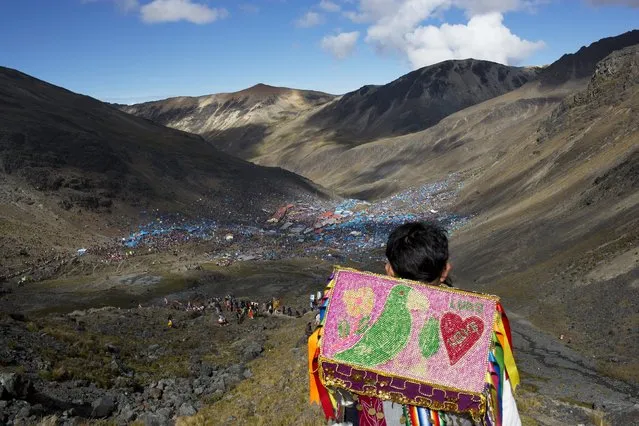
In this May 24, 2016 photo, a young boy descends the Qullqip'unqu mountain looking out at the tens of thousands of pilgrims gathered to celebrate the three-day festival Qoyllur Rit’i, translated from the Quechua language as Snow Star, in the Andean Sinakara Valley, in Peru's Cusco region. The celebration that mixes Catholic and indigenous beliefs honors Jesus as well as the area’s glacier, which is considered sacred among some indigenous people. While the native celebration is far older, the Christian part of the ritual stretches back to the 1700s, when Jesus is said to have appeared to a young shepherd in the form of another boy. (Photo by Rodrigo Abd/AP Photo)

In this May 24, 2016 photo, a young boy descends the Qullqip'unqu mountain looking out at the tens of thousands of pilgrims gathered to celebrate the three-day festival Qoyllur Rit’i, translated from the Quechua language as Snow Star, in the Andean Sinakara Valley, in Peru's Cusco region. The celebration that mixes Catholic and indigenous beliefs honors Jesus as well as the area’s glacier, which is considered sacred among some indigenous people. While the native celebration is far older, the Christian part of the ritual stretches back to the 1700s, when Jesus is said to have appeared to a young shepherd in the form of another boy. (Photo by Rodrigo Abd/AP Photo)
Details
04 Jun 2016 11:52:00
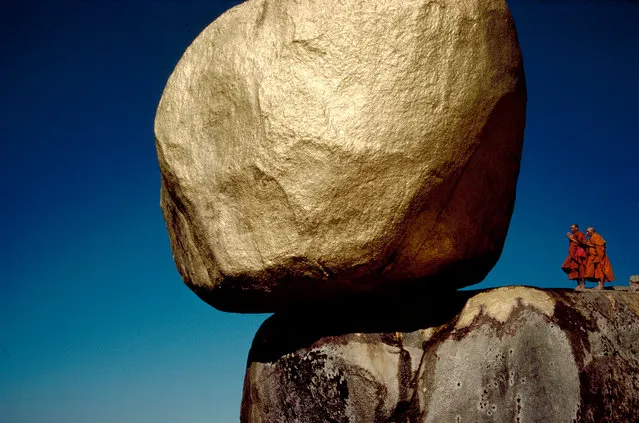
Kyaiktiyo, Burma, 1978. The Golden Rock at Shwe Pyi Daw (the Golden Country), the Buddhist holy place. Hiroji Kubota writes: “I was desperate to keep a distance from America for a while; luckily, I found Burma and its gentle and compassionate people. In the spring of 1978, on the top of the hill where I took this photo, I had two Leica bodies: the one with Tri-X and the other with Kodachrome 64. Soon after, I realised that the colour one looked very colourful and was more powerful. That was my decisive moment, to become a colour photographer”. (Photo by Hiroji Kubota/Magnum Photos)

Kyaiktiyo, Burma, 1978. The Golden Rock at Shwe Pyi Daw (the Golden Country), the Buddhist holy place. Hiroji Kubota writes: “I was desperate to keep a distance from America for a while; luckily, I found Burma and its gentle and compassionate people. In the spring of 1978, on the top of the hill where I took this photo, I had two Leica bodies: the one with Tri-X and the other with Kodachrome 64. Soon after, I realised that the colour one looked very colourful and was more powerful. That was my decisive moment, to become a colour photographer”. (Photo by Hiroji Kubota/Magnum Photos)
Details
10 Jun 2016 13:30:00
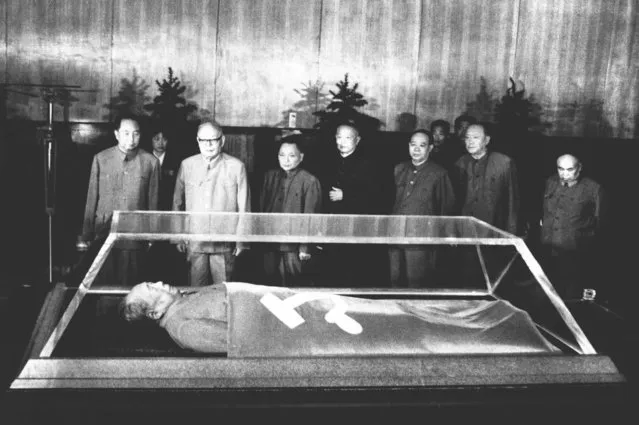
In this September 10, 1977, file photo, from left, Hua Guofeng, Chinese Communist Party (CCP) chairman and Mao Zedong's immediate successor; Ye Jianying, CCP vice chairman and future ceremonial head of state; Deng Xiaoping, no formal titles at the time but soon to emerge as paramount leader during the reform era; Li Xiannian, CCP vice chairman and future president; Wang Dongxing, head of the leadership bodyguard unit who helped topple the Gang of Four, view the body of later Chinese leader Mao Zedong in Beijing. (Photo via AP Photo)

In this September 10, 1977, file photo, from left, Hua Guofeng, Chinese Communist Party (CCP) chairman and Mao Zedong's immediate successor; Ye Jianying, CCP vice chairman and future ceremonial head of state; Deng Xiaoping, no formal titles at the time but soon to emerge as paramount leader during the reform era; Li Xiannian, CCP vice chairman and future president; Wang Dongxing, head of the leadership bodyguard unit who helped topple the Gang of Four, view the body of later Chinese leader Mao Zedong in Beijing. (Photo via AP Photo)
Details
13 Jun 2016 10:34:00
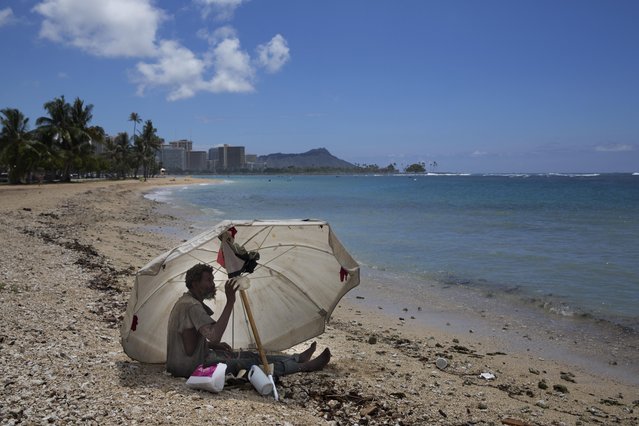
In this Thursday, August 27, 2015 photo, a homeless man drinks water while sitting on the beach at Ala Moana Beach Park located near Waikiki in Honolulu. Homelessness in Hawaii has grown steadily in recent years, leaving the state with the nation's highest rate of homeless people per capita. (Photo by Jae C. Hong/AP Photo)

Hawaii has long been known as a tropical paradise, but in recent years another image has intruded into the state's carefully crafted one of idyllic beaches and relaxing resorts: homelessness. The number of homeless people has grown in recent years, leaving the state with 487 homeless per 100,000 people, the nation's highest rate per capita, above New York and Nevada, according to federal statistics. Many of the homeless, however, defy the stereotype of the mentally ill or drug addicted. They are families, with men and women who work full-time jobs. They are struggling to get a foothold in a place with a high cost of living and low wages. Here: in this Thursday, August 27, 2015 photo, a homeless man drinks water while sitting on the beach at Ala Moana Beach Park located near Waikiki in Honolulu. (Photo by Jae C. Hong/AP Photo)
Details
11 Nov 2015 08:03:00
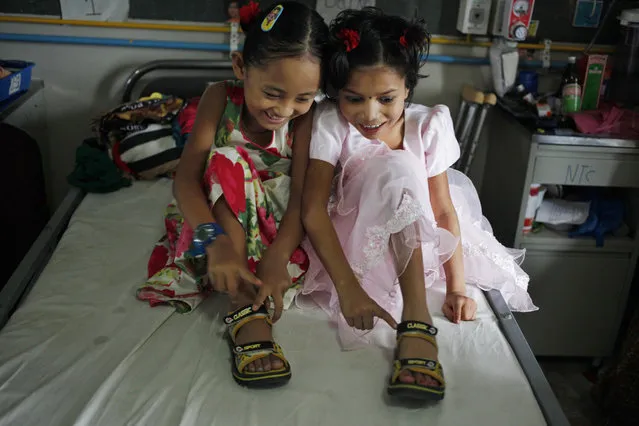
In this July 15, 2015 photo, Nepalese amputee victims Khendo Tamang, left, and Nirmala Pariyar, both 8, share a single pair of shoes at the Bir Trauma Center in Kathmandu, Nepal. After suffering serious leg wounds in Nepal's massive 2015 earthquake that killed and injured thousands, both girls were brought to the Bir Trauma Center in Kathmandu, to receive single leg amputations. Following their surgeries, Nirmala's relentless cheerfulness drew a still very depressed Khendo close and both found an inseparable friendship which has helped their emotional wounds heal. (Photo by Niranjan Shrestha/AP Photo)

In this July 15, 2015 photo, Nepalese amputee victims Khendo Tamang, left, and Nirmala Pariyar, both 8, share a single pair of shoes at the Bir Trauma Center in Kathmandu, Nepal. After suffering serious leg wounds in Nepal's massive 2015 earthquake that killed and injured thousands, both girls were brought to the Bir Trauma Center in Kathmandu, to receive single leg amputations. Following their surgeries, Nirmala's relentless cheerfulness drew a still very depressed Khendo close and both found an inseparable friendship which has helped their emotional wounds heal. (Photo by Niranjan Shrestha/AP Photo)
Details
23 Apr 2016 13:48:00
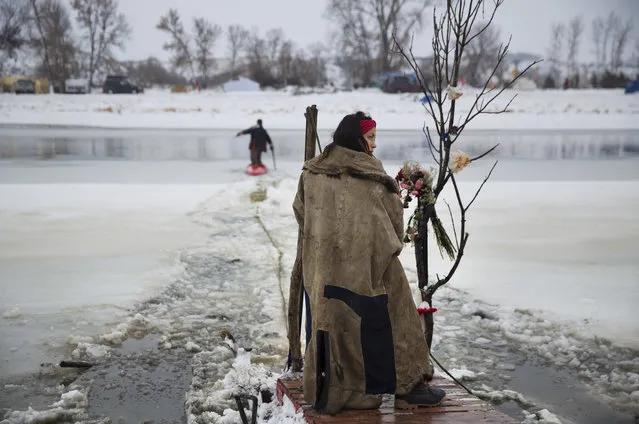
In this Thursday, December 1, 2016 photo, Cat Bigney, part of the Oglala Native American tribe, waits on the shore of the Cannonball river for travelers to arrive by canoe at the Oceti Sakowin camp where people have gathered to protest the Dakota Access oil pipeline in Cannon Ball, N.D. So far, those at the camp have shrugged off the heavy snow, icy winds and frigid temperatures. But if they defy next week's government deadline to abandon the camp, demonstrators know the real deep freeze lies ahead. Life-threatening wind chills and towering snow drifts could mean the greatest challenge is simple survival. (Photo by David Goldman/AP Photo)

In this Thursday, December 1, 2016 photo, Cat Bigney, part of the Oglala Native American tribe, waits on the shore of the Cannonball river for travelers to arrive by canoe at the Oceti Sakowin camp where people have gathered to protest the Dakota Access oil pipeline in Cannon Ball, N.D. So far, those at the camp have shrugged off the heavy snow, icy winds and frigid temperatures. But if they defy next week's government deadline to abandon the camp, demonstrators know the real deep freeze lies ahead. Life-threatening wind chills and towering snow drifts could mean the greatest challenge is simple survival. (Photo by David Goldman/AP Photo)
Details
06 Dec 2016 10:22:00
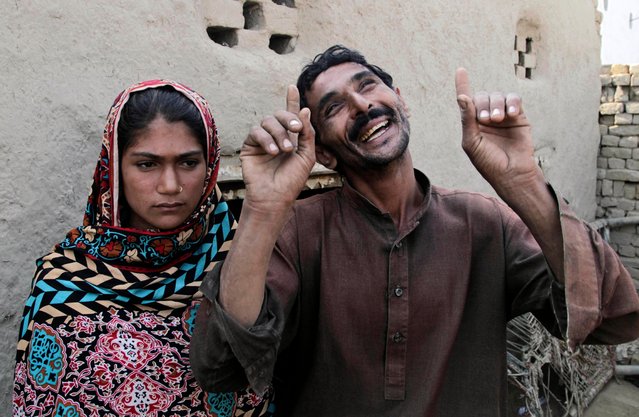
In this Tuesday, December 20, 2016 photo, Mohammad Ramzan, right, reacts while talking to The Associated Press with his young bride Saima in Jampur, Pakistan. Saima was given as a bride to the older man by her father so he could marry the groom’s sister, a practice of exchanging girls that is entrenched in conservative regions of Pakistan. It even has its own name in Urdu: Watta Satta, “give and take”. A mix of interests – family obligations, desire for sons, a wish to hand off a girl to a husband – can lead to a young teen in an a marriage she never sought. (Photo by K.M. Chaudhry/AP Photo)

In this Tuesday, December 20, 2016 photo, Mohammad Ramzan, right, reacts while talking to The Associated Press with his young bride Saima in Jampur, Pakistan. Saima was given as a bride to the older man by her father so he could marry the groom’s sister, a practice of exchanging girls that is entrenched in conservative regions of Pakistan. It even has its own name in Urdu: Watta Satta, “give and take”. A mix of interests – family obligations, desire for sons, a wish to hand off a girl to a husband – can lead to a young teen in an a marriage she never sought. (Photo by K.M. Chaudhry/AP Photo)
Details
31 Dec 2016 10:08:00
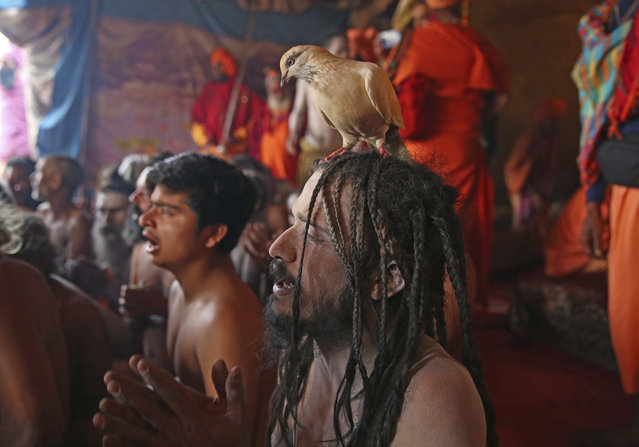
In this January 27, 2019, photo, Hindu holy men of monastic order Juna Akhara participate in a ritual before becoming Naga Sadhus or naked holy men at Sangam, the confluence of three holy rivers during the Kumbh Mela or pitcher festival in Prayagraj Uttar Pradesh state, India. At every Kumbh, including this year's, thousands of devotees were initiated into the reclusive sect of the Naga Sadhus, naked, ash-smeared cannabis-smoking Hindu warriors and onetime-armed defenders of the faith who for centuries have lived as ascetics in jungles and caves. (Photo by Rajesh Kumar Singh/AP Photo)

In this January 27, 2019, photo, Hindu holy men of monastic order Juna Akhara participate in a ritual before becoming Naga Sadhus or naked holy men at Sangam, the confluence of three holy rivers during the Kumbh Mela or pitcher festival in Prayagraj Uttar Pradesh state, India. At every Kumbh, including this year's, thousands of devotees were initiated into the reclusive sect of the Naga Sadhus, naked, ash-smeared cannabis-smoking Hindu warriors and onetime-armed defenders of the faith who for centuries have lived as ascetics in jungles and caves. (Photo by Rajesh Kumar Singh/AP Photo)
Details
18 Feb 2019 00:05:00