Loading...
Done
TomTato Plant Grows Both Tomatoes And Potatoes

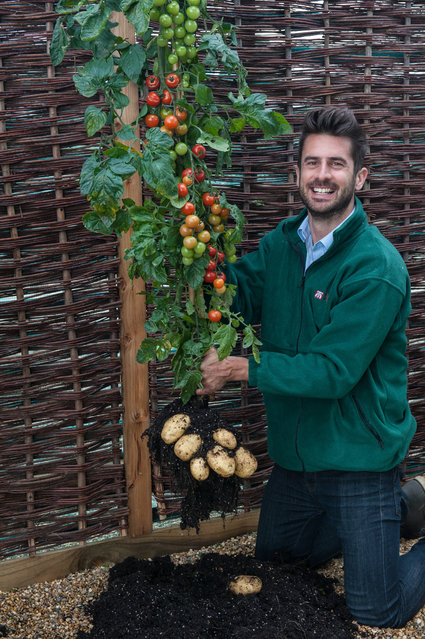
Nowadays, crossbreeding and gene splicing are creating things that would never have occurred in nature. Thanks to gene splicing, modern man can witness mice that glow in the dark, goats that produce milk which is then used to make bulletproof vests, and even cows that produce milk that is almost identical to human breast milk. One of the latest feats of human genius is the creation of Thompson and Morgan. By combining the genes of tomatoes and potatoes they were able to create a “TomTato”, which is essentially a plant that grows tomatoes and potatoes at the same time. With creations such as this, the world’s hunger problem may be resolved in a few decades.
Details
12 Dec 2014 12:43:00
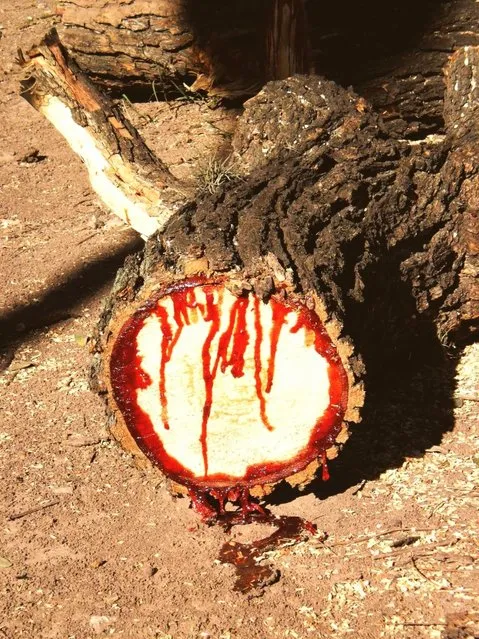
Bloodwood Tree

The bloodwood tree (Pterocarpus angolensis) is a deciduous tree with a high canopy, reaching about 15m in height and has dark bark. The red sap is used traditionally as a dye and in some areas mixed with animal fat to make a cosmetic for faces and bodies. It is also believed to have magical properties for the curing of problems concerning blood, apparently because of its close resemblance to blood. The name bloodwood for these trees stems from the dark red to brown sap that accumulates on wounds on the trunks.
Details
14 May 2014 12:44:00


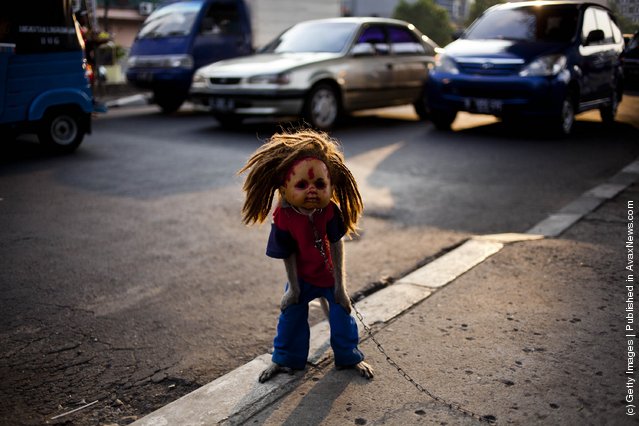
Ucil, a trained monkey, takes part in a street performance on June 1, 2011 in Jakarta, Indonesia. The street performances usually involve the monkeys wearing masks, such as dolls' heads or attire to mimic humans, with the monkeys trained to act out human activities such as shopping, riding bicycles or other simulations of human behaviour. Poverty drives the handlers to exploit the monkeys in the hope of earning small change, but the effect and cruelty to the monkeys is a cause that charities such as the Jakarta Animal Aid Network are increasingly taking up. (Photo by Ulet Ifansasti/Getty Images)
Details
02 Jun 2011 12:14:00
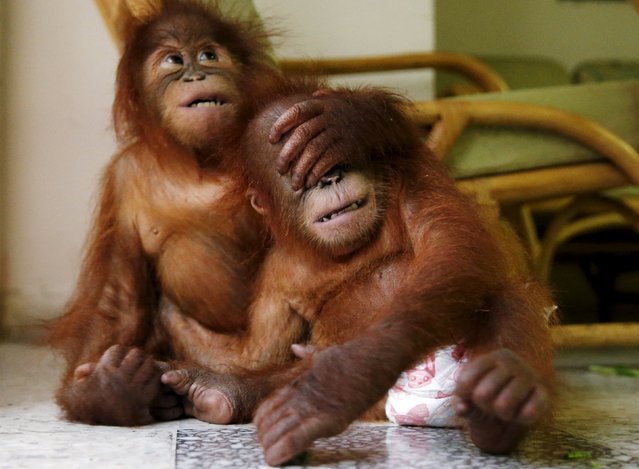
Two baby orangutans play with each other at the wildlife department in Kuala Lumpur, Malayasia, October 19, 2015. (Photo by Olivia Harris/Reuters)

Two baby orangutans play with each other at the wildlife department in Kuala Lumpur, Malayasia, October 19, 2015. The Malaysian wildlife department in July seized two baby Sumatran orangutans, found in duffel bags, from traffickers who were attempting to sell them to buyers in Malaysia. According to local media, the orangutans will be returned to Medan, Indonesia on Tuesday. The illegal wildlife trade is estimated to be $8 billion a year worldwide, according to TRAFFIC, a wildlife trade monitoring network. (Photo by Olivia Harris/Reuters)
Details
22 Oct 2015 08:05:00
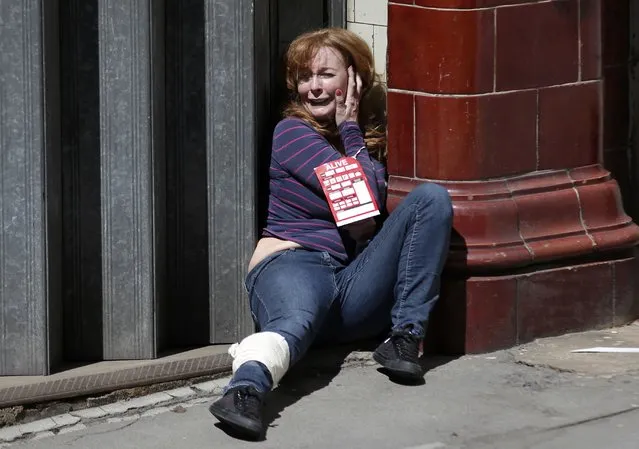
An actor plays an injured passer-by during Exercise Strong Tower, the scene of a mock terror attack at a disused underground station in central London, Britain June 30, 2015. (Photo by Peter Nicholls/Reuters)

An actor plays an injured passer-by during Exercise Strong Tower, the scene of a mock terror attack at a disused underground station in central London, Britain June 30, 2015. London police held their biggest-ever terrorism drill on Tuesday, pitting the emergency services against a group of marauding attackers, nearly 10 years since four young British Islamists killed 52 people in suicide bombings on London's transport network in July 2005. (Photo by Peter Nicholls/Reuters)
Details
01 Jul 2015 13:21:00
The unromantic gypsies. Children boxing in a gypsy camp in Kent, England on July 1, 1951. Like all boys these gypsy lads like to try their hand at boxing. Encouraged by their friends they fight it out on Corke's Meadow. Few Romanies now live a life of wandering romance. Most are like the three hundred squatters of Corke's Meadow, Kent, which is part of a “gypsy problem” that involves about 100,000 today. Of those about 25,000 can be rightly called gypsies, the rest are Mumpers and Posh-rats and Hobos. Corke's Meadow has both kinds. “Picture Post” cameraman Bert Hardy photographs the Corke's Meadow gypsies in their encampment. (Photo by Hulton-Deutsch Collection/Corbis via Getty Images)

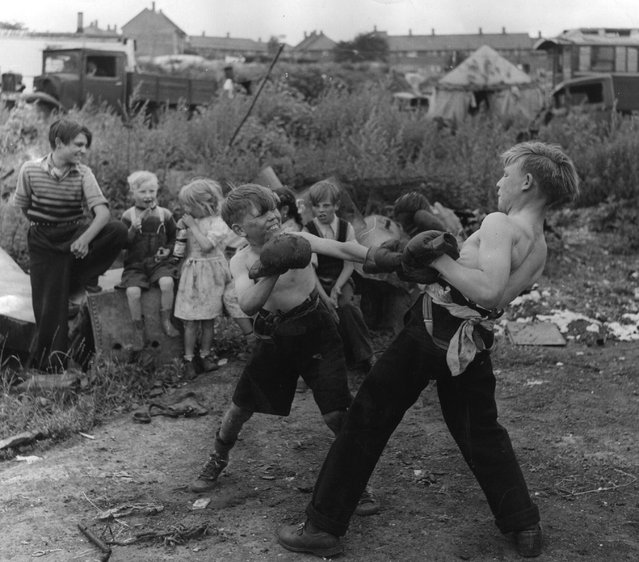
The unromantic gypsies. Children boxing in a gypsy camp in Kent, England on July 1, 1951. Like all boys these gypsy lads like to try their hand at boxing. Encouraged by their friends they fight it out on Corke's Meadow. Few Romanies now live a life of wandering romance. Most are like the three hundred squatters of Corke's Meadow, Kent, which is part of a “gypsy problem” that involves about 100,000 today. Of those about 25,000 can be rightly called gypsies, the rest are Mumpers and Posh-rats and Hobos. Corke's Meadow has both kinds. “Picture Post” cameraman Bert Hardy photographs the Corke's Meadow gypsies in their encampment. (Photo by Hulton-Deutsch Collection/Corbis via Getty Images)
Details
12 Mar 2017 00:01:00
One of the worlds shortest models Mary Russell at 4 feet 1 inch with 6 foot model Georgia Meacham in London, UK on June 16, 2016. The 4ft1 beauty suffers with achondroplasia  a medical term for dwarfism, which means she has as average sized torso but short arms and short legs, with an oversized head. As well as stifled growth, Mary also suffers with sciatica and spinal stenosis, an abnormal narrowing of the spinal canal – which cause agonising nerve problems, leaving her in excruciating pain and unable to stand for long periods of time. The condition leaves Mary, 47, struggling with everyday tasks  things most people take for granted like going to the supermarket, getting cash from an ATM and ordering a drink at a bar become a challenge. (Photo by Simon Jacobs/Caters News Agency)

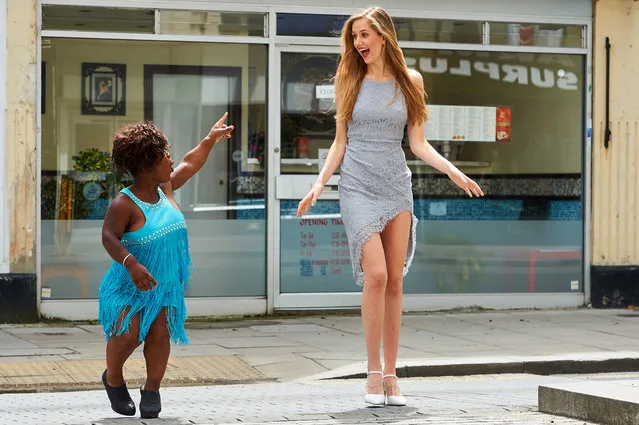
One of the worlds shortest models Mary Russell at 4 feet 1 inch with 6 foot model Georgia Meacham in London, UK on June 16, 2016. The 4ft1 beauty suffers with achondroplasia a medical term for dwarfism, which means she has as average sized torso but short arms and short legs, with an oversized head. As well as stifled growth, Mary also suffers with sciatica and spinal stenosis, an abnormal narrowing of the spinal canal – which cause agonising nerve problems, leaving her in excruciating pain and unable to stand for long periods of time. The condition leaves Mary, 47, struggling with everyday tasks things most people take for granted like going to the supermarket, getting cash from an ATM and ordering a drink at a bar become a challenge. (Photo by Simon Jacobs/Caters News Agency)
Details
28 Aug 2016 10:12:00
Faruk, 17, a Rohingya refugee trader holds betel leaves which are on sale at a stall in Palong Khali refugee camp near Cox's Bazar, Bangladesh, November 3, 2017. He left his village in Myanmar when the military opened fire towards the Rohingya. “I buy this betel leaf from Palong Khali market, in one bundle there are 160 pieces, I buy it for 80 taka and I sell it for 100 taka. Bangladeshi's and I sell for the same rate in the camp. Outside in the local market it is 80 taka per bundle. My problem is that I don't have money so I can't buy anything to eat, I can't buy fish to eat”, he said. (Photo by Hannah McKay/Reuters)

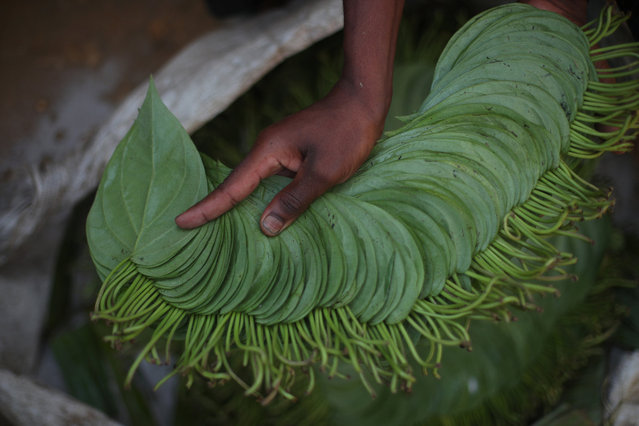
Faruk, 17, a Rohingya refugee trader holds betel leaves which are on sale at a stall in Palong Khali refugee camp near Cox's Bazar, Bangladesh, November 3, 2017. He left his village in Myanmar when the military opened fire towards the Rohingya. “I buy this betel leaf from Palong Khali market, in one bundle there are 160 pieces, I buy it for 80 taka and I sell it for 100 taka (1 Bangladeshi Taka = 0.012 US Dollar). Bangladeshi's and I sell for the same rate in the camp. Outside in the local market it is 80 taka per bundle. My problem is that I don't have money so I can't buy anything to eat, I can't buy fish to eat”, he said. (Photo by Hannah McKay/Reuters)
Details
27 Nov 2017 08:54:00