Loading...
Done


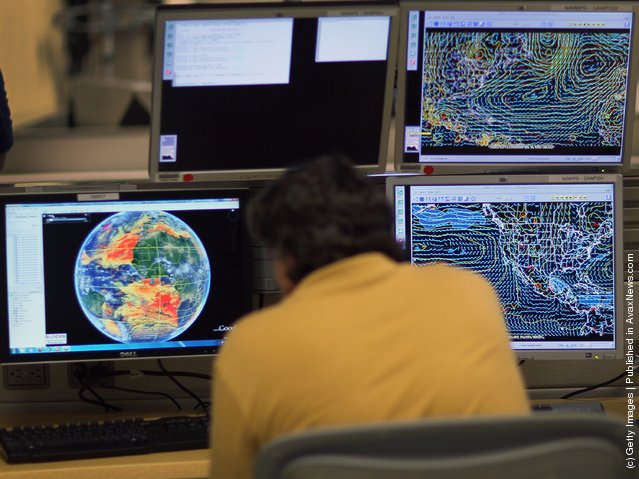
Senior hurricane forecaster Dr. Jack Beven studies computer models as he tracks Tropical Storm Arlene at the National Hurricane Center on June 29, 2011 in Miami, Florida. Arlene is the first named storm of the 2011 Atlantic hurricane season and is moving at 8 mph, packing sustained winds of 50 mph as it heads towards the east-central coast of Mexico. (Photo by Joe Raedle/Getty Images)
Details
30 Jun 2011 09:53:00
Number 10. BELL H-13 SIOUX was a two-bladed, single engine, light helicopter built by Bell Helicopter. Westland Aircraft manufactured the Sioux under license for the British military as the Sioux AH.1 and HT. (Photo by AP Photo)

Number 10. BELL H-13 SIOUX was a two-bladed, single engine, light helicopter built by Bell Helicopter. Westland Aircraft manufactured the Sioux under license for the British military as the Sioux AH.1 and HT. In 1947, the United States Air Force ordered the improved Bell Model 47A. Most were designated YR-13 and three winterized versions were designated YR-13A. The United States Army first ordered Bell 47s in 1948 under the designation H-13. These would later receive the name Sioux. The Bell-built H-13 B is seen airborne in this April 29, 1951 photo. The helicopter is equipped with a 173 horsepower engine, cruises at 85 miles per hour, climbs 900 feet in a minute and has a service ceiling of 11,500 feet. (Photo by AP Photo)
Details
08 Aug 2014 11:59:00
Yu Jietao, 26-year-old wood carver, sits in his homemade wooden car along a street in Guangfeng county of Shangrao, Jiangxi province, China February 9, 2015. The car can travel as fast as 30 km (18.6 miles) per hour, local media reported. (Photo by Reuters/Stringer)

Yu Jietao, 26-year-old wood carver, sits in his homemade wooden car along a street in Guangfeng county of Shangrao, Jiangxi province, China February 9, 2015. The car can travel as fast as 30 km (18.6 miles) per hour, local media reported. (Photo by Reuters/Stringer)
Details
13 May 2015 10:51:00
People struggle with the wind as they cross the street under the rain as typhoon Mitag is expected to hit northern Taiwan, in Keelung, Taiwan, 30 September 2019. According to report, Typhoon Mitag will disrupt air, land and water traffic. Mitag is located at sea about 290 kilometers off the south-southeast of Yilan County, moving at 27 kilometers per hour at a northwesterly direction, with maximum sustained winds of 126 kilometers per hour, with gusts of up to 162 kilometers per hour, and with a radius of 180 kilometers, according to Taiwan Central Weather Bureau. (Photo by Ritchie B. Tongo/EPA/EFE/Rex Features/Shutterstock)

People struggle with the wind as they cross the street under the rain as typhoon Mitag is expected to hit northern Taiwan, in Keelung, Taiwan, 30 September 2019. According to report, Typhoon Mitag will disrupt air, land and water traffic. Mitag is located at sea about 290 kilometers off the south-southeast of Yilan County, moving at 27 kilometers per hour at a northwesterly direction, with maximum sustained winds of 126 kilometers per hour, with gusts of up to 162 kilometers per hour, and with a radius of 180 kilometers, according to Taiwan Central Weather Bureau. (Photo by Ritchie B. Tongo/EPA/EFE/Rex Features/Shutterstock)
Details
02 Oct 2019 00:05:00
A woman rides the world's longest urban zip line, with a speed of up to 80 kilometers per hour on a one kilometer run from 170 meter to ground level, in the Marina district of Dubai, United Arab Emirates, Tuesday, December 5, 2017. (Photo by Kamran Jebreili/AP Photo)

A woman rides the world's longest urban zip line, with a speed of up to 80 kilometers per hour on a one kilometer run from 170 meter to ground level, in the Marina district of Dubai, United Arab Emirates, Tuesday, December 5, 2017. (Photo by Kamran Jebreili/AP Photo)
Details
06 Dec 2017 07:36:00
A car passes through an area of the boardwalk hit by strong waves in Havana, Cuba, 05 February 2024. The Cuban Institute of Meteorology (Insmet) recorded strong gusts of wind of up to 104 kilometers per hour and strong waves in the west of the island due to a cold front associated with an “extratropical low”. (Photo by Ernesto Mastrascusa/EPA)

A car passes through an area of the boardwalk hit by strong waves in Havana, Cuba, 05 February 2024. The Cuban Institute of Meteorology (Insmet) recorded strong gusts of wind of up to 104 kilometers per hour and strong waves in the west of the island due to a cold front associated with an “extratropical low”. (Photo by Ernesto Mastrascusa/EPA)
Details
09 Apr 2024 05:44:00


Traditional miners carry sulphur on the Ijen volcano complex on May 25, 2009 outside Banyuwangi, East Java, Indonesia. Miners carry the solidified yellow sulphur blocks from the crater floor to the rim for as many hours a day as they can tolerate, paid by the kilogram of sulphur they extract. The average wage is USD $.05 per kilogram of sulphur and a worker, depending on his strength and stamina, carry on average 3 baskets of 70-80kg per day, earning him around USD $11. (Photo by Ulet Ifansasti/Getty Images)
Details
08 Jul 2011 10:53:00
The spinning vortex of Saturn's north polar storm resembles a deep red rose of giant proportions surrounded by green foliage in this false-color image from NASA's Cassini spacecraft. (Photo by NASA/JPL-Caltech/SSI)

NASA's Cassini spacecraft has provided scientists the first close-up, visible-light views of a behemoth hurricane swirling around Saturn's north pole. In high-resolution pictures and video, scientists see the hurricane's eye is about 1,250 miles (2,000 kilometers) wide, 20 times larger than the average hurricane eye on Earth. Thin, bright clouds at the outer edge of the hurricane are traveling 330 mph(150 meters per second). The hurricane swirls inside a large, mysterious, six-sided weather pattern known as the hexagon. Photo: The spinning vortex of Saturn's north polar storm resembles a deep red rose of giant proportions surrounded by green foliage in this false-color image from NASA's Cassini spacecraft. (Photo by NASA/JPL-Caltech/SSI)
Details
31 May 2015 09:11:00