Loading...
Done
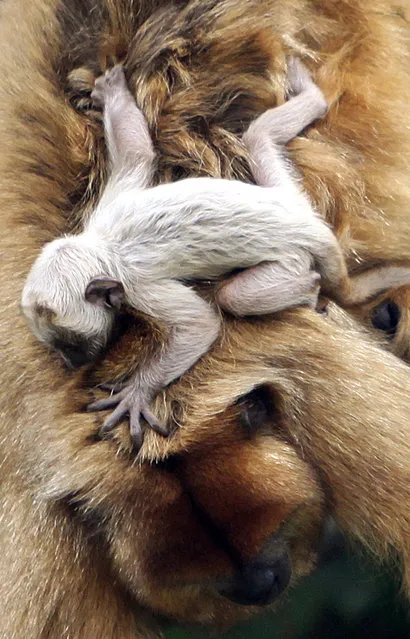
A baby black howler monkey (Alouatta caraya) clings onto its mother's back on Thursday January 29, 2009 in Singapore where it's national zoo is actively involved in the conservation and education of wildlife reserves. (Photo by Wong Maye-E/AP Photo)

“Wong Maye-E joined AP as a staff photographer in 2003. Based in Singapore, Maye-E's work is centered around Sports reportage, entertainment, politics, and regional news stories. Maye-E has covered headlining events such as the 2014 World Cup, Thailand political protests, and the devastation of the Philippines Typhoon”. – Associated Press. Photo: A baby black howler monkey (Alouatta caraya) clings onto its mother's back on Thursday January 29, 2009 in Singapore where it's national zoo is actively involved in the conservation and education of wildlife reserves. (Photo by Wong Maye-E/AP Photo)
Details
27 Aug 2014 09:14:00
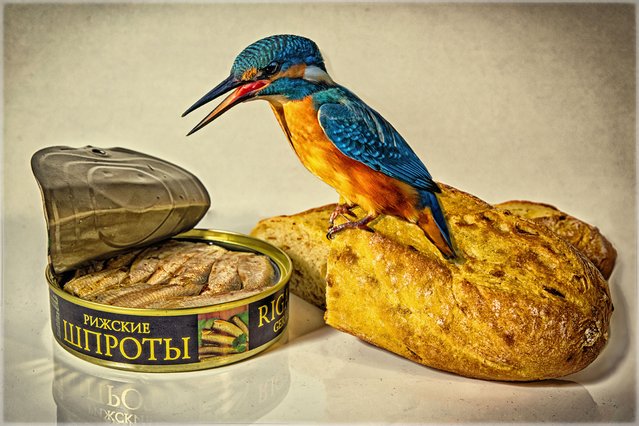
Creative imagery, gold winner: Sprats and Bread, Ruediger Schulz, Germany. (Photo by Ruediger Schulz/2021 Bird Photographer of the Year)

Creative imagery, gold winner: Sprats and Bread, Ruediger Schulz, Germany. (Photo by Ruediger Schulz/2021 Bird Photographer of the Year)
Details
26 Sep 2021 02:43:00
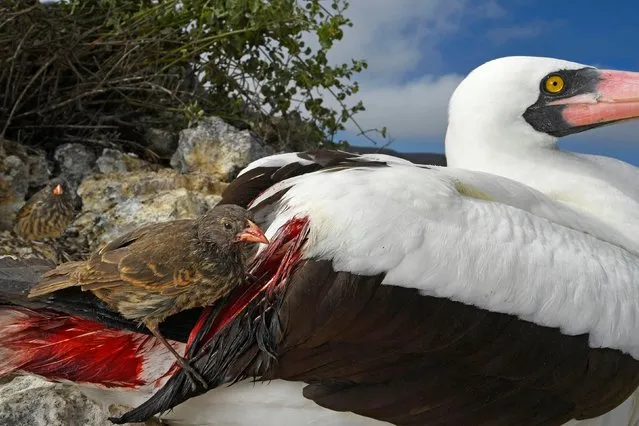
Bloodthirsty by Thomas P Peschak, Germany/South Africa — winner, Behaviour: birds. When rations run short on Wolf Island, in the remote northern Galápagos, the sharp-beaked ground finches become vampires. Their sitting targets are Nazca boobies and other large birds. The finches rely on a scant diet of seeds and insects, which regularly dries up, so they drink blood to survive. ‘I’ve seen more than half a dozen finches drinking from a single Nazca booby,’ says Tom. Rather than leave their nests the boobies tolerate the vampires, and the blood loss doesn’t seem to cause permanent harm. (Photo by Thomas P Peschak/2018 Wildlife Photographer of the Year)

Bloodthirsty by Thomas P. Peschak, Germany/South Africa — winner, Behaviour: birds. When rations run short on Wolf Island, in the remote northern Galápagos, the sharp-beaked ground finches become vampires. Their sitting targets are Nazca boobies and other large birds. The finches rely on a scant diet of seeds and insects, which regularly dries up, so they drink blood to survive. ‘I’ve seen more than half a dozen finches drinking from a single Nazca booby,’ says Tom. Rather than leave their nests the boobies tolerate the vampires, and the blood loss doesn’t seem to cause permanent harm. (Photo by Thomas P. Peschak/2018 Wildlife Photographer of the Year)
Details
19 Oct 2018 00:05:00
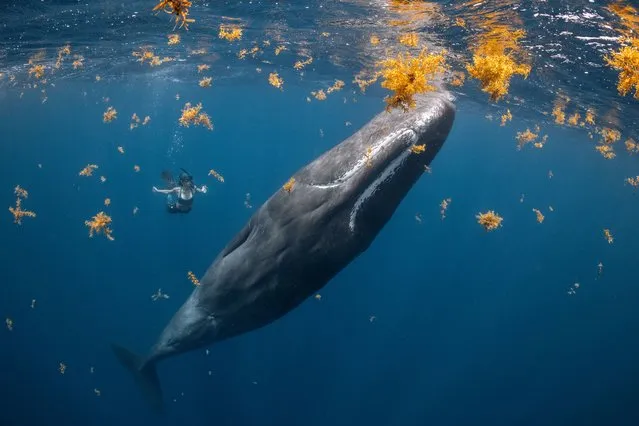
Human Connection Award: People and Planet Ocean – Winner – Steve Woods. A free diver interacts with a sperm whale among a cloud of sargassum weed, Dominica. (Photo by Steve Woods/Ocean Photographer of the Year 2022)

Human Connection Award: People and Planet Ocean – Winner – Steve Woods. A free diver interacts with a sperm whale among a cloud of sargassum weed, Dominica. (Photo by Steve Woods/Ocean Photographer of the Year 2022)
Details
09 Oct 2022 03:56:00
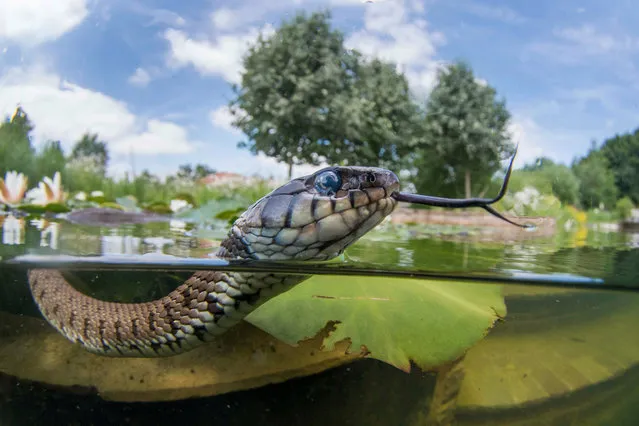
British Waters Wide Angle category runner-up. Grass snake swimming along a garden pond by Jack Perks (UK)in Nottinghamshire, UK. “I’m always on the lookout for unusual freshwater subjects and grass snakes are a species I’ve been after for years. I was told about a pond where the odd grass snake hangs around the lilly pads for frogs. I put my drysuit on and got into the water and could see one slithering along the surface. Slowly making my way towards it with my head only just poking above I got the spilt shot”. (Photo by Jack Perks/Underwater Photographer of the Year 2019)

British Waters Wide Angle category runner-up. Grass snake swimming along a garden pond by Jack Perks (UK)in Nottinghamshire, UK. “I’m always on the lookout for unusual freshwater subjects and grass snakes are a species I’ve been after for years. I was told about a pond where the odd grass snake hangs around the lilly pads for frogs. I put my drysuit on and got into the water and could see one slithering along the surface. Slowly making my way towards it with my head only just poking above I got the spilt shot”. (Photo by Jack Perks/Underwater Photographer of the Year 2019)
Details
28 Feb 2019 00:03:00
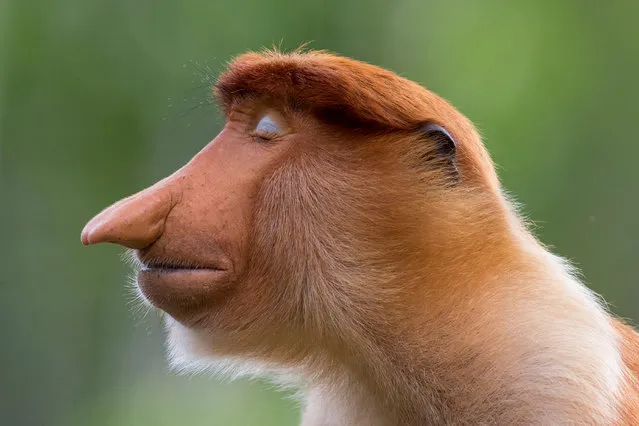
Winner – Animal Portraits: The pose by Mogens Trolle, Denmark. A young male proboscis monkey cocks his head slightly and closes his eyes. Unexpected pale blue eyelids now complement his immaculately groomed auburn hair. He poses for a few seconds as if in meditation. He is a wild visitor to the feeding station at Labuk Bay Proboscis Monkey Sanctuary in Sabah, Borneo – “the most laid-back character”, says Trolle, “quite unlike anything I’ve ever seen on another monkey” – connects us, he hopes, with a fellow primate. (Photo by Mogens Trolle/Wildlife Photographer of the Year 2020)

Winner – Animal Portraits: The pose by Mogens Trolle, Denmark. A young male proboscis monkey cocks his head slightly and closes his eyes. Unexpected pale blue eyelids now complement his immaculately groomed auburn hair. He poses for a few seconds as if in meditation. He is a wild visitor to the feeding station at Labuk Bay Proboscis Monkey Sanctuary in Sabah, Borneo – “the most laid-back character”, says Trolle, “quite unlike anything I’ve ever seen on another monkey” – connects us, he hopes, with a fellow primate. (Photo by Mogens Trolle/Wildlife Photographer of the Year 2020)
Details
16 Oct 2020 00:03:00
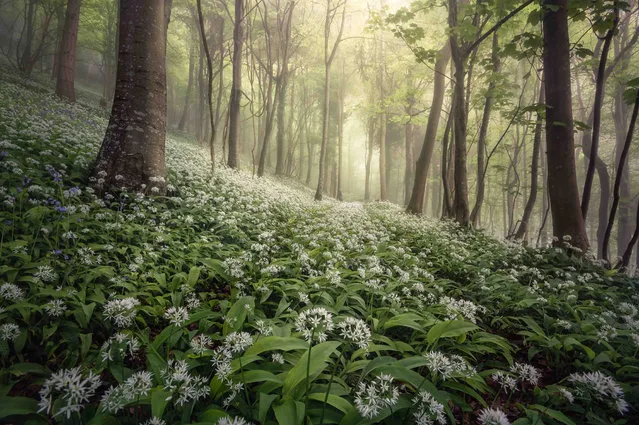
Woolland Woods, Dorset. Landscape photographer of the year 2020. “Taken in spring of 2018 in a wooded area close to Milborne St Andrew in Dorset, this was the third visit to the area in a matter of days. On the previous days, both devoid of morning mists, the light had been harsh and unappealing but the third day delivered stunning conditions with mist swirling through the trees. The low shooting position allowed more emphasis to be placed on the wild garlic and pathway”. (Photo by Chris Frost/UK Landscape Photographer of the Year 2020)

Woolland Woods, Dorset. Landscape photographer of the year 2020. “Taken in spring of 2018 in a wooded area close to Milborne St Andrew in Dorset, this was the third visit to the area in a matter of days. On the previous days, both devoid of morning mists, the light had been harsh and unappealing but the third day delivered stunning conditions with mist swirling through the trees. The low shooting position allowed more emphasis to be placed on the wild garlic and pathway”. (Photo by Chris Frost/UK Landscape Photographer of the Year 2020)
Details
22 Oct 2020 00:03:00
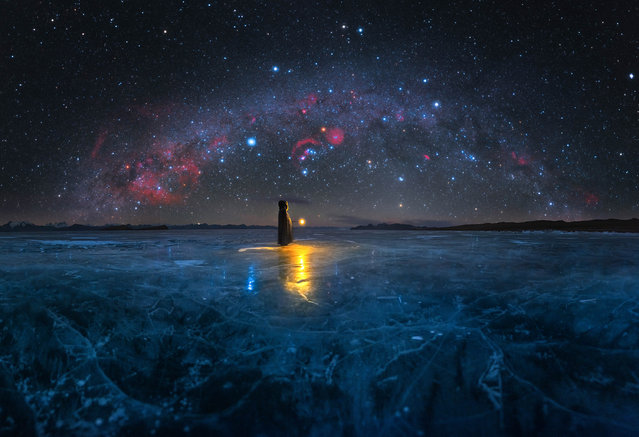
Ice Age – Tibet, China. “This is the Chinese version of the blue ice lake, Pumoungcuo, at an altitude of 5,070 metres (16,600 feet). This lake in Tibet freezes every winter. At night, under the low temperatures of -20C, you can listen to the sound of the ice cracking while capturing the most beautiful winter sky. The blue ice surface and dazzling Orion constellation create a fantasy landscape. I felt so happy to have the stars as my companion on this magical night”. (Photo by Daniel Zafra Portill/Milky Way Photographer of the Year)

Ice Age – Tibet, China. “This is the Chinese version of the blue ice lake, Pumoungcuo, at an altitude of 5,070 metres (16,600 feet). This lake in Tibet freezes every winter. At night, under the low temperatures of -20C, you can listen to the sound of the ice cracking while capturing the most beautiful winter sky. The blue ice surface and dazzling Orion constellation create a fantasy landscape. I felt so happy to have the stars as my companion on this magical night”. (Photo by Daniel Zafra Portill/Milky Way Photographer of the Year)
Details
21 May 2022 05:10:00