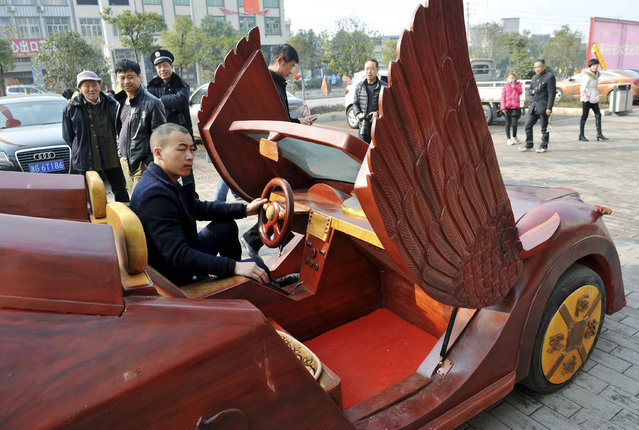
Yu Jietao, 26-year-old wood carver, sits in his homemade wooden car along a street in Guangfeng county of Shangrao, Jiangxi province, China February 9, 2015. The car can travel as fast as 30 km (18.6 miles) per hour, local media reported. (Photo by Reuters/Stringer)
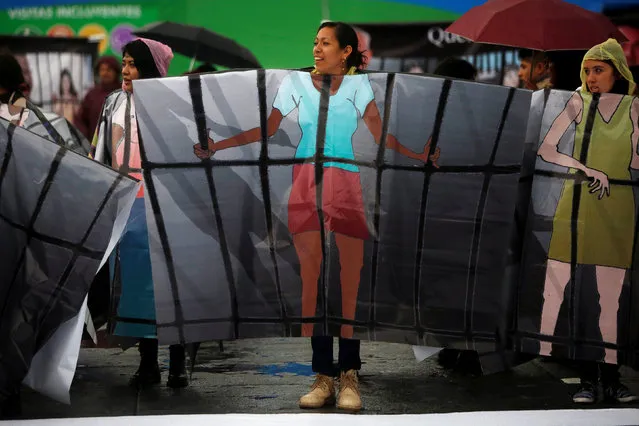
A pro-abortion activist wearing a poncho with an illustration of a woman in jail, demonstrates to demand the decriminalization of abortion in Mexico City, Mexico September 28, 2016. (Photo by Carlos Jasso/Reuters)
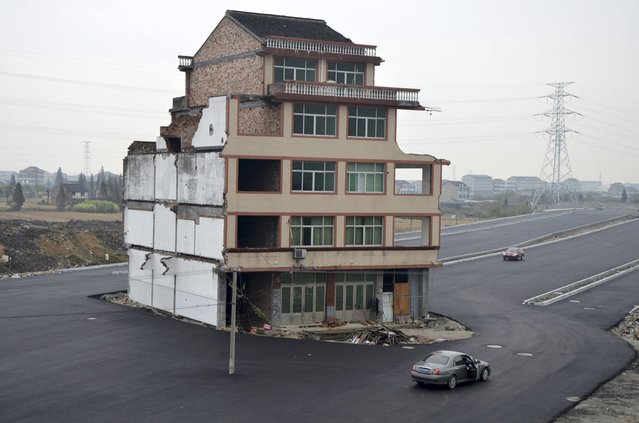
An isolated five-floor building stands in the middle of a new road on November 22, 2012 in Wenling, Zhejiang Province of China. Zhejiang Province of China. 67-year-old Luo Baogen and his 65-year-old wife from Xiazhangyang village still live in the half-demolished residential building, because they are dissatisfied with the relocation compensation. The road, which leads to the Wenling Railway Station, has not been put into use. (Photo by China Foto Press)
Emily Hicks (not pictured) of Charleston holds her dog Murphy along the waterfront ahead of the arrival of Hurricane Dorian in Charleston, South Carolina, U.S., September 4, 2019. (Photo by Randall Hill/Reuters)
There are many types of collections. Some are formed by purposefully collecting certain objects, such as stamps or coins. However, some collections are only a byproduct of an obsession, a quirk of mind. For example, Paul Brockmann got into the habit of buying his girlfriend and later his wife a dress every time they went ballroom dancing. It might seem excessive to some, but it was his way of showing his affection. Overtime, this collection grew to be enormous, counting 55,000 dresses in total. Basic math tells us that either they went ballroom dancing three times per day for every day of their lives, or he bought them in huge bundles every time.
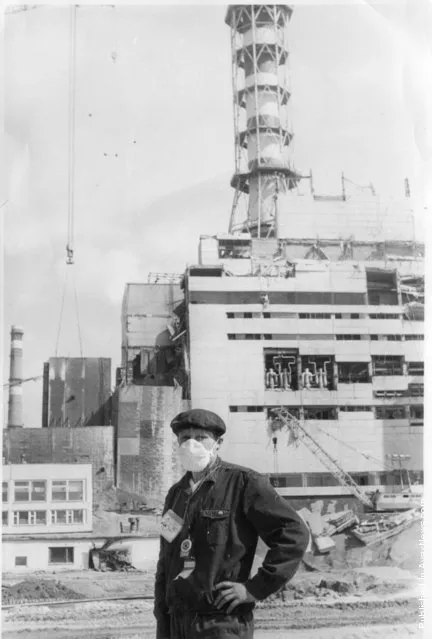
“The Chernobyl disaster was a catastrophic nuclear accident that occurred on 26 April 1986 at the Chernobyl Nuclear Power Plant in Ukrainian SSR, which was under the direct jurisdiction of the central authorities in Moscow. An explosion and fire released large quantities of radioactive contamination into the atmosphere, which spread over much of Western USSR and Europe. It is widely considered to have been the worst nuclear power plant accident in history, and is one of only two classified as a level 7 event on the International Nuclear Event Scale (the other being the Fukushima Daiichi nuclear disaster)”. – Wikipedia (Photos by Alexandr Strannik, August 1986; Source: LiveJournal)