Loading...
Done
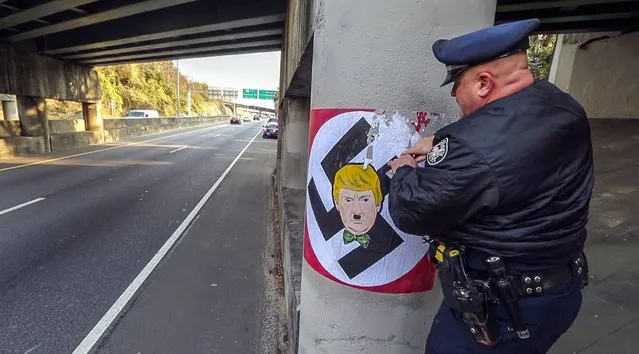
A photo provided by the Atlanta Journal-Constitution shows Atlanta police officer T. R. Coxe removing painted material of a large swastika featuring a likeness of Republican presidential candidate, Donald Trump, along the northbound Buford Highway Connector just south of the Piedmont exit, in Atlanta, Georgia, USA, 09 December 2015. Just days after Donald Trump's call to ban Muslims from entering the United States, someone painted large swastikas featuring the Republican presidential candidate's face on at least two northeast Atlanta bridge supports. (Photo by John Spink/EPA/AJC)

A photo provided by the Atlanta Journal-Constitution shows Atlanta police officer T. R. Coxe removing painted material of a large swastika featuring a likeness of Republican presidential candidate, Donald Trump, along the northbound Buford Highway Connector just south of the Piedmont exit, in Atlanta, Georgia, USA, 09 December 2015. Just days after Donald Trump's call to ban Muslims from entering the United States, someone painted large swastikas featuring the Republican presidential candidate's face on at least two northeast Atlanta bridge supports. The symbol, which includes a cartoon of Trump sporting a Hitler-like mustache, was painted along the Buford Highway Connector. A second, similar image was found on a concrete bridge support on nearby Piedmont Road. Trump said in a statement released on 07 December that there should be a total and complete shutdown of Muslims entering the United States. (Photo by John Spink/EPA/AJC)
Details
11 Dec 2015 11:49:00
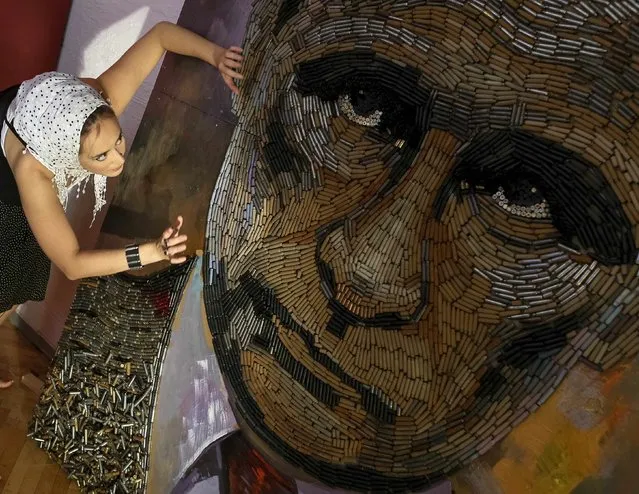
Ukrainian artist Dariya Marchenko works on a portrait of Russian President Vladimir Putin named “The Face of War” which is made out of 5,000 cartridges brought from the frontline in eastern Ukraine, in Kiev, July 23, 2015. The portrait will be presented along with a novel which will tell personal stories of six people involved in this project including Daria's own story and stories of people who helped her to collect shells from the frontline. (Photo by Gleb Garanich/Reuters)

Ukrainian artist Dariya Marchenko works on a portrait of Russian President Vladimir Putin named “The Face of War” which is made out of 5,000 cartridges brought from the frontline in eastern Ukraine, in Kiev, July 23, 2015. The portrait will be presented along with a novel which will tell personal stories of six people involved in this project including Daria's own story and stories of people who helped her to collect shells from the frontline. Daria Marchenko calls her art approach philosophic symbolism where every element has its hidden meaning. In her works cartridges mean human's life that was brutally ended. (Photo by Gleb Garanich/Reuters)
Details
28 Jul 2015 12:44:00


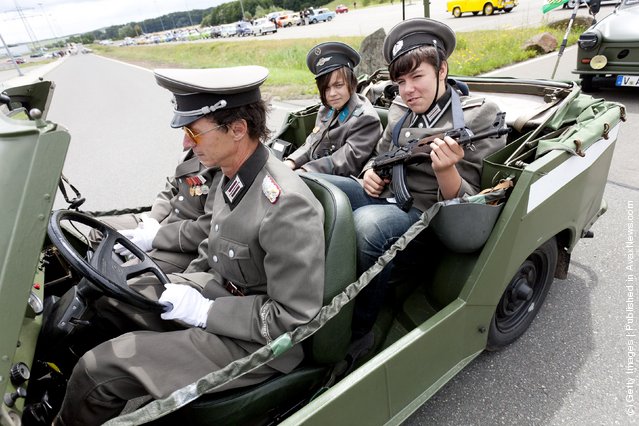
“The Trabant is a car that was produced by former East German auto maker VEB Sachsenring Automobilwerke Zwickau in Zwickau, Sachsen. It was the most common vehicle in East Germany, and was also exported to countries both inside and outside the communist bloc. The main selling points was that it had room for four adults and luggage in a compact, light and durable shell and that it was fast (when introduced) and durable. With its mediocre performance, smoky two-stroke engine, and production shortages, the Trabant is often cited as an example of the disadvantages of centralized planning; on the other hand, it is regarded with derisive affection as a symbol of the failed former East Germany and of the fall of communism (in former West Germany, as many East Germans streamed into West Berlin and West Germany in their Trabants after the opening of the Berlin Wall in 1989). It was in production without any significant changes for nearly 30 years with 3,096,099 Trabants produced in total”. – Wikipedia

Photo: Enthusiasts weared in uniforms of the former eastern german army trive in a military Trabant car as fans and owners of East German-era Trabant cars gather at the 2011 International Trabantfahrer Treffen (International Trabant Drivers Meeting) on June 26, 2011 in Zwickau, Germany. The Trabant, also known as the Trabi, was among the main cars produced in communist East Germany and built by VEB Sachsenring Automobilwerke in Zwickau for 30 years until 1989. Today the car has cult status for many followers and one company, IndiKar, is even seeking to revive the brand in a modern, electric version. (Photo by Carsten Koall/Getty Images)
Details
27 Jun 2011 12:21:00
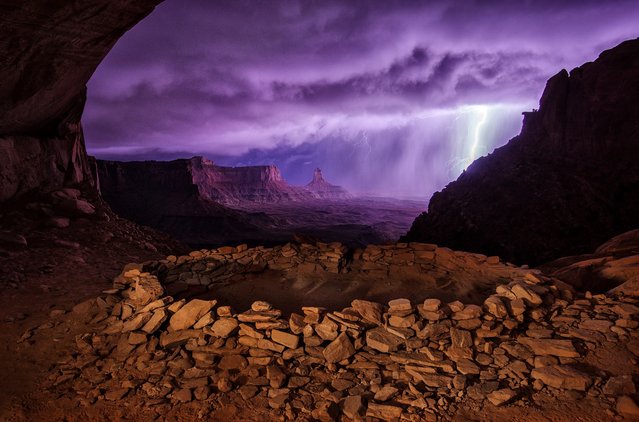
Second Place Winner: “Thunderstorm at False Kiva”. I hiked out to these ruins at night hoping to photograph them with the Milky Way, but instead a thunderstorm rolled through, creating this dramatic image. – Max Seigal. (Photo and caption by Max Seigal/National Geographic Traveler Photo Contest)

Second Place Winner: “Thunderstorm at False Kiva”. I hiked out to these ruins at night hoping to photograph them with the Milky Way, but instead a thunderstorm rolled through, creating this dramatic image. – Max Seigal. National Geographic Traveler Director of Photography Dan Westergren, one of this year's judges, shares his thoughts on the second place winner: “This photo combines two different scenes into one: the small kiva in a cliff dwelling and the grand vista of Canyonlands National Park across the valley. I really like the two different color palettes – warm inside and purple outside. This two-for-one scene was caused by the lightning storm outside the dwelling, which lit up the landscape like it was a huge electronic flash. Looking at this picture I can imagine what a wonderful sight it must have been for the ancient people who lived here. It doesn't seem too amazing now in our modern world, but might have been mind-blowing for the prehistoric residents”. Location: Utah. (Photo and caption by Max Seigal/National Geographic Traveler Photo Contest)
Details
02 Aug 2013 06:16:00
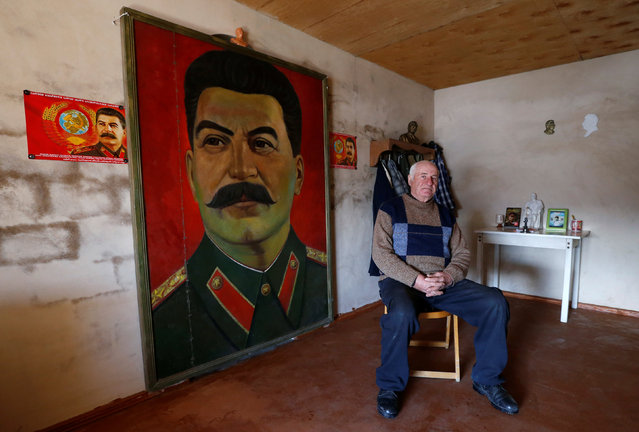
Retired builder Vasili Sidamonidze, 70, poses for a portrait at his home in Gori, Georgia, December 6, 2016. “Unfortunately, Stalin is not popular nowadays. Our people don't respect him. Only we, members of the (Communist) Party, respect him”, Sidamonidze said. “I always try to attend Stalin's birthday anniversaries in Gori. Unfortunately many people don't want to join us even if they live nearby. They look at us from their windows”. Stalin, who was born in Gori in 1878 and died in 1953, is largely reviled today in Georgia, which regained its independence during the 1991 collapse of the Soviet Union. Over the years, his memorials have been dismantled, most recently in 2010 when authorities removed a statue of the dictator from Gori's central square. But Stalin is still revered by a small group of mainly elderly supporters who stress his role in the industrialisation of the Soviet Union and in defeating Nazi Germany in World War Two. Each Dec. 21, a few dozen people mark his birthday by gathering outside a Gori museum dedicated to Stalin, where they make speeches and walk to the square where a 6-meter-high bronze statue of him once stood, calling for it to be reinstated. Opponents say it was a symbol of Moscow's still lingering shadow. In 2008, Russia fought a brief war with Georgia and recognised its breakaway regions of Abkhazia and South Ossetia as independent states. (Photo by David Mdzinarishvili/Reuters)

Retired builder Vasili Sidamonidze, 70, poses for a portrait at his home in Gori, Georgia, December 6, 2016. “Unfortunately, Stalin is not popular nowadays. Our people don't respect him. Only we, members of the (Communist) Party, respect him”, Sidamonidze said. “I always try to attend Stalin's birthday anniversaries in Gori. Unfortunately many people don't want to join us even if they live nearby. They look at us from their windows”. (Photo by David Mdzinarishvili/Reuters)
Details
17 Dec 2016 07:59:00
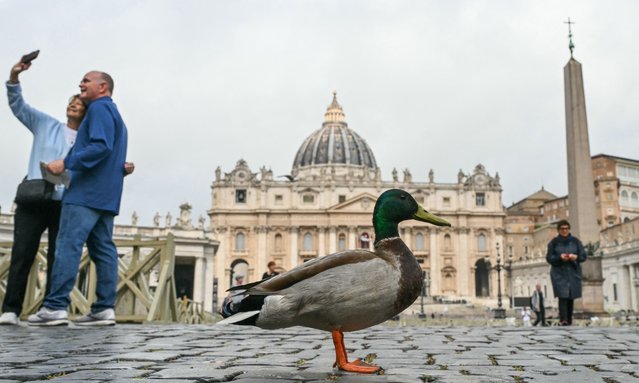
Visitors pose for a picture next to a mallard duck on the cobblestones of St Peter's Square with St Peter's Basilica in the background at The Vatican, on May 5, 2025. (Photo by Alberto Pizzoli/AFP Photo)

Visitors pose for a picture next to a mallard duck on the cobblestones of St Peter's Square with St Peter's Basilica in the background at The Vatican, on May 5, 2025. (Photo by Alberto Pizzoli/AFP Photo)
Details
18 May 2025 02:28:00
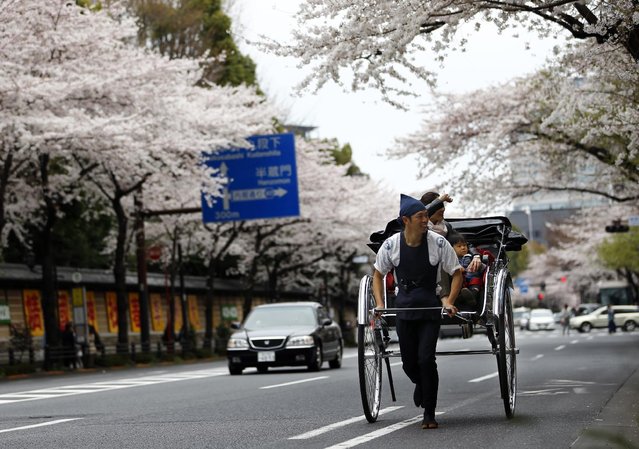
A rickshaw man runs under the blooming cherry blossoms in Tokyo, Sunday, March 29, 2015. (Photo by Shizuo Kambayashi/AP Photo)

A rickshaw man runs under the blooming cherry blossoms in Tokyo, Sunday, March 29, 2015. (Photo by Shizuo Kambayashi/AP Photo)
Details
30 Mar 2015 12:45:00
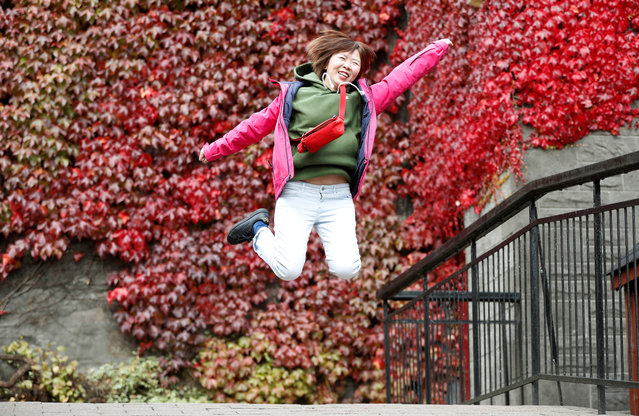
A tourist poses for a souvenir snap in front of autumn foliage in Pitlochry, Scotland, Britain September 28, 2018. (Photo by Russell Cheyne/Reuters)

A tourist poses for a souvenir snap in front of autumn foliage in Pitlochry, Scotland, Britain on September 28, 2018. (Photo by Russell Cheyne/Reuters)
Details
25 Jan 2019 00:05:00