Loading...
Done
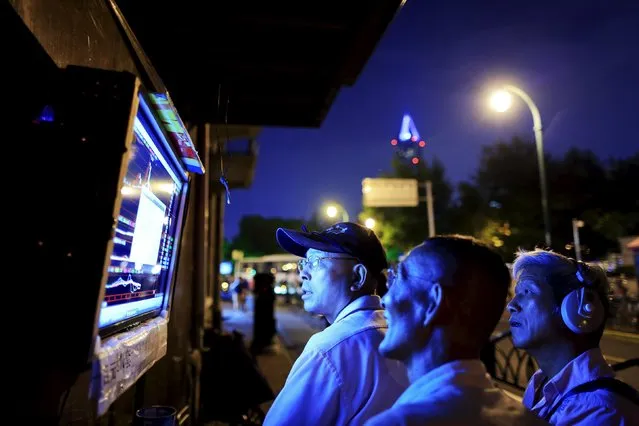
Shen Yuxi (L), introduces analysis software to investors at a “street stock salon” in central Shanghai, China, September 5, 2015. Shen carries a TV screen on his electronic bike to the "salon" every weekends where he sets it up on the wall outside a brokerage house. Shen's been selling analysis software at "the salon" for more than 10 years. (Photo by Aly Song/Reuters)

Some are in it just for the money, others to help buy a meal. Then there are those who trade for fun or to spend time among friends. Millions of investors – pensioners, security guards, high-school students – dominate China's stock markets, conducting about 80 percent of all trades. Retirees gather in brokerage houses dotted around China also to enjoy some company and savour the air conditioning on hot days. Some start as young as 13, trading from home with an eye on future careers in finance. Winning isn't guaranteed. This year, among the most turbulent in China's financial history, its stock markets more than doubled in the six months to May, only to crash amid concerns that growth in the country, which makes everything from cars to steel, is slowing faster than previously thought. (Photo by Aly Song/Reuters)
Details
13 Oct 2015 08:00:00
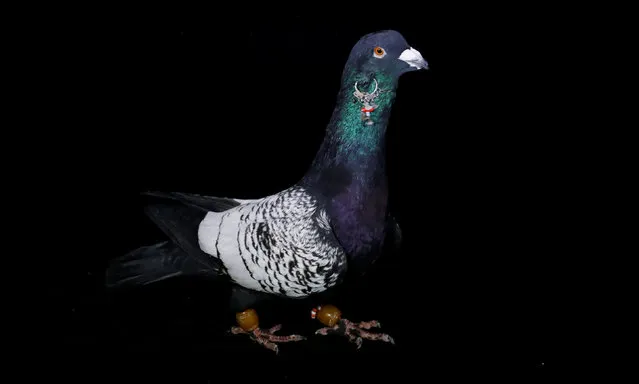
A pigeon, known as Siyah Kinifirli, with an approximate market value of 1000 Turkish Lira ($263), bred by 23-year-old Ismail Ozbek, is pictured in Sanliurfa, Turkey, December 23, 2016. As night-time approaches in Sanliurfa, southeastern Turkey, most of the alleyways of the city's old bazaar are emptying out of buyers and vendors, except for one. The bustle of daytime trading has died down, but on this little street, a stream of men carry cardboard boxes filled with pigeons to a cluster of three teahouses. Here, they sell the birds at Sanliurfa's famed auctions to a dedicated band of pigeon keepers and breeders, a pastime that has been thriving for hundreds of years across the region and over the nearby border into war-torn Syria. In a country where the minimum wage is about 1,400 Liras ($367) a month, enthusiasts regularly easily spend hundreds of dollars for one bird. “I once sold a pair of pigeons for 35,000 Turkish Lira”, says auctioneer Imam Dildas. “This is a passion, a hobby you cannot quit. I've been known to sell the fridge and my wife's gold bracelets to pay for pigeons”. (Photo by Umit Bektas/Reuters)

A pigeon, known as Siyah Kinifirli, with an approximate market value of 1000 Turkish Lira ($263), bred by 23-year-old Ismail Ozbek, is pictured in Sanliurfa, Turkey, December 23, 2016. As night-time approaches in Sanliurfa, southeastern Turkey, most of the alleyways of the city's old bazaar are emptying out of buyers and vendors, except for one. (Photo by Umit Bektas/Reuters)
Details
17 Jan 2017 12:05:00
Jenna carefully watches two giant boa constrictors that their owner, a street performer she barely knows, entrusted to her. She is careful to keep the one snake wrapped around exercise bars to prevent a wound in the animal’s mouth from touching the sand and getting infected. Jenna is a single mom on disability. She suffers from failed back surgery syndrome, acquired from a violent car accident she had as a teenager. She and her young son Jackson can be found most afternoons on the beach. Originally from South Carolina, Jenna came to Venice in 2010 and describes herself as “an open-minded Christian who loves everyone for who they are”. Nowadays Jenna sometimes has trouble reconciling her inclusive progressive values with her family’s conservative political stance, especially in today’s toxic political climate. (Photo by Dotan Saguy)

Over the past three years, Los Angeles-based photographer Dotan Saguy has spent hundreds of hours documenting the diverse culture, people and pageantry of the iconic Venice Beach boardwalk. He was irresistibly drawn to the free-spirited, anti-materialistic and inclusive nature of the world-famous location, which he found to be a breath of fresh air in contrast to Los Angeles’s sometimes homogenized, celebrity-obsessed culture. (Photo by Dotan Saguy)
Details
01 Aug 2018 00:03:00
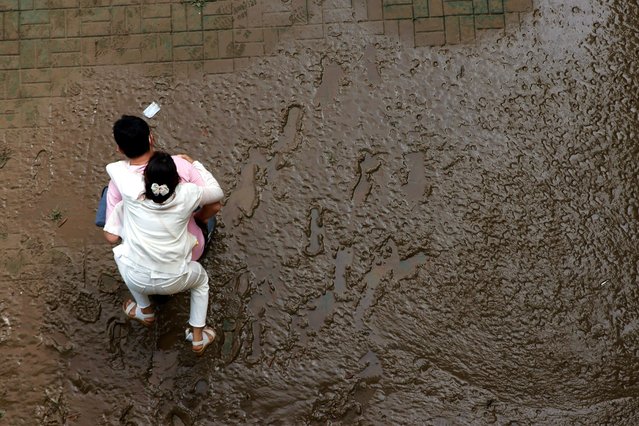
A man crosses a mud-covered trail carrying his wife on his back at a flooded Han River park in Seoul, South Korea, August 4, 2020. (Photo by Kim Hong-Ji/Reuters)

A man crosses a mud-covered trail carrying his wife on his back at a flooded Han River park in Seoul, South Korea, August 4, 2020. (Photo by Kim Hong-Ji/Reuters)
Details
11 Aug 2020 00:03:00
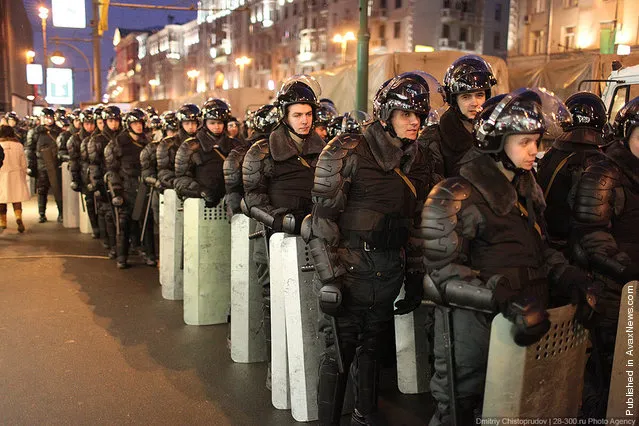
Protestors Denounce Putin Victory In Moscow

Moscow riot police prepare to move on activists during an unsacnctioned anti-Putin opposition rally at the Pushkin Square March 5, 2012 in central Moscow, Russia. Amid charges of fraud, demonstrators took to the streets a day after Vladimir Putin declared victory in Russia's presidential elections. (Photos by: Rustem Adagamov; Source: LiveJournal; Gleb Shchelkunov; Source: LiveJournal; Ilya Varlamov; Source: LiveJournal; Raskalov; Source: LiveJournal; Dmitry Chistoprudov; Source: LiveJournal)
Details
06 Mar 2012 13:04:00
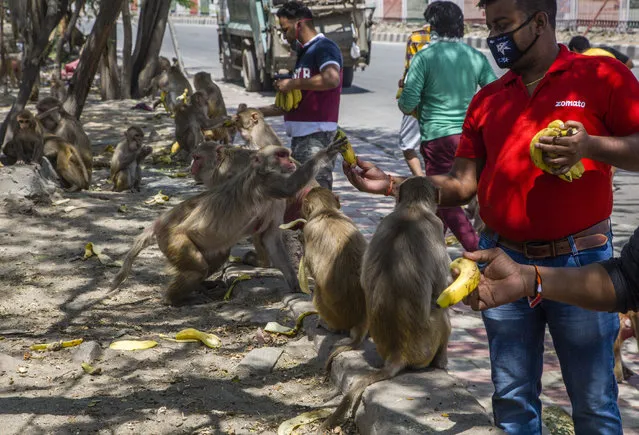
Men give bananas to monkeys gathered on the side of the road as India remains under an unprecedented lockdown over the highly contagious coronavirus (COVID-19) on April 08, 2020 in New Delhi, India. Wild animals, including monkeys, are roaming human settlements in India as people are staying indoors due to the 21-day lockdown. With India's 1.3 billion population and tens of millions of cars off the roads, wildlife is moving towards areas inhabited by humans. Wild animals in many countries have been seen roaming streets. A study says some 60 percent of the new diseases found around the globe every year are zoonotic, meaning they originate in animals and are passed on to humans. COVID-19 is a zoonotic disease that is suspected to have come from the wet markets of Wuhan, China. (Photo by Yawar Nazir/Getty Images)

Men give bananas to monkeys gathered on the side of the road as India remains under an unprecedented lockdown over the highly contagious coronavirus (COVID-19) on April 08, 2020 in New Delhi, India. Wild animals, including monkeys, are roaming human settlements in India as people are staying indoors due to the 21-day lockdown. (Photo by Yawar Nazir/Getty Images)
Details
12 Apr 2020 00:05:00
Crystal, 15, a part-time boutique sales assistant, poses on Nathan Road in Mongkok shopping district in Hong Kong October 7, 2014. Holding a walkie talkie for fast communication with other supporters, Crystal said, “I am not demanding Chief Executive Leung Chun-ying to quit, but (want) to protect protesters from being threatened badly by opponents and the police”. (Photo by Bobby Yip/Reuters)

Reuters photographers Carlos Barria and Bobby Yip photographed protestors and details of life on the barricades, asking demonstrators what their role was in the movement, and what they wanted to happen. Here: Crystal, 15, a part-time boutique sales assistant, poses on Nathan Road in Mongkok shopping district in Hong Kong October 7, 2014. Holding a walkie talkie for fast communication with other supporters, Crystal said, “I am not demanding Chief Executive Leung Chun-ying to quit, but (want) to protect protesters from being threatened badly by opponents and the police”. (Photo by Bobby Yip/Reuters)
Details
09 Oct 2014 12:53:00
A protester is taken away by policewomen after storming into the government headquarters in Hong Kong September 27, 2014. (Photo by Bobby Yip/Reuters)

A protester is taken away by policewomen after storming into the government headquarters in Hong Kong September 27, 2014. (Photo by Bobby Yip/Reuters)
Details
29 Sep 2014 10:44:00