Loading...
Done
A gaucho is unseat by a wild horse during the annual celebration of Criolla Week in Montevideo, March 30, 2015. Throughout Easter Week, “gauchos”, the Latin American equivalent of the North American cowboy, from all over Uruguay and neighboring Argentina and Brazil will visit Montevideo to participate in the Criolla Week to win the best rider award. The competition is held from March 29 to April 5 this year. (Photo by Andres Stapff/Reuters)

A gaucho is unseat by a wild horse during the annual celebration of Criolla Week in Montevideo, March 30, 2015. Throughout Easter Week, “gauchos”, the Latin American equivalent of the North American cowboy, from all over Uruguay and neighboring Argentina and Brazil will visit Montevideo to participate in the Criolla Week to win the best rider award. The competition is held from March 29 to April 5 this year. (Photo by Andres Stapff/Reuters)
Details
01 Apr 2015 12:22:00
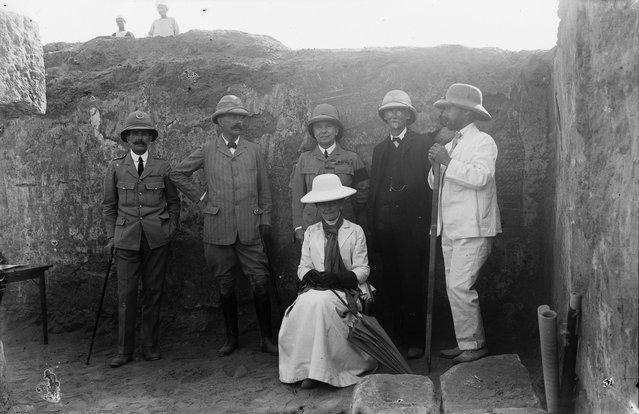
Remarkable discoveries were made, like the decapitated head of a bronze statue of Roman emperor Augustus, sacked from a raid on Roman garrisons further north in Egypt. Here: A group visiting the excavations at Meroë, including (from left) Midwinter Bey, director of Sudan Railways; Lord Kitchener; General Sir Francis Reginald Wingate, Sirdar of the Egyptian Army; Professor Archibald Sayce; John Garstang; and Lady Catherine Wingate, 1911. (Photo by Garstang Museum of Archaeology)

The city of Meroë laid undiscovered for two millennia before British archaeologist John Garstang excavated it in the early 20th century. Garstang took the radical decision to document his discoveries with photography – and immortalised an ancient world. “Meroë: Africa’s Forgotten Empire” is being shown until 14 September at Garstang Museum of Archaeology, Liverpool. Here: A group visiting the excavations at Meroë, including (from left) Midwinter Bey, director of Sudan Railways; Lord Kitchener; General Sir Francis Reginald Wingate, Sirdar of the Egyptian Army; Professor Archibald Sayce; John Garstang; and Lady Catherine Wingate, 1911. (Photo by Garstang Museum of Archaeology)
Details
15 Jun 2016 14:49:00
An activist kicks the shields of the military police officers during a demonstration in the military zone of the 27th infantry battalion in Iguala, Guerrero, January 12, 2015. Activists and relatives of the 43 missing trainee teachers from Ayotzinapa's teacher training college broke into the military zone. (Photo by Jorge Dan Lopez/Reuters)

An activist kicks the shields of the military police officers during a demonstration in the military zone of the 27th infantry battalion in Iguala, Guerrero, January 12, 2015. Activists and relatives of the 43 missing trainee teachers from Ayotzinapa's teacher training college broke into the military zone, located less than a mile from where the students went missing, in an attempt to look for the missing students.The remains of only one of the 43 students has been identified so far. (Photo by Jorge Dan Lopez/Reuters)
Details
14 Jan 2015 12:17:00
A woman walks in central Rason city, northeast of Pyongyang, August 29, 2011. (Photo by Carlos Barria/Reuters)

A woman walks in central Rason city, northeast of Pyongyang, August 29, 2011. (Photo by Carlos Barria/Reuters)
Details
16 Jul 2015 10:30:00
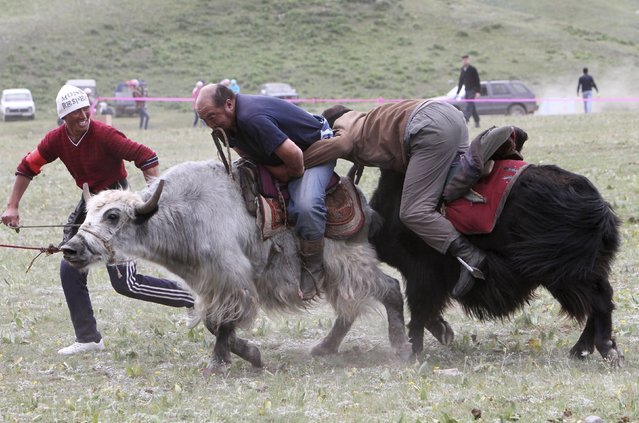
Participants wrestle while riding yaks during Kyrgyz national horse games and festival near the Tulpar-Kul in the Chon Alai range, some 3500 metres (11483 feet) above sea level, Osh region, Kyrgyzstan, July 25, 2015. (Photo by Vladimir Pirogov/Reuters)

Participants wrestle while riding yaks during Kyrgyz national horse games and festival near the Tulpar-Kul in the Chon Alai range, some 3500 metres (11483 feet) above sea level, Osh region, Kyrgyzstan, July 25, 2015. (Photo by Vladimir Pirogov/Reuters)
Details
27 Jul 2015 10:55:00
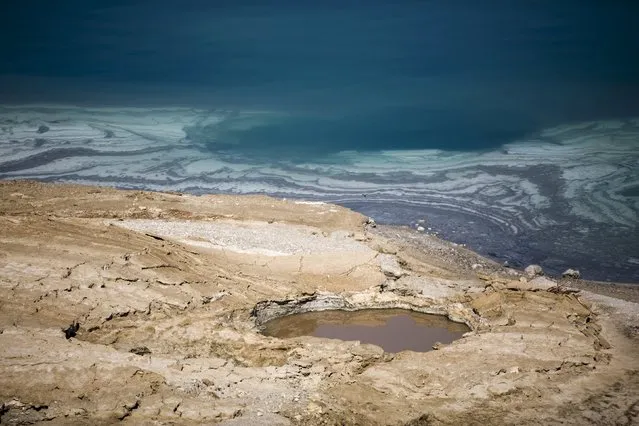
A sinkhole is seen on the shore of the Dead Sea near Kibbutz Ein Gedi, Israel July 27, 2015. The Dead Sea is shrinking, and as its waters vanish at a rate of more than one meter a year, hundreds of sinkholes, some the size of a basketball court, some two storeys deep, are devouring land where the shoreline once stood. (Photo by Amir Cohen/Reuters)

A sinkhole is seen on the shore of the Dead Sea near Kibbutz Ein Gedi, Israel July 27, 2015. The Dead Sea is shrinking, and as its waters vanish at a rate of more than one meter a year, hundreds of sinkholes, some the size of a basketball court, some two storeys deep, are devouring land where the shoreline once stood. (Photo by Amir Cohen/Reuters)
Details
30 Jul 2015 12:06:00
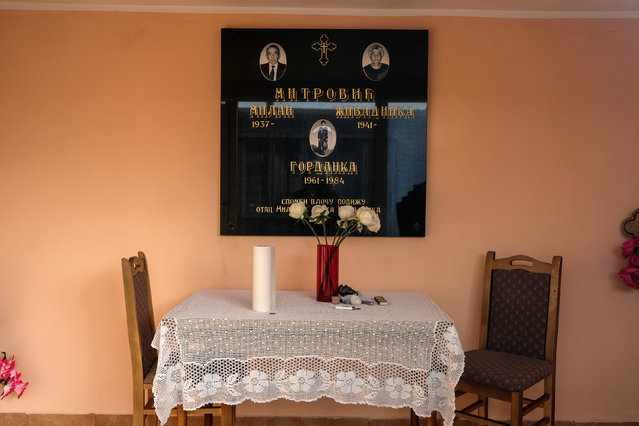
Pictures of deceased people are seen inside a chapel at a cemetery in the village of Smoljinac, Serbia, October 25, 2016. (Photo by Marko Djurica/Reuters)

Pictures of deceased people are seen inside a chapel at a cemetery in the village of Smoljinac, Serbia, October 25, 2016. From a distance, the cemetery in the eastern Serbian village of Smoljinac looks like a residential neighbourhood eerily placed among graves. But once inside the grounds, after passing a section with the usual stone slabs, visitors find rows of small bungalows painted in pastel colours. They have one or two rooms, large windows and ornate plaques – some inside, some outside – memorialising the deceased. These are the burial chapels of Smoljinac, cosy cabins with a furnished room inside, a storage place for wreaths and funeral paraphernalia, and the family crypt below. Some even have electric power inside. (Photo by Marko Djurica/Reuters)
Details
12 Nov 2016 10:37:00
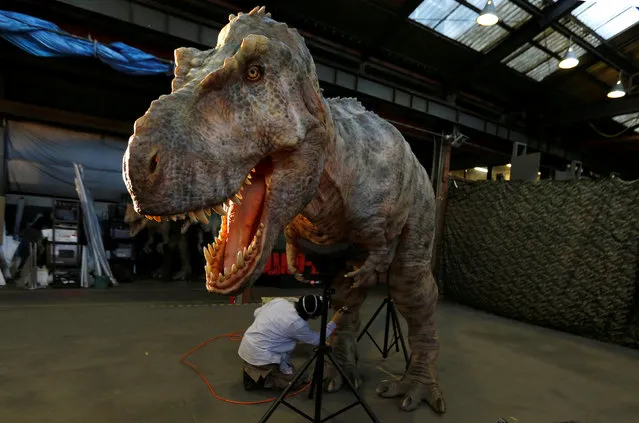
Japan's ON-ART Corp's staff repaints the company's eight metre tall man-operated walking dinosaur robot “TRX03” at the company's studio in Tokorozawa, Japan, December 6, 2016. (Photo by Toru Hanai/Reuters)

Japan's ON-ART Corp's staff repaints the company's eight metre tall man-operated walking dinosaur robot “TRX03” at the company's studio in Tokorozawa, Japan, December 6, 2016. (Photo by Toru Hanai/Reuters)
Details
23 Dec 2016 08:21:00