Loading...
Done
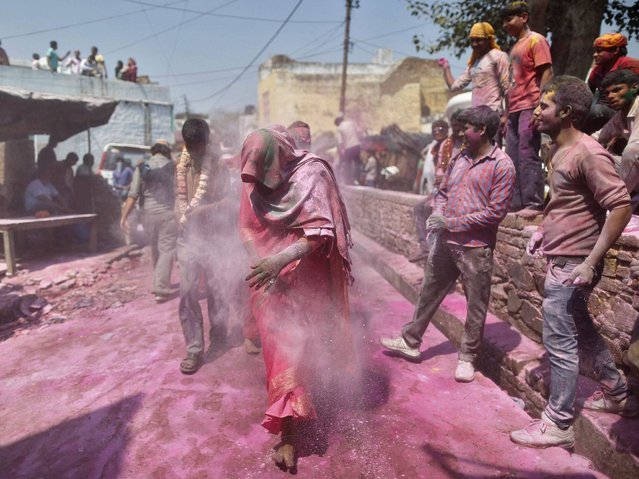
In a Holi tradition unique to Barsana and Nandgaon villages, men sing provocative songs to gain the attention of women, who then “beat” them with bamboo sticks called “lathis”. (Photo by Anindito Mukherjee/Reuters)

A woman covers her face as men throw colored powder at her during “Lathmar Holi” at the village of Barsana in the northern Indian state of Uttar Pradesh March 9, 2014. (Photo by Anindito Mukherjee/Reuters)
Details
13 Mar 2014 08:05:00
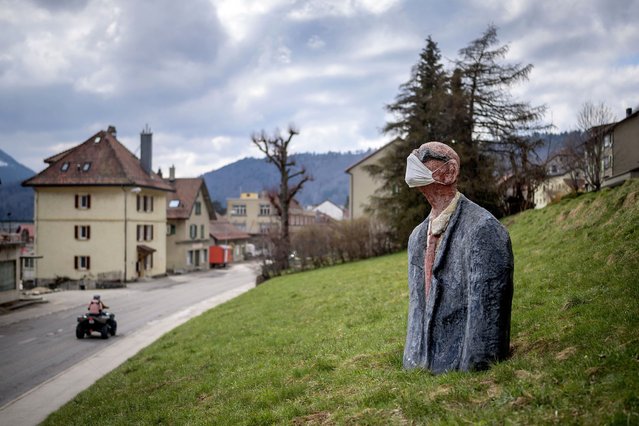
A picture taken on April 18, 2020 in Sainte-Croix shows a scultpure representing a man wearing a facemask as a preventive measure against the Covid-19 coronavirus in a field. (Photo by Fabrice Coffrini/AFP Photo)

A picture taken on April 18, 2020 in Sainte-Croix shows a scultpure representing a man wearing a facemask as a preventive measure against the Covid-19 coronavirus in a field. (Photo by Fabrice Coffrini/AFP Photo)
Details
02 May 2021 08:21:00
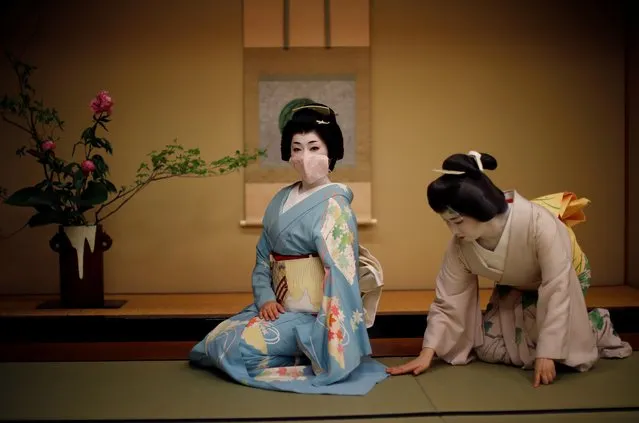
Mayu adjusts Koiku’s kimono, as Koiku wears a protective face mask while posing for a photograph, before they work at a party where they will entertain with other geisha at Japanese luxury restaurant Asada in Tokyo, Japan, June 23, 2020. The coronavirus pandemic has made Tokyo's geisha fear for their centuries-old profession as never before. Though the number of geisha - famed for their witty conversation, beauty and skill at traditional arts - has been falling for years, they were without work for months due to Japan's state of emergency and now operate under awkward social distancing rules. Engagements are down 95 percent, and come with new rules: no pouring drinks for customers or touching them even to shake hands, and sitting 2 meters apart. Masks are hard to wear with their elaborate wigs, so they mostly don't. “I was just full of anxiety”, said Mayu, 47. “I went through my photos, sorted my kimonos ... The thought of a second wave is terrifying”. (Photo by Kim Kyung-Hoon/Reuters)

Mayu adjusts Koiku’s kimono, as Koiku wears a protective face mask while posing for a photograph, before they work at a party where they will entertain with other geisha at Japanese luxury restaurant Asada in Tokyo, Japan, June 23, 2020. (Photo by Kim Kyung-Hoon/Reuters)
Details
23 Jul 2020 00:03:00
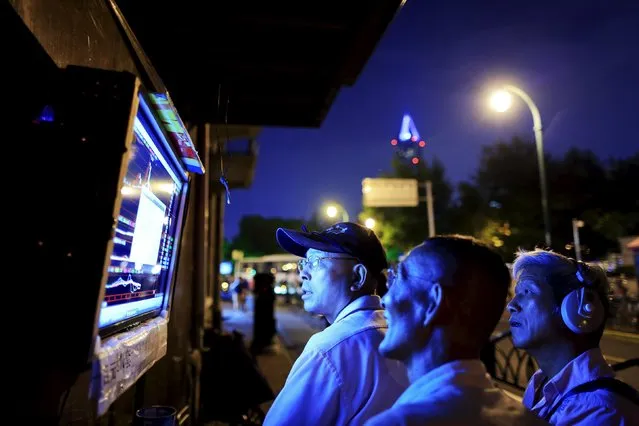
Shen Yuxi (L), introduces analysis software to investors at a “street stock salon” in central Shanghai, China, September 5, 2015. Shen carries a TV screen on his electronic bike to the "salon" every weekends where he sets it up on the wall outside a brokerage house. Shen's been selling analysis software at "the salon" for more than 10 years. (Photo by Aly Song/Reuters)

Some are in it just for the money, others to help buy a meal. Then there are those who trade for fun or to spend time among friends. Millions of investors – pensioners, security guards, high-school students – dominate China's stock markets, conducting about 80 percent of all trades. Retirees gather in brokerage houses dotted around China also to enjoy some company and savour the air conditioning on hot days. Some start as young as 13, trading from home with an eye on future careers in finance. Winning isn't guaranteed. This year, among the most turbulent in China's financial history, its stock markets more than doubled in the six months to May, only to crash amid concerns that growth in the country, which makes everything from cars to steel, is slowing faster than previously thought. (Photo by Aly Song/Reuters)
Details
13 Oct 2015 08:00:00
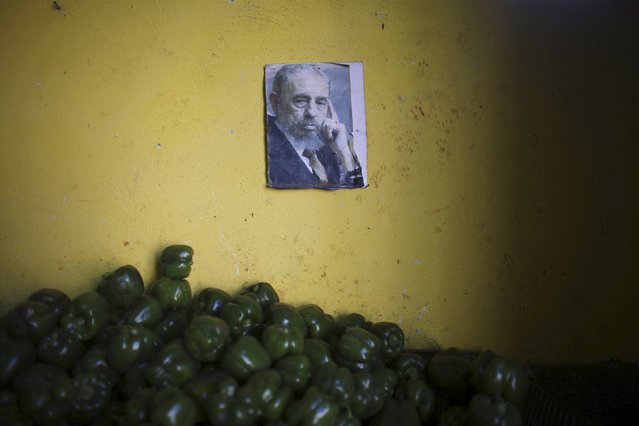
A photograph of Cuba's former President Fidel Castro decorates a wall inside a state-run market in Havana, March 8, 2016. (Photo by Alexandre Meneghini/Reuters)

A photograph of Cuba's former President Fidel Castro decorates a wall inside a state-run market in Havana, March 8, 2016. (Photo by Alexandre Meneghini/Reuters)
Details
15 Mar 2016 13:48:00
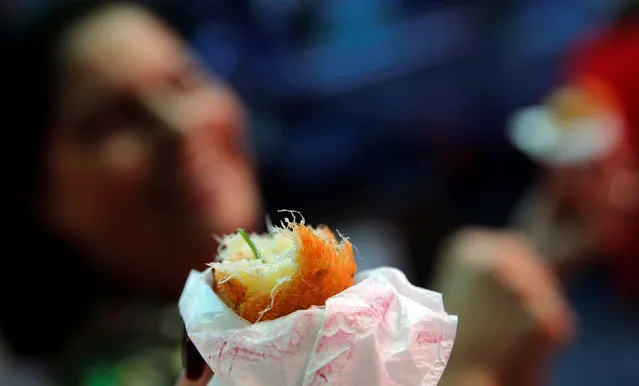
A view of traditional bolinhos de bacalhau (fried codfish balls) in Rio de Janeiro, Brazil, May 7, 2016. (Photo by Sergio Moraes/Reuters)

If the most popular foods of Rio de Janeiro have one thing in common, it is their informality. You can find fine restaurants in the city, but they do not set Rio apart from other places. What does set it apart, and what invariably brings its residents, known as "Cariocas," together is the unpretentious food they eat in bright, loud, crowded bars and restaurants, on busy street corners, or after a day at the beach. Here: A view of traditional bolinhos de bacalhau (fried codfish balls) in Rio de Janeiro, Brazil, May 7, 2016. (Photo by Sergio Moraes/Reuters)
Details
05 Aug 2016 13:20:00
Tigray refugees who fled the conflict in the Ethiopia's Tigray arrive with their donkey on the banks of the Tekeze River on the Sudan-Ethiopia border, in Hamdayet, eastern Sudan, Saturday, November 21, 2020. (Photo by Nariman El-Mofty/AP Photo)

Tigray refugees who fled the conflict in the Ethiopia's Tigray arrive with their donkey on the banks of the Tekeze River on the Sudan-Ethiopia border, in Hamdayet, eastern Sudan, Saturday, November 21, 2020. (Photo by Nariman El-Mofty/AP Photo)
Details
03 Dec 2020 00:01:00
A model presents a creation from the Jeremy Scott Spring/Summer 2015 collection during New York Fashion Week September 10, 2014. (Photo by Lucas Jackson/Reuters)

A model presents a creation from the Jeremy Scott Spring/Summer 2015 collection during New York Fashion Week September 10, 2014. (Photo by Lucas Jackson/Reuters)
Details
13 Sep 2014 11:46:00