Salcomp players huddle at the center of the pitch of Arena da Amazonia after winning the Peladao amateur soccer tournament in Manaus, Brazil, Saturday, February 16, 2019. It is the team's second title, the first was in 2011. (Photo by Victor R. Caivano/AP Photo)
Large waves break at Burleigh Heads on the Gold Coast,, Queensland, Australia, 05 June 2016. Recent wild weather unleashed heavy rainfalls, powerful winds and abnormally high tides in Southeast Queensland and northern New South Wales. (Photo by Dan Peled/EPA)
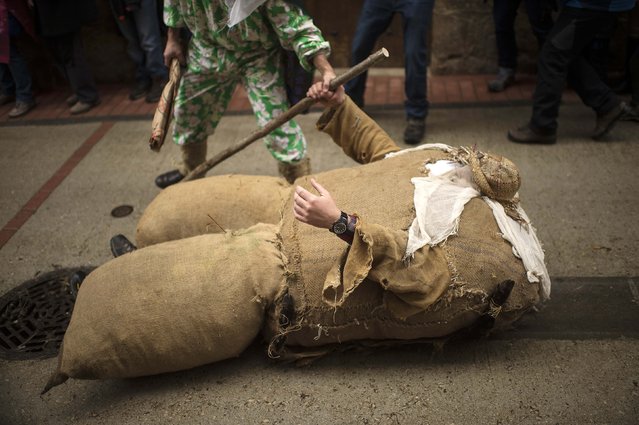
Ziripot, a traditional figure stuffed with straw, is helped up during Carnival celebrations in the Navarran village of Lantz, on February 16, 2015. (Photo by Vincent West/Reuters)
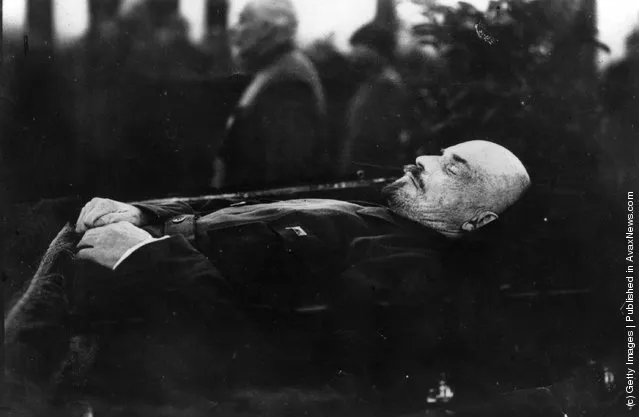
Photo: Vladimir Ilyich Lenin (1870 – 1924) lying in state in the Kremlin. (Photo by Hulton Archive/Getty Images). 1924
Important! For the same article in Russian language click here.
Something quite intriguing is happening within Russian-speaking internet during the last few – should you type a fully academic inquiry (at least, according to Russian academic requirements) in national search engines for "Lenin's mausoleum" – the first thing you get (even in top 10 searches) is website pages talking about black magic and occult. Website authors view this construction differently, but unconditionally agree on one thing: the mausoleum of the "leader of the world proletariat” – the essence of a magical artifact, a sort of “energy vampire”. It was built with a certain purpose: to drain the energy out of miserable Soviet citizens on one hand; and to poison the anthroposphere of one-sixth part of the earth with its vibes (the exact territory that was occupied by the former Soviet Union), depriving the Russian people of will to resist on the other hand. Complete nonsense? No doubt. Nevertheless, an intriguing one. Well, probably because some oddities do exist in mausoleum's history. These oddities are the thing we are going to discuss this time. First, let me refresh you memory on the subject.
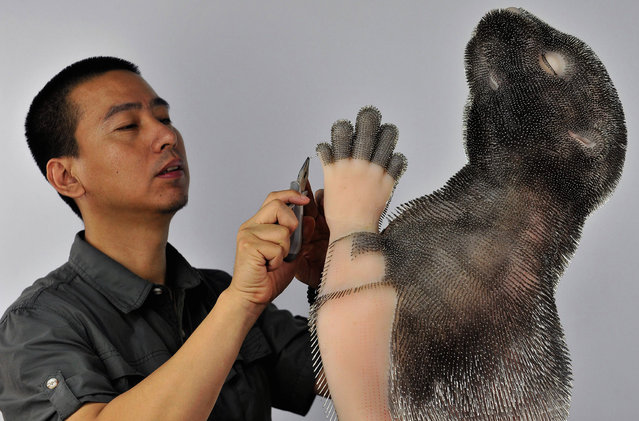
Professor Xie Yong works on an art installation of a beaver, which is made out of plastic and around 300,000 needles, in Shenyang, Liaoning province, July 23, 2013. The needles, according to Xie, represent the pain felt by animals when their fur is taken off to produce clothing. (Photo by Reuters/Stringer)