Loading...
Done
Luling, Louisiana US. New evidence contradicts previous claims of the relative safety of glyphosate, the world’s most widely used herbicide, which is manufactured here. It is often used in conjunction with seeds that have been genetically modified to tolerate its application, meaning that anyone consuming these crops is eating a genetically modified plant, and whatever residue of the pesticide that remains. (Photo by J. Henry Fair/Industrial Scars/Papadakis Publisher)

Luling, Louisiana, US. New evidence contradicts previous claims of the relative safety of glyphosate, the world’s most widely used herbicide, which is manufactured here. It is often used in conjunction with seeds that have been genetically modified to tolerate its application, meaning that anyone consuming these crops is eating a genetically modified plant, and whatever residue of the pesticide that remains. (Photo by J. Henry Fair/Industrial Scars/Papadakis Publisher)
Details
25 Oct 2016 10:40:00
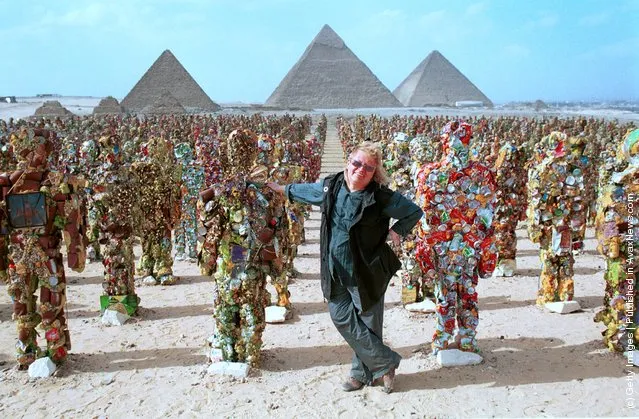
German artist Ha Schult stands with his trash people below the pyramids May 15, 2002 in Giza, Egypt

“HA Schult, born Hans-Jürgen Schult on June 24, 1939 in Parchim, Mecklenburg is a German installation, happening and conceptual artist known primarily for his object and performance art and more specifically his work with garbage”. – Wikipedia

Photo: German artist Ha Schult stands with his “trash people” below the pyramids May 15, 2002 in Giza, Egypt. Inspired by the statues of the terracotta army of Chinese Emperor Quin Shi Huangdi (247–206 B.C.), the thousand piece sulpture has stood in Red Square in Moscow, La Defense in Paris and the Great Wall in China. Schult, born in 1939 wants to bring the “trash war” to the world's attention beause trash is the greatest battle facing mankind. (Photo by Norbert Schiller/Getty Images)
Details
31 Jul 2011 13:37:00


Zivert – Life
Details
23 Apr 2019 00:03:00


“Sektor gaza” (Russian: Сектор газа) was a Russian rock band formed on 5 December 1987 in the city of Voronezh, Russia. Despite only semi-officially existing (due to obscene lyrics), the group remains popular in Russia today. The group name was taken from an eponymous industrial district of Voronezh (itself named for high levels of environmental contamination). Their music style could be defined as Russian punk, integrated with elements of different musical genres such as rock, rap, and Russian folk. On 4 July 2000, group leader Yuri “Hoy” Klinskih complained of strong pains in his stomach and the left side of his chest. He suffered heart failure shortly thereafter. Klinskikh died in Voronezh (Russia)at the age of 35. He is buried in the Levoberezhniy Cemetery. The group ceased to exist.

About the music video: The First Chechen War, also known as the War in Chechnya, was a conflict between the Russian Federation and the Chechen Republic of Ichkeria, fought from December 1994 to August 1996. After the initial campaign of 1994 – 1995, culminating in the devastating Battle of Grozny, Russian federal forces attempted to seize control of the mountainous area of Chechnya but were set back by Chechen guerrilla warfare and raids on the flatlands in spite of Russia's overwhelming manpower, weaponry, and air support...
Details
24 May 2012 14:38:00


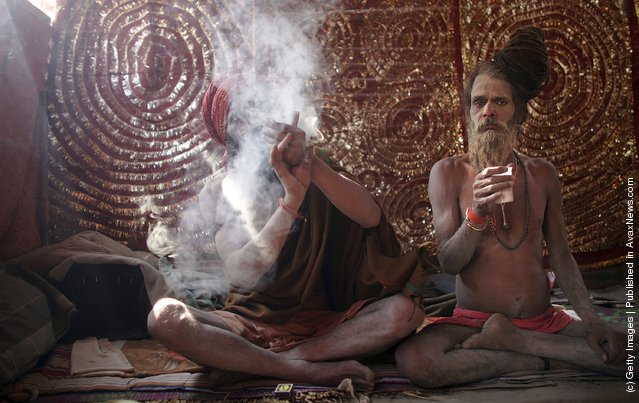
“Kumbh Mela is a mass Hindu pilgrimage in which Hindus gather at the Ganges river. The normal Kumbh Mela is celebrated every 3 years, the Ardh (half) Kumbh Mela is celebrated every six years at Haridwar and Prayag, the Purna (complete) Kumbh takes place every twelve years, at four places (Prayag (Allahabad), Haridwar, Ujjain, and Nashik). The Maha (great) Kumbh Mela which comes after 12 “Purna Kumbh Melas”, or 144 years, is held at Allahabad.

The last Ardh Kumbh Mela was held over a period of 45 days beginning in January 2007, more than 70 million Hindu pilgrims took part in the Ardh Kumbh Mela at Prayag, and on January 15, the most auspicious day of the festival of Makar Sankranti, more than 5 million participated. The previous Maha Kumbh Mela, held in 2001, was attended by around 60 million people, making it at the time the largest gathering anywhere in the world in recorded history”. – Wikipedia

Photo: Sadhus (holy men) smoke at their camp near the ritual site at Sangam, the confluence of the Ganges, Yamuna and mythical Saraswati rivers during the Ardh Kumbh Mela festival (Half Pitcher festival) January 18, 2007 in Allahabad, India. Millions of Hindu pilgrims have flocked to the largest religious gathering in the world which lasts for 45 days in northern India. The festival commemorates the mythical conflict between gods and demons over a pitcher filled with the “nectar of immortality”. Devotees believe that taking a holy dip in the Ganges at this time washes away their sins and paves the path to salvation. (Photo by Mario Tama/Getty Images)

Details
30 Jun 2011 10:27:00
New Yorkers Celebrate At West Indian Day Parade

“The Labor Day Parade (or West Indian Carnival), is an annual celebration held on American Labor Day (the first Monday in September), in Crown Heights, Brooklyn, New York. Ms. Jessie Waddell and some of her West Indian friends started the Carnival in Harlem in the 1920s by staging costume parties in large enclosed places like the Savoy, Renaissance and Audubon Ballrooms due to the cold wintry weather of February. This is the usual time for the pre-Lenten celebrations held in most countries around the world. However, because of the very nature of Carnival, and the need to parade in costume to music, indoor confinement did not work well. The earliest known Carnival street parade was held on September 1, 1947. The Trinidad Carnival Pageant Committee was the founding force behind the parade, which was held in Harlem. The parade route was along Seventh Avenue, starting at 110th St.” – Wikipedia

Photo: A reveler looks on during the West Indian-American Day Parade September 5, 2011 in the Brooklyn borough of New York City. More than 2 million spectators were expected to attend the celebration of Caribbean culture. (Photo by Mario Tama/Getty Images)

Details
06 Sep 2011 11:18:00
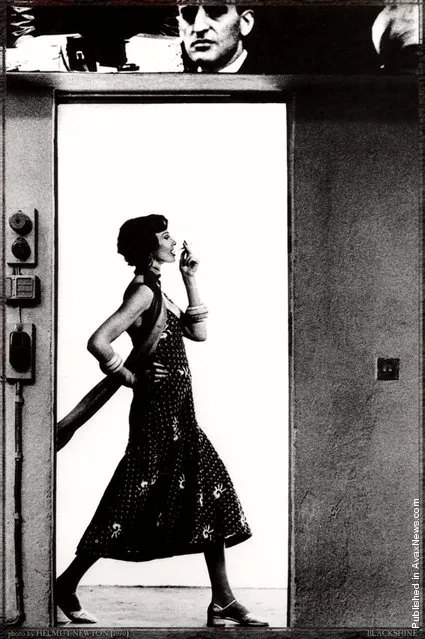
Photographers: Helmut Newton

“Newton was born in Berlin, the son of Klara “Claire” (Marquis) and Max Neustädter, a button factory owner. His family was Jewish. Newton attended the Heinrich-von-Treitschke-Realgymnasium and the American School in Berlin. Interested in photography from the age of 12 when he purchased his first camera, he worked for the German photographer Yva (Elsie Neulander Simon) from 1936. The increasingly oppressive restrictions placed on Jews by the Nuremberg laws meant that his father lost control of the factory in which he manufactured buttons and buckles; he was briefly interned in a concentration camp on “Kristallnacht”, November 9, 1938, which finally compelled the family to leave Germany. Newton's parents fled to South America. He was issued with a passport just after turning 18, and left Germany on December 5, 1938. At Trieste he boarded the “Conte Rosso” (along with about 200 others escaping the Nazis) intending to journey to China. After arriving in Singapore he found he was able to remain there, first and briefly as a photographer for the Straits Times and then as a portrait photographer”. – Wikipedia

Photo: Sigourney Weaver by Helmut Newton, 1995.
Details
08 Apr 2012 13:49:00
The Flying Bull's P-38 Lockheed Lightning N25Y / 13 – Red Bull – Flying Legends Airshow 2012 Duxford (Rob Lovesey)

The Flying Bull's P-38 Lockheed Lightning N25Y / 13 – Red Bull – Flying Legends Airshow 2012 Duxford (Photo by Rob Lovesey)


Details
20 Nov 2012 12:10:00