Loading...
Done
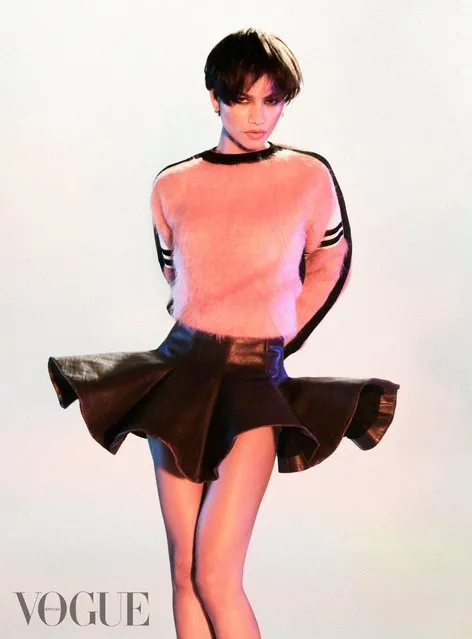
Undated handout photo issued by Vogue of Zendaya appearing in the May issue British Vogue. Zendaya has spoken of her concerns surrounding her potential future children having to deal with her level of fame and the movie industry becoming “bored” of her. The 27-year-old American actress, known for teen show Euphoria and the Dune films, has been romantically linked to her Spider-Man: Homecoming co-star Tom Holland since 2021. Issue date: Tuesday, April 9, 2024. (Photo by Carlijn Jacobs/British Vogue/PA Wire)

Undated handout photo issued by Vogue of Zendaya appearing in the May issue British Vogue. Zendaya has spoken of her concerns surrounding her potential future children having to deal with her level of fame and the movie industry becoming “bored” of her. The 27-year-old American actress, known for teen show Euphoria and the Dune films, has been romantically linked to her Spider-Man: Homecoming co-star Tom Holland since 2021. Issue date: Tuesday, April 9, 2024. (Photo by Carlijn Jacobs/British Vogue/PA Wire)
Details
28 Apr 2024 03:28:00
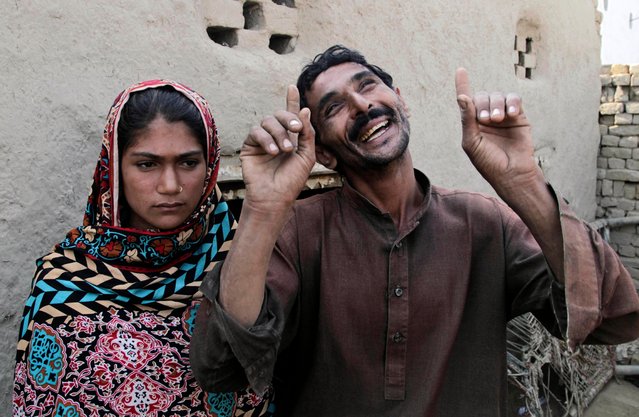
In this Tuesday, December 20, 2016 photo, Mohammad Ramzan, right, reacts while talking to The Associated Press with his young bride Saima in Jampur, Pakistan. Saima was given as a bride to the older man by her father so he could marry the groom’s sister, a practice of exchanging girls that is entrenched in conservative regions of Pakistan. It even has its own name in Urdu: Watta Satta, “give and take”. A mix of interests – family obligations, desire for sons, a wish to hand off a girl to a husband – can lead to a young teen in an a marriage she never sought. (Photo by K.M. Chaudhry/AP Photo)

In this Tuesday, December 20, 2016 photo, Mohammad Ramzan, right, reacts while talking to The Associated Press with his young bride Saima in Jampur, Pakistan. Saima was given as a bride to the older man by her father so he could marry the groom’s sister, a practice of exchanging girls that is entrenched in conservative regions of Pakistan. It even has its own name in Urdu: Watta Satta, “give and take”. A mix of interests – family obligations, desire for sons, a wish to hand off a girl to a husband – can lead to a young teen in an a marriage she never sought. (Photo by K.M. Chaudhry/AP Photo)
Details
31 Dec 2016 10:08:00
A man cries as he carries his daughter while walking from an Islamic State-controlled part of Mosul towards Iraqi special forces soldiers during a battle in Mosul, Iraq March 4, 2017. Reuters Photographer Goran Tomasevic: “Both screaming in terror, a father and the young daughter he cradled in his arm fled through the rubble-strewn streets of Wadi Hajar, transformed in a flash into a battleground between Islamic State fighters and Iraqi special forces. They and their neighbours – some wearing rubber sandals, some barefoot –  were running from an IS counter-attack in this part of Mosul, dodging gunfire as the militants closed in”. (Photo by Goran Tomasevic/Reuters)

A man cries as he carries his daughter while walking from an Islamic State-controlled part of Mosul towards Iraqi special forces soldiers during a battle in Mosul, Iraq March 4, 2017. Reuters Photographer Goran Tomasevic: “Both screaming in terror, a father and the young daughter he cradled in his arm fled through the rubble-strewn streets of Wadi Hajar, transformed in a flash into a battleground between Islamic State fighters and Iraqi special forces. They and their neighbours – some wearing rubber sandals, some barefoot – were running from an IS counter-attack in this part of Mosul, dodging gunfire as the militants closed in”. (Photo by Goran Tomasevic/Reuters)
Details
13 Mar 2017 00:02:00


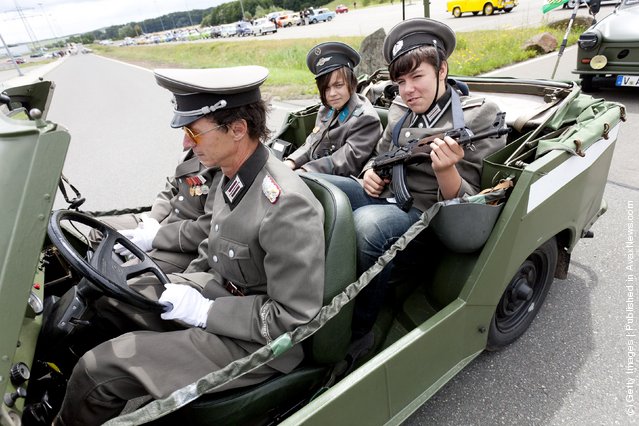
“The Trabant is a car that was produced by former East German auto maker VEB Sachsenring Automobilwerke Zwickau in Zwickau, Sachsen. It was the most common vehicle in East Germany, and was also exported to countries both inside and outside the communist bloc. The main selling points was that it had room for four adults and luggage in a compact, light and durable shell and that it was fast (when introduced) and durable. With its mediocre performance, smoky two-stroke engine, and production shortages, the Trabant is often cited as an example of the disadvantages of centralized planning; on the other hand, it is regarded with derisive affection as a symbol of the failed former East Germany and of the fall of communism (in former West Germany, as many East Germans streamed into West Berlin and West Germany in their Trabants after the opening of the Berlin Wall in 1989). It was in production without any significant changes for nearly 30 years with 3,096,099 Trabants produced in total”. – Wikipedia

Photo: Enthusiasts weared in uniforms of the former eastern german army trive in a military Trabant car as fans and owners of East German-era Trabant cars gather at the 2011 International Trabantfahrer Treffen (International Trabant Drivers Meeting) on June 26, 2011 in Zwickau, Germany. The Trabant, also known as the Trabi, was among the main cars produced in communist East Germany and built by VEB Sachsenring Automobilwerke in Zwickau for 30 years until 1989. Today the car has cult status for many followers and one company, IndiKar, is even seeking to revive the brand in a modern, electric version. (Photo by Carsten Koall/Getty Images)

Details
27 Jun 2011 12:21:00
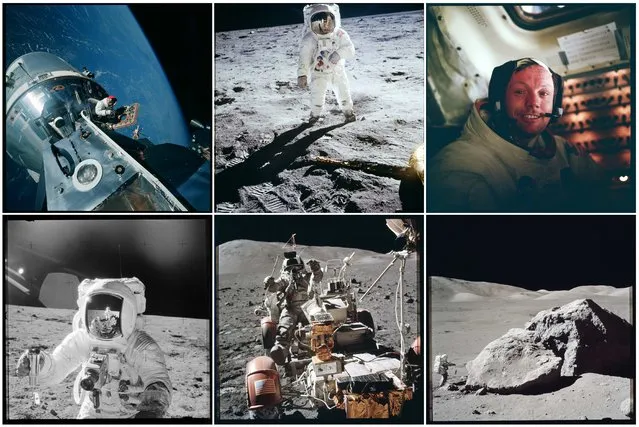
NASA handout photographs from the various Apollo missions are shown in this combination photograph. The photographs are some of more than 12,000 from NASA's archives recently aggregated on the Project Apollo Archive Flickr account. (Photo by Reuters/NASA)

NASA handout photographs from the various Apollo missions are shown in this combination photograph. The photographs are some of more than 12,000 from NASA's archives recently aggregated on the Project Apollo Archive Flickr account. (Top L) David R. Scott, command module pilot, stands in the open hatch of the Command Module during the Apollo 9 mission March 6, 1969. (Top centre) Edwin "Buzz" Aldrin Jr.walks on the surface of the moon during the Apollo 11 mission July 20, 1969. (Top R) Neil Armstrong, Apollo 11 commander, is pictured inside the Lunar Module during the Apollo 11 mission July 20, 1969. (Bottom L) Alan Bean holds a container filled with lunar soil collected during the Apollo 12 mission November 19, 1969. (Bottom centre) Scientist-astronaut Harrison Schmitt rides in the Lunar Roving Vehicle during the Apollo 17 mission December 13, 1972. (Bottom R) Harrison Schmitt stands next to a huge, split boulder during the Apollo 17 mission December 13, 1972. (Photo by Reuters/NASA)
Details
13 Oct 2015 08:02:00
A performer wearing a lion mask performs the Ise Daikagura lion dance at the remote village of Yamanawa on February 08, 2021 in Ryuo, Japan. Ise Daikagura is a group of traditional Lion Dance performers who pray in front of farmers houses and businesses for good grain harvests and disease-free lives. Performers play sacred music using drums and flutes with two lion mask dancers. A lion mask is considered a symbol of God, who enters the house and performs in front of the Shinto God, a statue placed inside the house, mostly in the kitchen. These prayers are called “Kamodo Barai”. After the prayers, they are gifted with money, rice, sake and Japanese sweets from the householders. A group can travel for more than one hundred days to thousands of households and businesses throughout rural-villages in western Japan, and pray to those who are unable to visit the country’s most sacred shrine, the Grand Ise Shrine in Mie Prefecture. The group started its performance in the Edo era between 1603 to 1868 according to Japanese history. The Japanese government designated it as an important folk cultural national property in 1981. (Photo by Buddhika Weerasinghe/Getty Images)

A performer wearing a lion mask performs the Ise Daikagura lion dance at the remote village of Yamanawa on February 08, 2021 in Ryuo, Japan. Ise Daikagura is a group of traditional Lion Dance performers who pray in front of farmers houses and businesses for good grain harvests and disease-free lives. (Photo by Buddhika Weerasinghe/Getty Images)
Details
18 Feb 2021 09:27:00
Second Place Winner: “Thunderstorm at False Kiva”. I hiked out to these ruins at night hoping to photograph them with the Milky Way, but instead a thunderstorm rolled through, creating this dramatic image. – Max Seigal. (Photo and caption by Max Seigal/National Geographic Traveler Photo Contest)

Second Place Winner: “Thunderstorm at False Kiva”. I hiked out to these ruins at night hoping to photograph them with the Milky Way, but instead a thunderstorm rolled through, creating this dramatic image. – Max Seigal. National Geographic Traveler Director of Photography Dan Westergren, one of this year's judges, shares his thoughts on the second place winner: “This photo combines two different scenes into one: the small kiva in a cliff dwelling and the grand vista of Canyonlands National Park across the valley. I really like the two different color palettes – warm inside and purple outside. This two-for-one scene was caused by the lightning storm outside the dwelling, which lit up the landscape like it was a huge electronic flash. Looking at this picture I can imagine what a wonderful sight it must have been for the ancient people who lived here. It doesn't seem too amazing now in our modern world, but might have been mind-blowing for the prehistoric residents”. Location: Utah. (Photo and caption by Max Seigal/National Geographic Traveler Photo Contest)
Details
02 Aug 2013 06:16:00
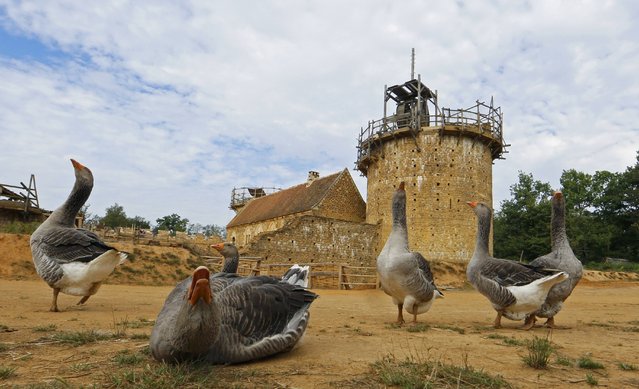
A view of the construction site of the Chateau de Guedelon near Treigny in the Burgundy region of France, September 13, 2016. Blacksmiths, stonemasons and quarry men are hard at work in a Burgundy forest building a 13th-century-style castle using the most basic tools and materials, replicating the methods used hundreds of years ago to better understand them. Forgoing all modern technology, workers use hammers to break stones and forge iron, operate wooden wheels to hoist their materials up to where they are needed, and rely on a quarry for stone, clay and sand as they build up a castle from scratch. Construction on Guedelon Castle in central France began in 1997 after an archaeological survey revealed a medieval fortress hidden inside the walls of nearby Chateau de Saint-Fargeau. Those behind the project hope to answer questions about medieval construction and provide lessons on sustainable building. (Photo by Jacky Naegelen/Reuters)

A view of the construction site of the Chateau de Guedelon near Treigny in the Burgundy region of France, September 13, 2016. Blacksmiths, stonemasons and quarry men are hard at work in a Burgundy forest building a 13th-century-style castle using the most basic tools and materials, replicating the methods used hundreds of years ago to better understand them. (Photo by Jacky Naegelen/Reuters)
Details
15 Sep 2016 09:43:00