Loading...
Done
A murmuration of starlings above the  the small village of Rigg, near Gretna, in the Scottish Borders, on November 25, 2013. The weight of the resting birds on power lines caused some power localised power outages in the village. Still one of the commonest of garden birds, its decline elsewhere puts it on the Red List of endangered species. (Photo by Owen Humphreys/PA Wire)

A murmuration of starlings above the the small village of Rigg, near Gretna, in the Scottish Borders, on November 25, 2013. The weight of the resting birds on power lines caused some power localised power outages in the village. Still one of the commonest of garden birds, its decline elsewhere puts it on the Red List of endangered species. (Photo by Owen Humphreys/PA Wire)
Details
27 Nov 2013 11:00:00
Papai Simon Ole Mamai of the Maasai Cricket Warriors team from Kenya runs during a match against English team “The Shed” during “The Last Man Stands” cricket tournament at Dulwich sports ground in South London September 1, 2013. (Photo by Philip Brown/Reuters)

Papai Simon Ole Mamai of the Maasai Cricket Warriors team from Kenya runs during a match against English team “The Shed” during “The Last Man Stands” cricket tournament at Dulwich sports ground in South London September 1, 2013. (Photo by Philip Brown/Reuters)
Details
02 Sep 2013 13:09:00
McMurdo Station Antarctic

McMurdo Station is a U.S. Antarctic research centre located on the southern tip of Ross Island, which is in the New Zealand-claimed Ross Dependency on the shore of McMurdo Sound in Antarctica. It is operated by the United States through the United States Antarctic Program, a branch of the National Science Foundation. The station is the largest community in Antarctica, capable of supporting up to 1,258 residents, and serves as the United States Antarctic science facility. All personnel and cargo going to or coming from Amundsen–Scott South Pole Station first pass through McMurdo.
Details
05 Sep 2013 10:18:00
[Battle Of Helm’s Deep Made From Lego

Based on the layout of Helm’s Deep featured in Peter Jackson’s film adaptation, this 150,000 brick set piece is astounding. The artists, who go by the names Rich-K and Big J, apparently, nail the atmosphere and scale of the conflict of one Lord of the Rings most iconic scenes. At the time these photos were taken, the model was about 90% complete, with an estimated four months worth of work. The time, money and personal investment that must have gone into this project is impressive.
Details
19 Sep 2013 10:22:00
Son Doong Cave

Son doong cave is a cave in Phong Nha-Kẻ Bàng National Park, Bố Trạch district, Quảng Bình Province, Vietnam. Currently the biggest known cave in the world, the cave is located near the Laos-Vietnam border. Inside is a large, fast-flowing underground river.
In early August 2013, the first tourist group explored the cave on a guided tour at a cost of US$3,000 each. The group had six members from Australia, Norway, Russia and USA and spent 7 days and 6 nights for the tour. Next exploration trips will be arranged.
Details
22 Sep 2013 12:30:00
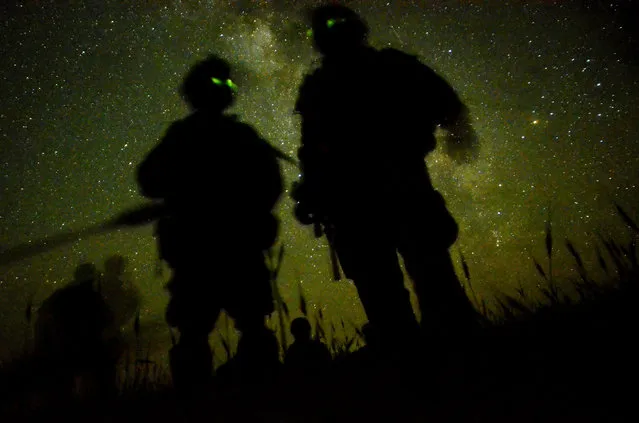
Jamie's overall winning image entitled “Celtic Warrior” and shows Private Ross Cunningham from 1 Scots cleaning his personal weapon. (Photo by Jamie Peters/PA Vire)

A Scots soldier has won a top award for his photos vividly depicting Army life in Afghanistan. Corporal Jamie Peters took the overall first prize for his portfolio in the annual Army Photographic Competition. Photo: Jamie's overall winning image entitled “Celtic Warrior” and shows Private Ross Cunningham from 1 Scots cleaning his personal weapon. (Photo by Jamie Peters/PA Wire)
Details
10 Oct 2013 11:59:00
Karis, a one month old lion cub being weighed at Blair Drummond Safari Park near Stirling, Scotland, Thursday October 10, 2013.  Weighing in at 5kg, the cub will stay with her mother, Teekay until she is 12 weeks old before they are returned to the pride. (Photo by Andrew Milligan/AP Photo/PA Wire)

Karis, a one month old lion cub being weighed at Blair Drummond Safari Park near Stirling, Scotland, Thursday October 10, 2013. Weighing in at 5kg, the cub will stay with her mother, Teekay until she is 12 weeks old before they are returned to the pride. (Photo by Andrew Milligan/AP Photo/PA Wire)
Details
12 Oct 2013 11:21:00
Split Apple Rock

Split Apple Rock is a geological rock formation in The Tasman Bay off the northern coast of the South Island of New Zealand. Made of granite, it is in the shape of an apple which has been cut in half. It is a popular tourist attraction in the waters of the Tasman Sea approximately 50 metres off the coast between Kaiteriteri and Marahau. The rock sits in shallow water at low tide and is accessible by wading. It is also a point of interest for the many tourist boats and pleasure craft which operate along the shores of the Abel Tasman National Park. The cleft to produce two sides of the 'apple' was a natural occurrence. It is unknown when this happened and therefore the cleaving of the rock has attracted mythological explanations.
Details
19 Oct 2013 10:58:00